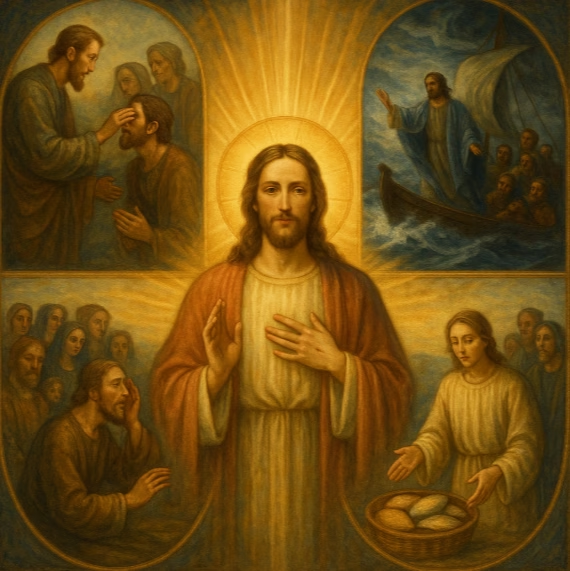
There are four Gospels in the New Testament, mined by scholarship for two thousand years. Rudolf Steiner made a claim that startled even many of his own students: a fifth account of Christ’s life exists, unwritten in any book, readable only through trained spiritual perception directly into the Akashic Record — the imprint every event leaves on the fabric of existence. In October 1913, in five lectures given at Christiania, he began to describe what he found there.
A Balance With Two Scales
Steiner opened with a puzzle about how Christianity actually spread. Picture two scales: on one side, everything scholarship and theology have contributed toward understanding Christ; on the other, the raw devotional force — uneducated, often theologically confused — that carried Christianity from a handful of Galilean fishermen into the whole Roman world. The scholarly scale barely moves. The devotional scale sinks, heavy with a force that “erudite scholarship concerning Him has contributed least of all to.” Something, Steiner insisted, was working through history independent of anyone’s actual comprehension of it.
The Baptism as Conception
Steiner offered a structural key that reorganizes the entire Gospel narrative: the Baptism in the Jordan functions, for the Christ Being, as conception functions for an ordinary human life. The three years that follow are a kind of embryonic existence; the Mystery of Golgotha is the actual birth, with everything after Pentecost corresponding to the life a soul lives once born. He described the Being who entered the body of Jesus of Nazareth at the Jordan as belonging to conditions entirely unlike earthly existence — a Being with no karma of His own, making Christ’s three years on earth the one exception in human history: suffering entirely without karmic cause, undeserved in the most literal sense possible.
A God Slowly Becoming a Man
Perhaps the most striking claim in the cycle concerns the relationship between the Christ Being and the physical body of Jesus of Nazareth. In the earliest period, the connection was loose — the Christ Being could leave the body aside, appearing to the Apostles directly as a spiritual presence they sometimes could not distinguish from the man they knew. Over the following three years, the Christ Being drew into ever-closer identity with the physical body — the opposite direction from how an ordinary human matures, growing to reflect the macrocosm; here a macrocosmic Sun-power instead narrowed into a single human frame. The wonder-working power of the early ministry gradually ebbed, precisely because the Being working the wonders was binding Himself ever more completely to a body that could not sustain that power indefinitely — until, by Steiner’s account, the silence before Pilate was not evasion but simple fact: the power that might have answered had, by then, nearly departed.
Renan’s Beautiful Mistake
Steiner used Ernest Renan’s 1863 bestseller Life of Jesus — which portrayed Christ as gradually corrupted by his own fame, going so far as to present the Raising of Lazarus as a staged fraud — to sharpen his own claim. If Christ’s life had actually unfolded that way, an enormous weight of karma would necessarily have accumulated across those three years. The entire spiritual architecture Steiner was describing depends on those years having generated no karma at all — and Steiner noted, almost bemused, how strange it was that such a book could still move so many readers to a deeper love of its subject, in spite of itself.
The full article on Substack covers the specific scenes the Fifth Gospel describes that appear nowhere in the four canonical Gospels — Jesus’s years among the Essenes, an intimate conversation with Mary before the Baptism, a mirror-image Lord’s Prayer arrived at from within, and the temptation in the wilderness examined as the newly-arrived Christ Being’s first trial. This is a paid article.
Read the full article on Substack — paid subscribers only → Paid subscribers receive all articles in full plus an exclusive monthly guided reading of a Steiner text. Join here →https://anthroposophist.substack.com/