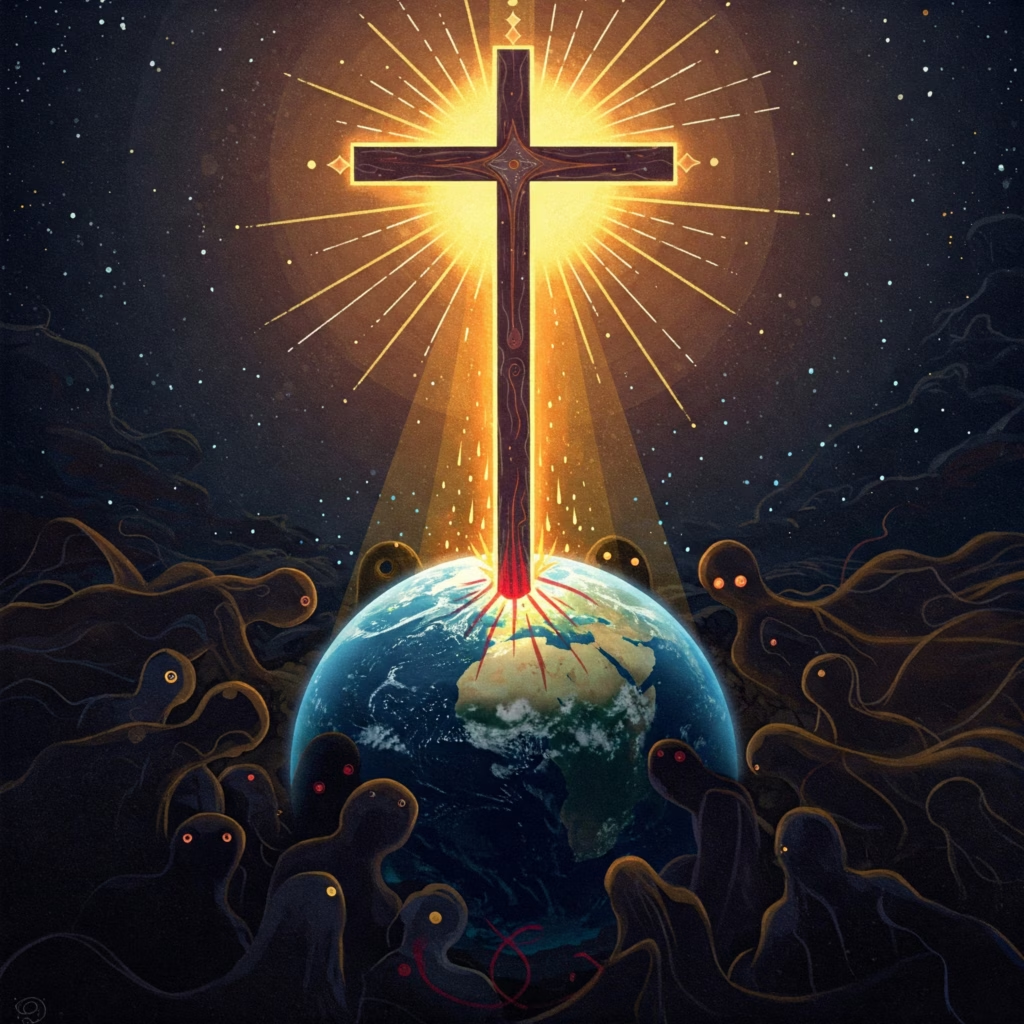
Human history often appears as a chaotic series of events. However, is there a deeper, guiding intelligence behind its unfolding? Rudolf Steiner’s spiritual science, Anthroposophy, reveals a grand, purposeful spiritual drama. This drama plays out through successive cultural epochs. Each epoch has a unique mission. Each contributes to the overall evolution of human consciousness. Steiner’s insights, drawn from reading the Akasha Chronicle (a spiritual record of all events), illuminate these ages. Understanding “Rudolf Steiner cultural epochs spiritual missions humanity” provides a profound context. It helps us grasp our own time and our individual tasks within it. This article explores Steiner’s vision. We will look at the key post-Atlantean epochs: Ancient Indian, Persian, Egypto-Chaldean, Greco-Roman, and our current Fifth Epoch.
The Grand Design: Spiritual Guidance and Consciousness Evolution
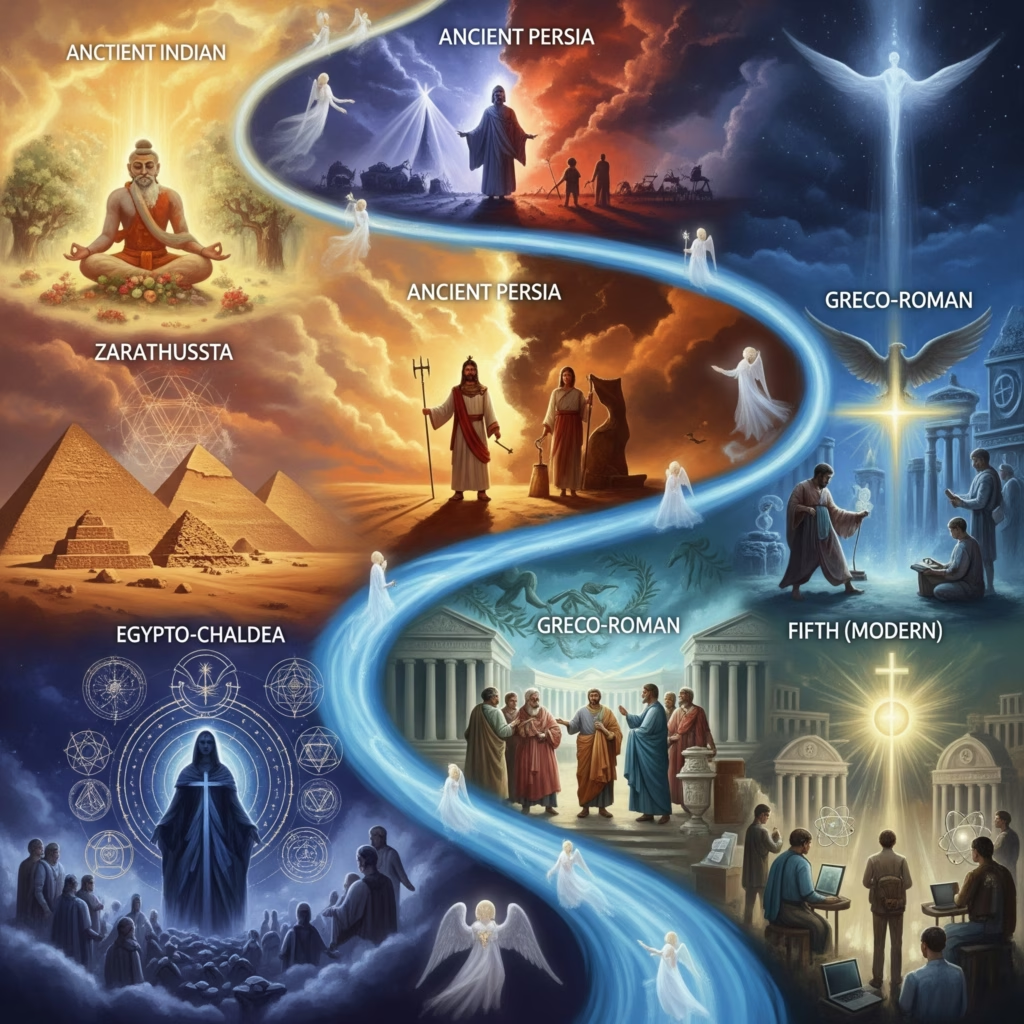
Rudolf Steiner described human evolution after the sinking of Atlantis. This evolution unfolds in seven great post-Atlantean cultural epochs. We are currently in the Fifth. These epochs are not arbitrary divisions of time. They are guided by spiritual hierarchies. Beings such as Time Spirits (Archai) and Folk Souls oversee this development. (See GA 13, An Outline of Esoteric Science, and GA 11, Cosmic Memory).
The central purpose of this long evolutionary journey is the development of the human ‘I’ (Ego). This ‘I’ is our immortal spiritual core. It strives towards self-awareness, freedom, and love. Each epoch focuses on cultivating a particular aspect of the human soul. This prepares the ‘I’ for its ultimate spiritual destiny. Steiner identified three key soul members. These are the sentient soul, the intellectual or mind-soul, and the consciousness soul. Their gradual unfolding characterizes these epochs.
The First Post-Atlantean Epoch: Ancient India – A Dream of Spiritual Origins
The first post-Atlantean cultural epoch was that of Ancient India. This period followed the Atlantean catastrophe. It was guided by the Holy Rishis. These were great spiritual teachers. (Steiner discusses this epoch in GA 13 and GA 11).
Mission and Consciousness
The primary mission of this epoch was to preserve a memory of humanity’s spiritual origin. Atlantean humanity had lived in closer connection with the spiritual worlds. After the trauma of Atlantis, the early Indian culture developed a deep yearning. It was a nostalgia for these lost spiritual heights. Consequently, the physical world was experienced as Maya, or illusion. True reality was seen as residing in the spiritual realms.
Consciousness during this time was still somewhat dream-like. It was not the sharp, sensory-bound awareness of today. People possessed a natural, fading clairvoyance. This allowed them to perceive spiritual truths directly. However, these truths were often veiled in profound, symbolic imagery. The development focus was on the etheric body (life body) in a new way. This was after its earlier formation in Lemurian and Atlantean times.
Legacy
The legacy of Ancient India is its profound spiritual wisdom. This includes the Vedas, the Upanishads, and the foundations of yoga. These teachings emphasize the illusory nature of the sensory world. They also point to the eternal spirit within each human being. This culture instilled a deep sense of reverence for the divine. It laid the groundwork for future spiritual development. However, its very inwardness meant that humanity needed to turn more towards the Earth. This was the task of subsequent epochs.
The Second Post-Atlantean Epoch: Ancient Persia – Engaging the Earthly Struggle
The second cultural epoch was that of Ancient Persia. This civilization was guided by the great initiate Zarathustra (or Zoroaster). (Steiner details this in GA 13 and GA 11).
Mission and Consciousness
The mission of the Persian epoch was to turn humanity’s attention towards the physical world. It was about engaging with earthly existence. It involved learning to work and transform the material realm. This was a necessary step after the inwardness of India. Consequently, a central theme was the struggle between light and darkness. Ahura Mazda (the Spirit of Light) was opposed by Angra Mainyu (later Ahriman, the Spirit of Darkness).
Human consciousness in this epoch became more outwardly focused. People learned to differentiate between good and evil in the earthly sphere. They were called to actively cultivate the land. They were also urged to care for useful animals. This was seen as a way of supporting the forces of light against darkness. The primary development focus was on the astral body (soul body). This body is the carrier of feelings, desires, and active impulses.
Legacy
The Persian epoch brought a new sense of human agency. It also brought moral responsibility towards the Earth. Its legacy includes the beginnings of agriculture as a sacred task. It also includes the ethical imperative to choose good over evil. This culture fostered a strong will. It prepared humanity to engage more fully with the challenges of material existence.
The Third Post-Atlantean Epoch: Egypto-Chaldea – Harmony of Cosmos and Human
The third cultural epoch encompassed the civilizations of Egypt, Chaldea, and Babylonia. Spiritual leaders like Hermes Trismegistus and, later, Moses were key figures. (Found in GA 13, GA 106, Egyptian Myths and Mysteries).
Mission and Consciousness
The mission of this epoch was the development of the sentient soul (Empfindungsseele). This is the part of the soul that experiences the world through feelings and sensations. There was a deep awareness of the connection between the microcosm (human being) and the macrocosm (the starry heavens). Therefore, astronomy, astrology, mathematics, and geometry flourished. These were not purely intellectual pursuits. They were ways of understanding the divine order expressed in the cosmos. This order was also seen to be reflected in human life and society.
Human consciousness was deeply imbued with feeling. People experienced the influence of cosmic forces in their daily lives. This led to the development of sophisticated systems of governance, temple worship, and early forms of medicine. The Egyptian mysteries, for example, offered profound insights into life, death, and the spiritual worlds.
Legacy
The Egypto-Chaldean epoch laid foundations for many sciences. It also established principles of social organization. Its deep understanding of cosmic rhythms and human physiology was remarkable. Furthermore, it cultivated a rich inner life of feeling and devotion. This prepared the way for the development of more individualized thinking.
The Fourth Post-Atlantean Epoch: Greco-Roman – Birth of Intellect and Individuality
The fourth cultural epoch was that of Greece and Rome. This period saw the rise of philosophy, art that celebrated the human form, drama, and Roman law. (Steiner discusses this epoch widely, e.g., in GA 13, GA 92).
Mission and Consciousness
The central mission of the Greco-Roman epoch was the development of the intellectual or mind-soul (Verstandes- oder Gemütsseele). For the first time, human beings began to develop abstract, logical thinking in a widespread way. The individual ‘I’ started to experience itself with greater clarity. It began to assert its independence from the group soul.
Greek philosophy, from Thales to Aristotle, exemplifies this awakening intellect. Greek art sought ideal beauty in human form. Greek drama explored the complexities of human character and destiny. Roman culture contributed a strong sense of law, order, and civic organization. Human consciousness became increasingly focused on the earthly world. It explored this world through reason and artistic creation.
The Turning Point of Time: The Mystery of Golgotha
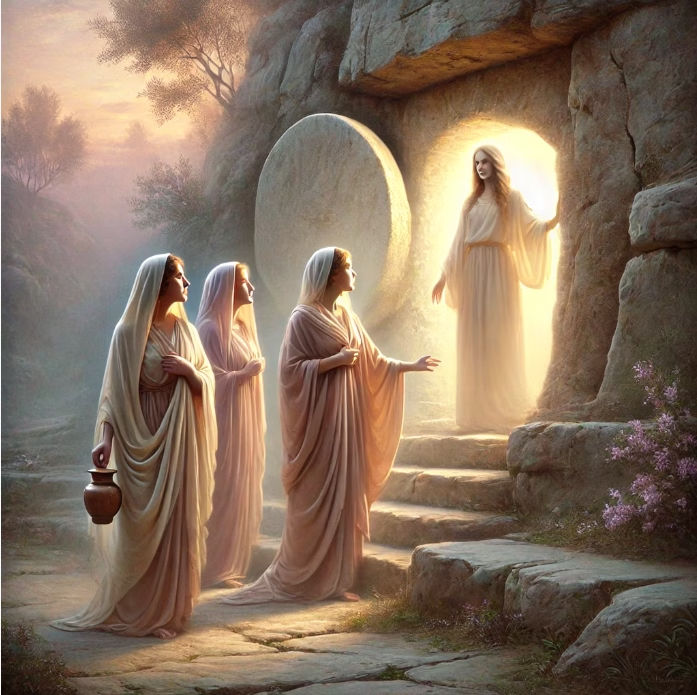
Within this fourth epoch, the most significant event in all of human and Earth evolution occurred: the Mystery of Golgotha. The Cosmic Christ Spirit, a divine Sun Being, incarnated in the man Jesus of Nazareth. This occurred at the Baptism in the Jordan. For three years, He taught and worked on Earth. His sacrificial death on the Cross and His Resurrection infused the Earth and humanity with a new spiritual impulse. This impulse was one of selfless love and the power to overcome death. (Standard English capitalization for pronouns for the Christ respects His divine nature). This event became the new spiritual center of Earth evolution. It gave meaning and direction to all past and future development.
Legacy
The Greco-Roman epoch bequeathed to humanity the foundations of Western thought, art, and political life. It cultivated the intellect. It also fostered a sense of human dignity and individuality. Most importantly, it provided the historical and cultural setting for the Christ event. This event laid the seeds for a new spiritual future.
The Fifth Post-Atlantean Epoch: Our Present Age – The Challenge of the Consciousness Soul
We are currently living in the Fifth Post-Atlantean Epoch. Rudolf Steiner indicated that this epoch began around 1413 AD. It will last until approximately 3573 AD. (See GA 13).
Mission and Consciousness
The primary mission of our current epoch is the development of the consciousness soul (Bewusstseinsseele). This involves the full awakening of ‘I’-consciousness. It means achieving spiritual self-awareness. It also means cultivating inner freedom and taking individual moral responsibility. Human thinking in this age is characterized by sharp intellect. This has led to extraordinary scientific and technological advancements. However, it has also brought the danger of materialism. This is the tendency to believe that only the physical world is real.
Challenges and Tasks
Our epoch faces significant challenges. These include rampant materialism. There is also the rise of divisive nationalism. We also see individualism without a spiritual grounding. However, our age also holds immense potential. This potential is for conscious spiritual development. Anthroposophy itself, as a spiritual science, is a product of this Fifth Epoch. It aims to provide a path to spiritual knowledge. This path is suited to modern consciousness.
A key task for our time is to overcome materialism. We must find the spirit in our scientific understanding. We need to cultivate universal human love (brotherhood/sisterhood). This can transcend national and ethnic divisions. Furthermore, Steiner indicated that since the 20th century, the Christ Being can be perceived again. He can be seen in the etheric realm by those who develop the appropriate spiritual faculties. This offers a new, direct connection to His living impulse.
Looking to the Future: The Sixth and Seventh Epochs
Rudolf Steiner also gave indications about future cultural epochs. The Sixth Post-Atlantean Epoch will see the development of the Spirit Self (Manas). This will involve a further spiritualization of human consciousness. Love and brotherhood will become more natural social forces. The Seventh Post-Atlantean Epoch will focus on developing the Life Spirit (Buddhi). These are distant future developments. However, the seeds for them are sown in how we meet the tasks of our current epoch. The Christ impulse will continue to be the central guiding force in this future evolution.
Relevance for Modern Spiritual Seekers: Finding Our Place in the Unfolding Story
Why is it important for modern spiritual seekers to understand this grand sweep of human evolution?
- Provides Context and Meaning: It shows that our individual lives and the challenges of our time are part of a vast, purposeful spiritual drama.
- Clarifies Present Tasks: It helps us recognize the specific spiritual and cultural tasks of our Fifth Epoch. These include developing the consciousness soul and working against materialism.
- Encourages Responsibility: It highlights our role in shaping the future. Our individual efforts towards self-knowledge and moral development contribute to humanity’s collective journey.
- Fosters Universal Understanding: It helps us appreciate the unique contributions of all cultures. It encourages us to see humanity as one evolving spiritual family.
This knowledge empowers us. It helps us to navigate life with greater awareness. It also encourages us to contribute consciously to a positive future.
Conclusion: Humanity’s Conscious Journey Through Time
Rudolf Steiner’s spiritual science reveals a breathtaking vision. It shows history as the unfolding story of humanity’s spiritual missions through distinct cultural epochs. From the dreamy spiritual nostalgia of Ancient India to the intellectual awakening of Greece and Rome, and into the challenges and opportunities of our current Fifth Epoch, humanity has been on a guided journey. This journey is towards self-awareness, freedom, and love. The “Rudolf Steiner cultural epochs spiritual missions humanity” framework illuminates this path.
The Christ event stands as the radiant center of this evolution. It gives ultimate meaning and direction to our collective striving. By understanding our place within this great unfolding, modern spiritual seekers can find deeper purpose. We can engage more consciously with the tasks of our time. We can also contribute to a future where the human spirit can fully realize its divine potential.