In the grand pantheon of world mythology, few figures are as arresting and paradoxical as the Titan Prometheus. He is the great benefactor of humanity, the bringer of fire and the arts, a rebel who defied the ruling gods out of compassion for the fledgling human race. For this act of love, he endured one of the most horrific tortures imaginable, an eternal punishment that has made him an enduring symbol of heroic sacrifice and the struggle for knowledge against tyranny. But is this political or heroic interpretation the deepest one? A spiritual-scientific investigation, such as that pioneered by a researcher like Rudolf Steiner, invites us to look through the outer pictures of the myth to the profound spiritual realities they conceal.
This article will offer a detailed exploration of the spiritual meaning of Prometheus. We will discover that this myth is a magnificent, pictorial account of the dawning of human self-consciousness—the awakening of the individual “I” or Ego. We will see the famous “fire” not as physical flame, but as the inner fire of thought and freedom. We will understand Prometheus not merely as a Titan, but as the Greek cultural imagination of the great Luciferic impulse, a divine light-bringer whose gift, while essential for our freedom, was given prematurely and thus plunged humanity into a new kind of suffering. The punishment of Prometheus, we will find, is a precise and moving image of the human condition itself: the eternal spirit chained to a physical body, tormented by the endless activity of a soul not yet brought into harmony. To understand the spiritual meaning of Prometheus is to understand the origin of our own inner world and the profound spiritual task that has been set for us.
The Mythic Narrative: More Than a Titan’s Rebellion
Reading the Language of Myth
Before we delve into the esoteric interpretation, let us recall the story itself. After the Olympian gods led by Zeus defeated the older generation of Titans, Prometheus and his brother Epimetheus were tasked with creating mortals and giving them the gifts they would need to survive. Epimetheus (“Afterthought”) carelessly gave all the best gifts—fur, claws, strength, speed—to the animals, leaving humanity naked and helpless. Seeing this, Prometheus (“Forethought”), out of pity, ascended to the heavens and stole fire from the workshop of Hephaestus and Athena. He brought this fire down to humanity in a hollow fennel stalk. With this gift, humans could forge tools, build cities, and develop civilization.
Enraged by this transgression, Zeus enacted a terrible revenge. He ordered the creation of Pandora, the first woman, who would bring strife and misery to humanity. And for Prometheus himself, he devised an eternal punishment. The Titan was taken to the Caucasus Mountains, chained to a great rock, where every day an eagle would descend and devour his liver, only for the liver to regenerate overnight, to be devoured again the next day.
Spiritual science teaches us to see such a myth not as a primitive attempt at science or a simple political allegory, but as the product of an ancient, pictorial, “dream-like” consciousness. For the ancient Greeks, this was not just a story; it was the way in which they experienced profound spiritual truths about their own origins and nature. To interpret it, we must learn to read its symbolic language, to see the spiritual events that are clothed in these mighty images.
Unveiling the “Fire”: The Premature Gift of the “I” Consciousness
The Spark That Defines Humanity
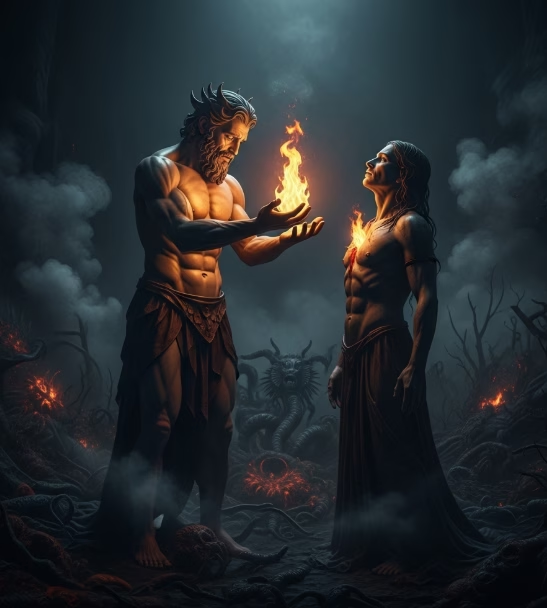
The central act of the myth is the theft of fire. What is this sacred fire? It is far more than the physical flame used for warmth and cooking. The fire that Prometheus brought to humanity is the inner fire of the spirit. It is the spark of self-consciousness, the very thing that separates the human being from the animal kingdom. It is the capacity to think, to reason, to be self-aware, and to say “I” to oneself. It is the birth of the individual Ego.
To grasp the revolutionary nature of this gift, we must imagine the state of humanity before its arrival. As described in esoteric traditions, early humanity lived in a very different state of consciousness. It was a dreamy, clairvoyant consciousness, where the individual was not sharply separated from their environment or from the spiritual world. Human beings felt themselves as part of a “group soul,” much as we might imagine a hive of bees experiences a collective consciousness. They were guided directly by the wisdom of the divine-spiritual beings—”the gods”—who surrounded them. It was a state of innocent, harmonious union with the cosmos, but it was a state without individual freedom, without self-knowledge, and without the possibility of conscious love.
Into this dreamy childhood of humanity came the Promethean gift. It was like a lightning strike that shattered the old harmony. For the first time, the human being experienced a point of selfhood within, a center from which they could look out at the world as an “other.” The “I” was kindled. With this fire, humanity gained the potential for art, for science, for morality born of free choice. But this gift came at a great price, and it was given in a way that set humanity on a perilous new course. The spiritual meaning of Prometheus is inextricably bound up with the nature of this primordial “theft.”
The Gods’ Dilemma: Why the Gift Was a “Theft”
Lucifer, the Premature Light-Bringer
The myth states that the fire was “stolen” from the gods, against the will of the ruling deity, Zeus. To understand this, we must ask: who are these “gods” in the context of spiritual science? The great ruling gods of a cultural epoch, such as the Olympians of ancient Greece, are the outer, mythological names for the regular guiding hierarchies of the spiritual world. These are the beings—Spirits of Form, Spirits of Motion, and so on—who were tasked with overseeing the slow, steady, and harmonious evolution of humanity according to a vast divine plan.
Their original plan was for the human “I” to awaken much more slowly, much more gently. The Ego was meant to dawn within humanity while still cradled in the divine wisdom of these guiding gods. This would have been a long, serene evolution, free from the harshness of error and evil. But another group of spiritual beings intervened. These are beings who, in their own evolution, had developed a great sense of independence and a brilliant light of their own, but a light that was separated from the central, divine will of the leading hierarchies. In Christian esotericism, these are known as the Luciferic spirits.
Prometheus is the magnificent Greek imagination of this Luciferic impulse. He is a “light-bearer” (the meaning of “Lucifer”). Moved by a kind of impatient compassion, he saw humanity in its helpless state and decided to give it the fire of selfhood before the appointed time. He broke the divine quarantine. He gave humanity freedom before it had developed the moral strength to handle it. This is why it was a “theft.” It was an act that went against the established cosmic order of the time. The spiritual meaning of Prometheus is that of a great benefactor, yes, but a benefactor whose gift ripped humanity out of its divine cradle and set it upon a path of self-responsible, and therefore painful, freedom. From the perspective of the guiding gods like Zeus, this was a catastrophe. It introduced egoism, pride, the possibility of error, and the capacity for evil into their carefully managed creation.
The Punishment as Picture: Understanding the Human Condition
A Precise Image of Our Inner and Outer Life
The punishment of Prometheus is one of the most terrifying images in all of world literature. Yet, from a spiritual-scientific viewpoint, it is not an arbitrary torture. It is a precise and profound symbolic picture of the new condition of every human being after receiving the fire of the “I.”
- Chained to the Caucasus Rock: This is the image of the human spirit’s new relationship with its body. Before the Promethean gift, humanity lived in a more fluidic, etheric form. The physical body was softer and more responsive to the spirit. The awakening of the “I” required a much denser, more solid physical instrument. The bony skeleton solidified and mineralized. The spirit became “chained” to this “rock” of the physical body. For the first time, the human being felt the full weight and resistance of matter. We became earthly beings in a new and profound way. The torment of being bound, of feeling the spirit constrained by the limitations of physical existence, is the first part of the Promethean suffering that lives in every human soul.
- The Eagle and the Ever-Regenerating Liver: This is the picture of our new inner condition. To understand it, we must know two things from ancient and esoteric wisdom. Firstly, the liver is the physical seat of the forces of the astral body—the part of our soul that carries our desires, our will, our passions, and our raw life-forces. Secondly, the eagle is a creature of the air and the sun. It is a symbol of the heavens, but also a bird of prey. In this context, it represents the power of thinking, the very “I”-consciousness that Prometheus bestowed.
What does this mean? The thinking “I” (the eagle), once awakened, turns its gaze inward and begins to prey upon the desiring soul (the liver). This is the source of endless inner turmoil. We have desires, but our consciousness reflects upon them, judges them, finds them wanting, and creates inner conflict. We have a will, but our thinking tells us of all our limitations, causing frustration. The liver, seat of life-forces, regenerates—our desires and life-forces well up anew each day. But each day, the sharp, critical, self-conscious mind descends to pick them apart, to create worry, anxiety, and the torment of self-awareness. This daily gnawing of the eagle on the liver is the inner picture of the human condition: the endless struggle between our awakened consciousness and our untamed soul-forces. It is the suffering of Amfortas in the Grail legend, but told in a different, more ancient language. The spiritual meaning of Prometheus is not just that he was punished, but that his punishment is a description of us.
The Complementary Adversary: How Prometheus Opened the Door for Ahriman
From Lucifer’s Fire to Ahriman’s Ice
The Luciferic impulse, embodied by Prometheus, does not work alone. Its very action creates the conditions for its polar opposite to enter the scene. In spiritual science, this polar opposite is the Ahrimanic influence—the force of materialism, darkness, and cold, calculating intellect.
How did Prometheus open this door? By chaining the human spirit to the “rock” of the physical body and by kindling the sharp fire of the intellect. The Luciferic gift makes us aware of ourselves as free beings. But the Ahrimanic impulse then comes along and tempts this new consciousness with a terrible lie. It says: “This rock, this physical body, is all that you are. This fire of intellect is nothing more than a chemical process in your brain. There is no spirit. There is no god. There is only matter.”
Prometheus gives us the potential for science. Ahriman tries to corrupt it into soulless materialism. Prometheus gives us the freedom to think. Ahriman tries to harden that thinking into rigid dogma and mechanistic, computer-like logic. The Promethean suffering is the hot, burning torment of the soul’s inner passions. The Ahrimanic danger is the cold, icy death of the soul, the belief that it does not even exist. The complete spiritual meaning of Prometheus includes understanding that his one-sided gift of light made humanity vulnerable to a new kind of darkness.

The Unbinding of Prometheus: Heracles and the Christ Impulse
The Hero Who Slays the Eagle
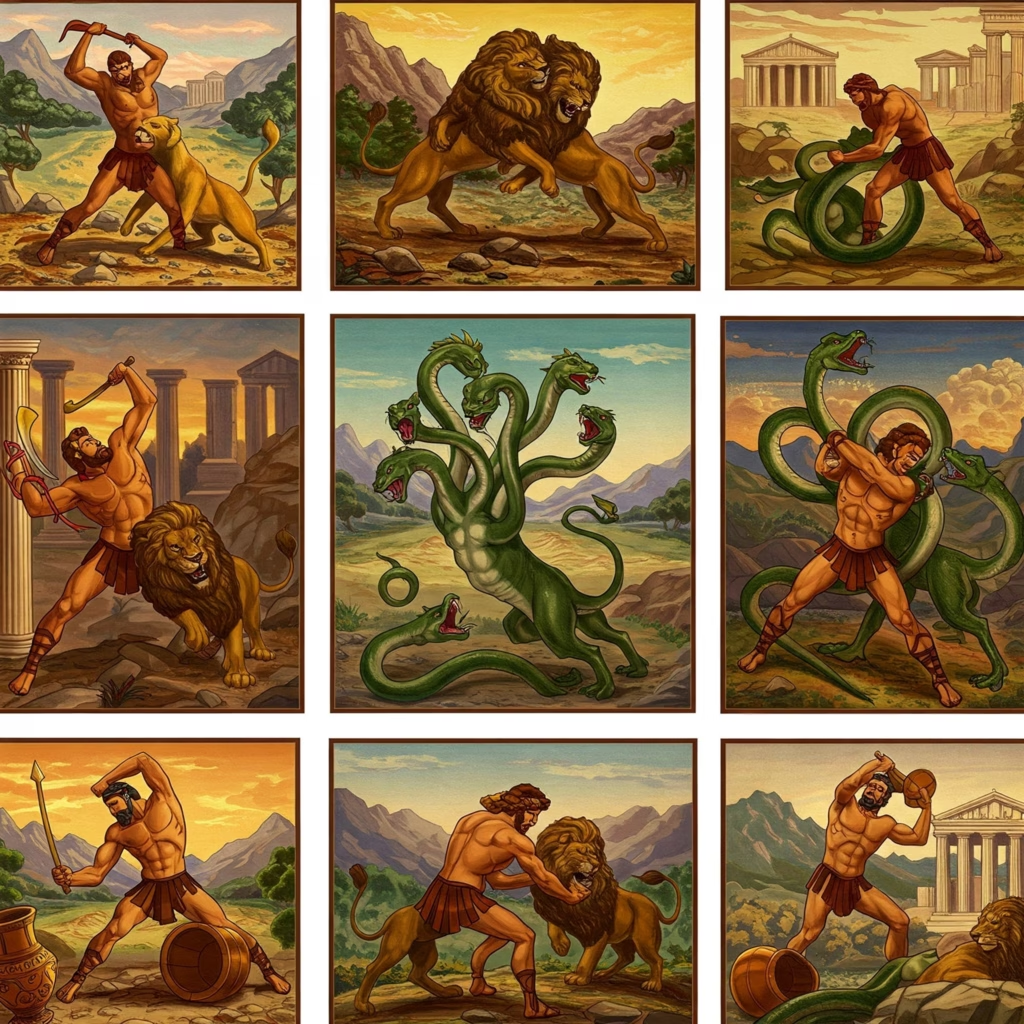
The myth does not end with eternal torture. After ages of suffering, a great hero comes to release the tormented Titan. This hero is Heracles (or Hercules), who slays the eagle with an arrow and breaks the chains that bind Prometheus. Once again, this is a picture of a profound spiritual event.
Who is Heracles? He is the great Sun-hero of Greek mythology. He is the demigod who must prove his worthiness by undertaking twelve immense labors, which are an esoteric picture of a solar initiation, a journey through the twelve forces of the zodiac. Heracles represents the highest possibility for the human being who strives to become master of their own lower nature and unite themselves with the divine Sun. He is a pre-Christian imagination, a prophetic picture, of the coming Christ Being.
Only a being who comes from the Sun—the central source of divine, balancing power—can heal the wound inflicted by the one-sided Luciferic impulse. The Christ Impulse is the force that can truly “unbind” the human “I.” How does it do this?
- Slaying the Eagle: The Christ Impulse gives the human “I” a new power: the power of selfless love. This love is the only force that can tame the eagle of self-centered thinking. When the “I” learns to think not just about itself, but to turn its thinking outwards with compassion and understanding for the other, the inner torment ceases. Love stills the gnawing anxiety and fills the soul with a new kind of warmth.
- Breaking the Chains: The Christ event, specifically the Mystery of Golgotha and the Resurrection, demonstrated that the spirit is stronger than the physical body. It showed that the “rock” of matter is not a final prison, but a temporary vessel that can itself be spiritualized. The Christ Impulse gives the “I” the strength to become master of its physical instrument, to live on Earth in freedom, no longer as a slave to matter but as its conscious transformer.
The unbinding of Prometheus by Heracles is therefore a prophecy. It foretells that the suffering initiated by the Luciferic gift of premature selfhood can and will be healed by the conscious reception of the Christ Impulse into the human soul.
Conclusion
The spiritual meaning of Prometheus is as vast as it is profound. He is the tragic, magnificent bearer of the Luciferic light. His gift of fire was the kindling of our own “I,” the necessary precondition for us to become free, self-aware individuals. But this gift, given against the wisdom of the guiding gods, cast us out of a divine childhood and into a world of painful self-responsibility. His eternal punishment is a startlingly accurate picture of our own human condition: the spirit chained to matter, the self-conscious mind tormenting the desiring soul.
The myth does not leave us in despair. It shows that the very same humanity that received the Promethean fire is also the beneficiary of a greater, healing impulse. The path for the modern individual is not to reject the Promethean gift—we cannot and should not return to a state of unconsciousness. Our task is to become masters of this fire. We must use our intellect without becoming cold Ahrimanic machines, and we must embrace our freedom without falling into the destructive pride of Lucifer. The path to achieving this balance, the path to unbinding the titan within, is the path of uniting our free “I” with the compassionate, harmonizing power of the Christ Impulse. By doing so, we can transform the ancient suffering of Prometheus into the future creative power of a truly free and loving humanity.