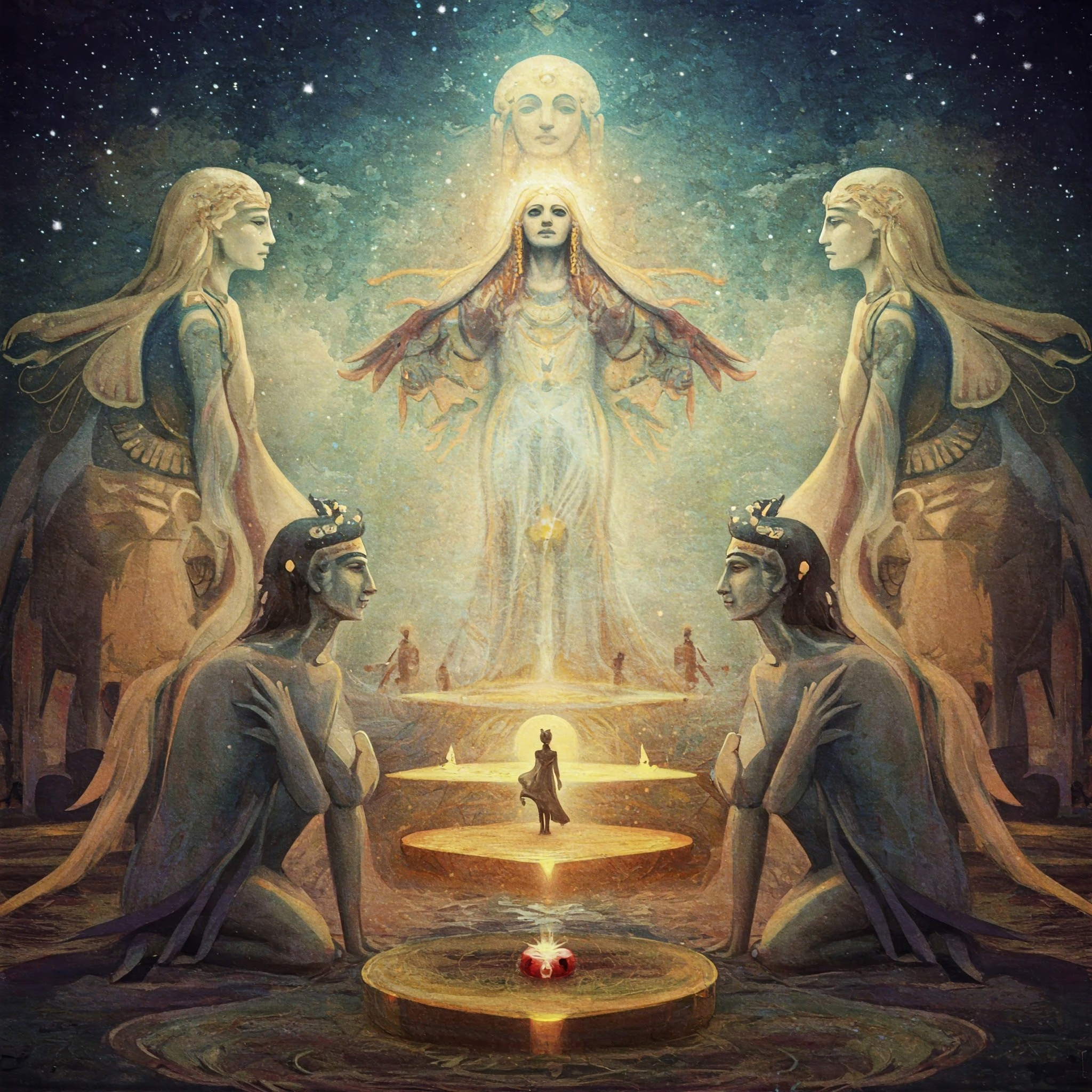
Myths and legends often captivate us. They tell stories of gods, heroes, creation, and cosmic battles. Yet, modern thinking frequently dismisses them. Many see myths merely as primitive attempts to explain nature. They view them as fanciful fictions or distorted historical memories. Rudolf Steiner, however, offered a profoundly different perspective through his spiritual science, Anthroposophy. The Steiner myths interpretation reveals these ancient narratives not as naive inventions, but as profound echoes of spiritual reality. They are remnants of an ancient form of human consciousness. Anthroposophy sees these stories as imaginative pictures. They portray actual spiritual beings, cosmic events, and deep truths about human evolution. Understanding the meaning of the myths unlocks a hidden layer of wisdom. It connects us to humanity’s spiritual heritage.
Myths: Windows into Spiritual Reality
Steiner’s core insight is revolutionary. Myths are not primarily allegories or symbolic representations invented to explain physical phenomena. Instead, they are often direct, pictorial accounts of spiritual experiences. Earlier humanity possessed a different form of consciousness. This consciousness perceived the spiritual world directly, though often in a dreamlike, imaginative way. What modern humans grasp through abstract concepts, ancient people experienced as living pictures, beings, and events.
Therefore, myths represent genuine spiritual reality as perceived through this older consciousness. When ancient myths speak of gods interacting with humans, or of cosmic battles between light and darkness, they often describe events witnessed on the spiritual planes. They depict the actions of real spiritual hierarchies. They portray processes of cosmic and human creation. They are not failed science; they are remembered spiritual perceptions clothed in powerful imagery. This view elevates myths and legends’ studies through spiritual science from mere literary analysis to an exploration of humanity’s spiritual past.
Ancient Consciousness: The Source of Myth
To understand myth-making, Steiner directs us to the evolution of human consciousness. In the remote past, during the Lemurian and early Atlantean epochs described in spiritual science, human perception differed vastly from ours today. Directclairvoyance, albeit often dim and dreamlike, was widespread. Humans experienced the spiritual forces behind nature directly. They perceived elemental beings in wind and water. They saw the formative thoughts of divine beings shaping the world. They experienced their own soul-life interwoven with cosmic happenings.
This consciousness did not operate through abstract logic. It perceived realities through living pictures, through powerful inner imagery. The soul experienced spiritual truths not as concepts, but as dynamic events and personified beings. Consequently, when recounting these experiences, ancient people naturally used the language of myth. The gods, heroes, symbolic animals, and cosmic landscapes found in mythology were often direct transcriptions of these inner, clairvoyant perceptions. They were the most accurate way possible to communicate supersensible realities experienced through an image-based consciousness. Modern abstract thought represents a later stage of development. It gains precision in the physical world but loses the direct, pictorial access to the spiritual that characterized earlier humanity and gave birth to myth.
Cosmic Memory: Myths as Archetypal Truths
Steiner further connected myths to the concept of the Akasha Chronicle, or “Cosmic Memory.” This is the spiritual record of all events, imprinted in the fine substance of the spiritual world. Initiates and those with developed clairvoyance can, according to Steiner, learn to read this chronicle. Myths often represent fragments or reflections drawn from this cosmic memory Steiner’s research reveals. They encode archetypal patterns of human and world evolution.
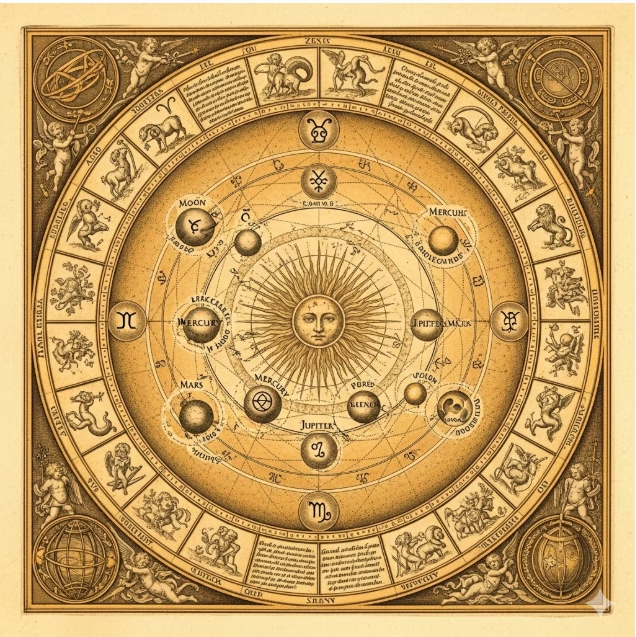
Creation myths worldwide, for example, often contain surprisingly concordant pictures of cosmic beginnings when read through the lens of spiritual science. They reflect stages like the ancient Saturn, Sun, and Moon periods described by Steiner. Narratives of a “fall,” a loss of paradise, or a separation from the divine echo humanity’s gradual descent into material existence and the fading of direct spiritual perception. Hero myths frequently depict the soul’s journey, the overcoming of lower impulses (dragons, monsters representing adversarial forces), and the quest for higher knowledge or initiation (finding sacred objects, rescuing maidens symbolizing the soul). These recurring themes are not mere coincidences. They point to universal spiritual truths embedded within the cosmic memory, reflected diversely through the imagery of different cultures.
Examples of Steiner’s Myth Interpretation
Steiner provided numerous examples, showing how specific myths reveal spiritual facts:
- Egyptian Myths: In works like GA 106 Egyptian Myths, Steiner explained the profound Osiris-Isis cycle. He showed it reflects cosmic events like the sun’s spiritual forces descending into the earth (‘death’ of Osiris), the soul’s search for spiritual knowledge (Isis seeking Osiris), and the eventual resurrection of spiritual power within earthly processes (Horus, the forces working from within the earth). He interpreted animal-headed gods not as primitive concepts, but as accurate portrayals of how divine beings manifested during earlier, Lemurian stages when human and animal forms were less distinct. The enigmatic Sphinx, too, he saw as a memory-picture of a specific stage in human evolution, combining different soul forces.
- Greek Myths: Steiner interpreted many Greek myths as pictures of initiation or soul development. The story of Oedipus confronting the Sphinx represents the challenge faced by the developing human Ego (Oedipus) in mastering the powerful, riddling forces of the astral body (Sphinx) during the Greco-Latin epoch. Prometheus, bringing fire to humanity against the gods’ will, depicts the intervention of Luciferic beings. These beings granted premature independence and intellect (fire) but also led humanity into suffering and entanglement with matter (being chained to the rock, the liver eaten by the eagle – representing corrupted astral forces). The Argonauts’ quest for the Golden Fleece symbolizes the initiate’s search for the purified, luminous astral body, reclaiming the soul’s original spiritual potential.
- Norse/Germanic Myths: Steiner connected figures like Wotan (Odin) and Loki to specific spiritual beings and their influence on Northern European soul development. He interpreted the twilight of the gods (Ragnarök) not as a final end, but as a picture of cosmic transformation leading to a new world-age. These myths reflect the unique spiritual experiences and tasks of those specific folk souls.
- Biblical Narratives (Genesis): Steiner approached the early chapters of Genesis not as literal history or geology, but as profound imaginative pictures conveying spiritual truth. The “Days of Creation” depict vast cosmic evolutionary epochs (Saturn, Sun, Moon, Earth stages). The Paradise story reflects an early human condition before the full descent into matter and the awakening of self-conscious egoism. The “Fall” represents the intervention of Luciferic forces, leading to earthly entanglement but also paving the way for freedom.
These examples illustrate that the esoteric meaning of myths reveal requires insight into the spiritual realities they depict.
The Purpose of Myths: Preserving Ancient Wisdom
Why did humanity create and preserve myths? According to Steiner, myths served a crucial function. As direct clairvoyant perception gradually faded during the Atlantean and early post-Atlantean epochs, humanity needed a new way to retain connection with spiritual truths. The old, direct vision became memory. This memory was then clothed in vivid, imaginative stories.
Myths became the primary vessel for transmitting profound spiritual knowledge across generations. They preserved wisdom about cosmology, the spiritual hierarchies, human origins, and the soul’s destiny in a pictorial form. This form could resonate with the feeling life and imagination, even when direct spiritual sight was no longer common. The Rudolf Steiner meaning of myths assigns them is that of essential carriers of wisdom. They bridged the gap between the ancient world of direct spiritual experience and later ages increasingly reliant on intellectual understanding. They kept alive the awareness of higher realities during periods when human consciousness was focused primarily on the physical world.
Myths Reflecting Human Evolution
The form and content of myths also evolve, reflecting changes in human consciousness itself. Steiner pointed out how myths from earlier epochs (like ancient India or Egypt) often possess a more direct connection to cosmic events and beings. Later myths (like the Greek or Norse) frequently focus more intensely on the experiences of the human soul, its struggles, its inner development, and its relationship with divine-spiritual powers that feel more distinct from the human being.
This evolution in mythology mirrors humanity’s own developmental journey. As the ‘I’ or Ego strengthened, as thinking became more individualized, the nature of spiritual experience changed. The myths reflect this shift, moving from cosmic panoramas to more focused dramas of the soul. Studying the ancient myths’ evolution that Steiner described helps us understand not only the myths themselves but also the changing consciousness of the peoples who created them.
Understanding Myths Today Through Spiritual Science
How can modern humanity approach these ancient narratives? Simply collecting and comparing myths, or analyzing them with purely intellectual tools, misses their core reality according to Steiner. Rationalistic interpretations often reduce myths to primitive psychology or garbled history.
Spiritual science offers a different key. By developing capacities for imaginative and inspired cognition, one can begin to perceive the spiritual realities behind the myths. Understanding Steiner’s cosmology—the evolution of Earth through Saturn, Sun, Moon stages, the roles of Lucifer and Ahriman, the working of spiritual hierarchies—provides the context needed to decode the mythic pictures. The goal is not simply to find allegorical equivalents for every detail. Rather, it involves recognizing the spiritual processes, beings, and evolutionary stages depicted in the myth’s imaginative language. Mythology through spiritual science aims to reawaken an understanding of the living truths clothed in these ancient forms.
Conclusion: Myths as Humanity’s Spiritual Memory
In conclusion, Rudolf Steiner’s interpretation radically revalues myths and legends. They are not mere primitive fictions. They are vital fragments of humanity’s spiritual memory. The Steiner myths’ interpretation shows them as imaginative pictures born from ancient clairvoyant consciousness. They reflect actual spiritual reality. They encode deep wisdom about cosmic origins, human evolution, and the workings of spiritual beings. Anthroposophy treats these myths and legends with reverence. They are seen as essential records preserving knowledge from times when humanity lived in closer communion with the spiritual world. By learning to read their imaginative language through the lens of spiritual science, we can rediscover profound truths about ourselves and our place in the cosmos. Myths connect us to our spiritual heritage. They offer invaluable guidance for navigating our present and shaping our future.