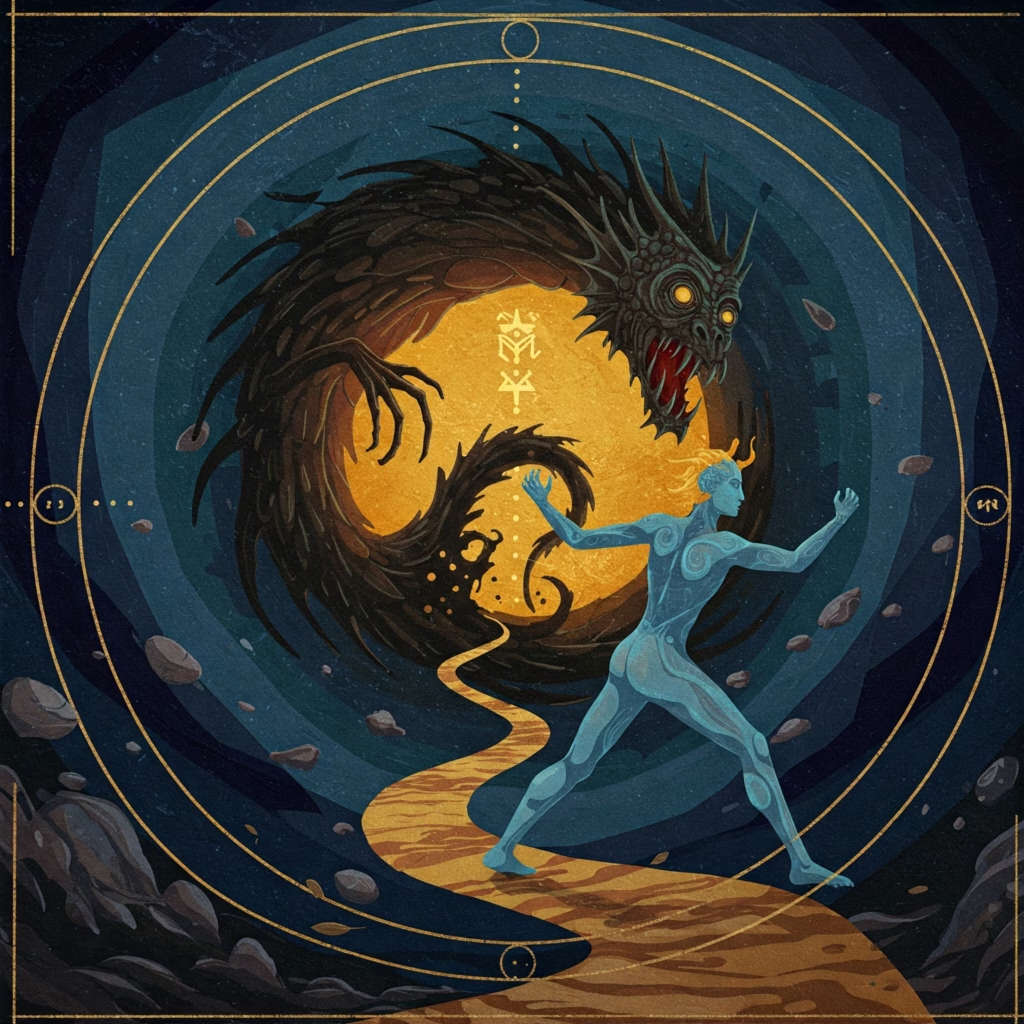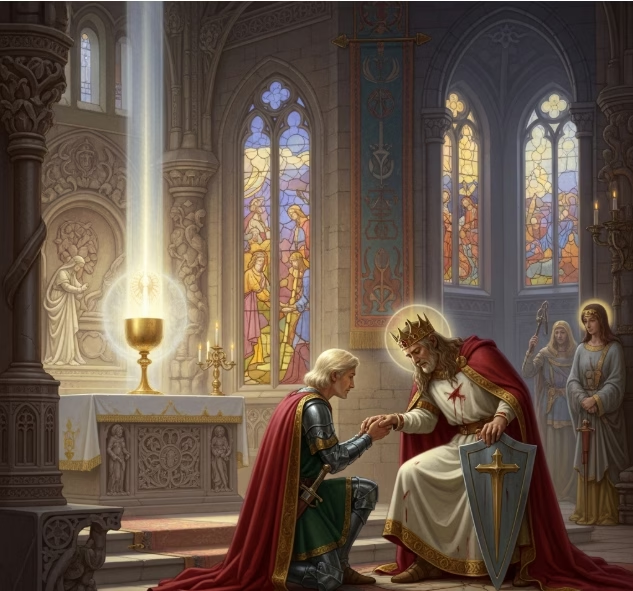
No object in Western legend has captured the spiritual imagination more powerfully than the Holy Grail. For nearly a thousand years, the stories of its quest have been told and retold, inspiring art, poetry, and a deep, soul-felt yearning. In the popular mind, the Grail is often seen as a physical cup—the vessel used by Christ at the Last Supper, or the one that caught His blood at the foot of the Cross—a lost relic possessing miraculous powers. A spiritual-scientific investigation, however, lifts this search from the realm of earthly treasure hunting and reveals its true nature as an inner pilgrimage. This article will explore the Holy Grail spiritual meaning, drawing upon the insights of spiritual researchers like Rudolf Steiner and the rich tapestry of medieval Grail legends, particularly the story of Parsifal.
We will discover that the Grail is not ultimately an external object to be found, but a state of consciousness to be attained. It is the sublime symbol for the purified human soul, a soul that has become a conscious and worthy vessel for the spirit. The quest for the Grail is the timeless, archetypal journey of inner development. The story of its most famous seeker, Parsifal, provides a detailed roadmap for this journey—a path that leads from innocent ignorance, through doubt and worldly trial, to a state of enlightened compassion and spiritual freedom. Unveiling the Holy Grail spiritual meaning is to unveil the deepest potential and highest calling of the human soul in our modern age.
Beyond Legend: The Grail as a Spiritual Reality
What is the Holy Grail?
To begin to grasp the Holy Grail spiritual meaning, we must understand its origin in the central event of human history: the Mystery of Golgotha. The legends consistently connect the Grail to the blood of Christ. This is the essential key. In spiritual science, blood is understood as the direct physical expression of the “I” or the Ego, the spiritual core of the human being. The blood that flowed from the wounds of Christ on the Cross was, therefore, something utterly unique. It was a physical substance completely permeated by the being of a divine, cosmic spirit—the great Sun Spirit who had chosen to undergo death within a human body. When this sacred blood touched the Earth, it infused the Earth’s spiritual atmosphere with a new, life-giving impulse.
The Holy Grail, the cup that, according to legend, received this blood, is the symbol for a vessel capable of consciously holding this new spiritual force. In its highest sense, the Holy Grail is the sanctified, purified human soul itself. It is the human heart and mind, which through long training and moral development, has been made clean and strong enough to receive the Christ Impulse directly, without being shattered by its power. It is a soul that has learned to be receptive to the spirit in full, waking consciousness. The quest for the Grail is therefore the quest to transform oneself into such a vessel. It is the path of making one’s own soul into a worthy receptacle for the divine.
The Lance and the Grail: Two Poles of Esoteric Christianity
Will and Wisdom, Power and Compassion
The Holy Grail spiritual meaning cannot be fully understood in isolation. It must be seen in relation to its polar opposite, which we have explored before: the Holy Lance, or the Spear of Longinus. In the Grail Mysteries, these two sacred objects represent the two great pillars of esoteric Christian initiation. They are the two paths that the developing human being must walk and ultimately unite within themselves.
- The Holy Lance: The Spear is the instrument that actively pierced the side of Christ, releasing the sacred blood and water. It is a symbol of the active, outward-striving human will. It represents power, action, courage, and the path of shaping the world through moral deeds. It is connected to the forces of thinking, of clear-cut discernment, and the strength of the “I” to assert itself in the world. Esoterically, it is often seen as the “masculine” or active principle of the spiritual path.
- The Holy Grail: The Grail is the vessel that passively and reverently received the sacred blood. It is a symbol of the receptive, inward-turning human soul. It represents piety, devotion, compassion, and the path of purifying the heart to make it worthy of spiritual wisdom. It is about becoming empty so that one can be filled by the divine. It is connected to the forces of feeling, of selfless love, and the capacity of the soul to offer itself in service. It is the “feminine” or receptive principle of the spiritual path.
For centuries, humanity has tended to develop these two paths separately. We have had active, worldly leaders and conquerors who possessed a strong will but often lacked heart-wisdom. We have also had devout, contemplative mystics who possessed a pure heart but lacked the will or capacity to bring their spiritual insights effectively into the world. The central task of our modern age, and the ultimate secret of the Grail quest, is the uniting of these two principles within each individual soul. A complete human being must become both a Grail-bearer and a Spear-wielder: a being whose powerful, active will is guided by a wise and compassionate heart.

Amfortas’s Wound: The Dilemma of the Modern Soul
The Sickness of a King, The Sickness of an Age
The central tragedy of the Grail stories is the figure of the wounded Grail King, Amfortas. He is the guardian of the Grail, but he suffers from a grievous wound that will not heal. This suffering is not his alone; because the king is sick, the entire land becomes a barren “wasteland.” Amfortas’s wound is a profound and painfully relevant symbol for the spiritual condition of modern humanity.
How was he wounded? He was wounded by the Holy Spear itself. In a moment of weakness, while on a worldly adventure, he was seduced by a temptress (Klingsor’s magical creation) and in that moment of unwatchfulness, the evil magician Klingsor seized the sacred Spear and wounded Amfortas with it. This story is a powerful picture of what happens when the human will, the spear of the “I,” is used for selfish, egoistic purposes, divorced from the purity and compassion of the heart. When our intelligence and our power are not guided by love, they turn against us and become a source of sickness and suffering.
This is precisely the ailment of our modern age. We have developed a brilliant, sharp, “spear-like” intellect through science and technology. We have immense power to shape the physical world. But we have largely lost the connection to the wisdom of the heart, the compassion of the Grail. Our science can analyze the world into its smallest parts but struggles to find meaning. Our technology can connect the globe but leaves people feeling more isolated than ever. Our economic systems can generate immense wealth but create a spiritual wasteland. Amfortas’s endless suffering is the suffering of a humanity that possesses a powerful will but has forgotten the question of the heart. The Holy Grail spiritual meaning is deeply tied to understanding and healing this wound in ourselves and in our culture.
The Path of Parsifal: A Threefold Journey of Becoming
The Archetypal Path of the Modern Initiate
The only one who can heal Amfortas is the one who can become the new Grail King. This is Parsifal, and his life story is the detailed map of the modern path of initiation. It is a journey with three distinct stages.
Stage One: The “Pure Fool” (Der reine Tor)
Parsifal begins his life in utter seclusion, raised in a forest by his mother, Herzeloyde (“Heart’s Sorrow”), who deliberately keeps him ignorant of the world of chivalry and strife. He is a “pure fool”—innocent, strong, and completely unconscious. He acts purely from instinct. When he first encounters knights in shining armor, he mistakes them for gods. Inspired, he leaves his mother (unwittingly causing her death from grief) and sets out into the world. He learns the outer forms of knighthood but has no inner understanding.
In this state, he finds his way to the Grail castle. He witnesses the sacred ritual, he sees the suffering King Amfortas, and he sees the Grail itself. But he remains silent. He has been taught that it is impolite to ask too many questions. He fails the test. He is cast out of the castle in shame. This first stage represents the state of innocent, picture-consciousness. It is the soul that can perceive spiritual realities but does not yet have the conscious “I” to understand them or engage with them freely. His failure is the failure of a consciousness that is not yet fully awake to the reality of another’s suffering.
Stage Two: The Years of Doubt and Striving
Cast out from the Grail castle, Parsifal enters a long period of wandering and despair. He feels he has been abandoned by God. He rejects the spiritual world and throws himself entirely into worldly adventures, becoming a great and famous knight. These years of struggle, doubt, and earthly experience are absolutely essential for his development. It is during this time that his “I” is forged. He is no longer an innocent fool acting on instinct. He becomes a self-conscious individual, grappling with the great questions of life, fate, and his own identity. He learns through trial and error, through suffering and success. This long, arduous journey represents the development of the conscious soul and the intellectual soul, the tempering of the character through its encounter with the resistance of the world. It is a stage that every modern individual must pass through to develop a strong, free, and independent “I.”
Stage Three: The Question of Compassion
After many years, through a meeting with a wise hermit on a Good Friday, Parsifal is reawakened to his spiritual quest. He has now integrated his worldly experiences. His “I” is strong and mature. He finds his way back to the Grail castle, but he returns as a completely different man.
He again witnesses the solemn ritual and the suffering of the king. But this time, his heart, purified and made wise through his own years of suffering, is able to truly see the pain of another. He is no longer bound by outer rules of etiquette. He acts from a new inner faculty. He turns to the king and asks the simple, profound question that unlocks the entire mystery: “Uncle, what ails thee?” (“Was feilet dir, oheim?”).
This is not a question seeking information. Parsifal can see what ails him. This question is the purest expression of selfless, heartfelt compassion. It is the “I” freely turning its attention away from itself and towards the suffering of another. It is an act of love. In this moment, Parsifal unites the wisdom of the world with the purity of the heart. The spell is broken. The king begins to heal.

Healing the Wound and Becoming Grail King
The Union of Spear and Grail
The asking of the question of compassion makes Parsifal worthy to take up the sacred implements himself. He is now able to take the Holy Spear—the very weapon that caused the wound—and heal Amfortas by touching the wound with it. This is a moment of supreme spiritual alchemy. The will (Spear), which caused suffering when used with selfish intent, can now bring healing when guided by compassion (Grail). This is the great secret. Power united with love becomes a force for healing and creation.
By accomplishing this deed, Parsifal becomes the new Grail King. This means he has become the master of his own soul forces. He has harmonized his thinking, his feeling, and his willing. His clear thought can now direct the power of his will, and both are now infused with the warmth and wisdom of his compassionate heart. He is a complete human being, a free individual who can consciously bear the Christ Impulse and work with it in the world. The Holy Grail spiritual meaning finds its ultimate fulfillment in this image of the initiated human being who has united the paths of wisdom and love.
Finding the Grail Today: The Path of Inner Development
The Modern Quest
The story of Parsifal is not just a medieval legend; it is our story. The quest for the Grail is the task set for modern humanity. We are not meant to search for a physical cup in some remote location. The Grail castle is within us. Amfortas’s wound is our own soul’s sickness when our intellect is divorced from our heart. Parsifal’s path is the path of inner development available to every individual who chooses to walk it.
How do we walk this path today? We do it by consciously undertaking the work of self-knowledge and self-transformation. This path includes:
- Purifying the Astral Body: We must work to observe and gradually gain mastery over our inner life of sympathies and antipathies, our instinctive reactions, our selfish desires. This is the modern equivalent of Parsifal’s long wandering and moral tempering.
- Strengthening Thinking: We must cultivate clear, objective, and spiritually-oriented thinking. Engaging with spiritual science or anthroposophy is a primary way of doing this. This develops the strong, conscious “I” that Parsifal forged in his years of doubt.
- Cultivating Compassion: The final and most crucial step is the conscious cultivation of selfless interest in the other. This is the “Grail question.” It is the daily effort to ask, in every human encounter, not “What can I get?” but “What does this other person need? How can I understand their journey?”
Practices such as meditation, self-observation, and the “six basic exercises” described by Rudolf Steiner are concrete, practical tools for the modern Grail-seeker. They are designed to bring about the same harmonization of thinking, feeling, and willing that Parsifal achieved.
Conclusion
The Holy Grail spiritual meaning is one of the most hopeful and profound messages for humanity. It tells us that within each human soul lies the potential to become a shining vessel, a chalice capable of consciously holding the spirit. It shows us that our purpose on Earth is to undertake a great transformation—from the unconscious innocence of a “pure fool” to the conscious, compassionate wisdom of a Grail King. The path of Parsifal is the archetypal map for this journey. It teaches us that our suffering and our doubts are not meaningless; they are the very fire that forges the strength of our “I.” And it reveals that the ultimate key to healing ourselves and the world is the simple, sacred power of a compassionate question, a heartfelt turning towards the other. The Grail is not lost. It awaits its discovery within every human heart that is willing to undertake the quest.