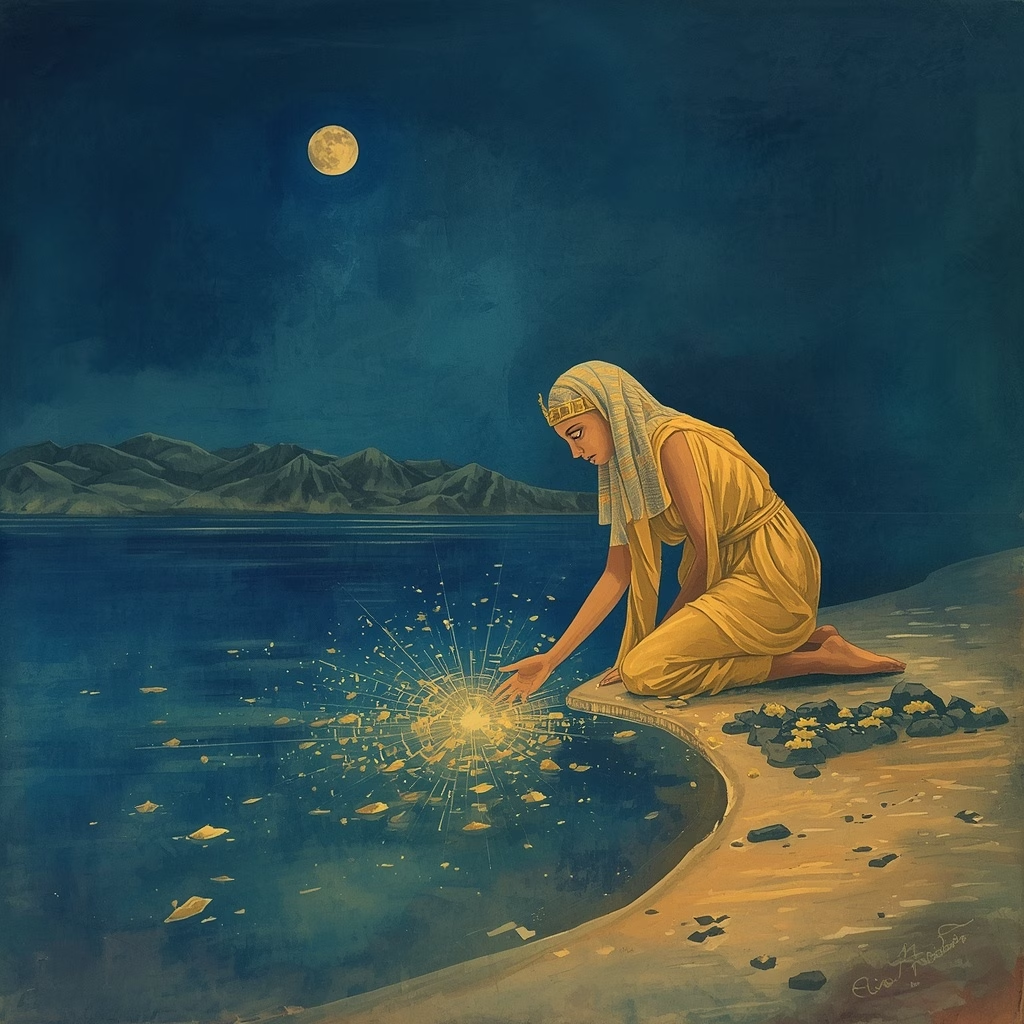
Few myths encode the structure of genuine spiritual development as precisely as the story of Psyche and Eros. A mortal woman of extraordinary beauty, whose very name means “soul” in Greek, is united with a divine but invisible husband under a single condition: she must never look upon his face. When she breaks this condition, she loses him and must undertake a series of seemingly impossible trials before she can be reunited with him and achieve, through her own effort, the status of a goddess herself.
Rudolf Steiner’s spiritual science approaches this myth, preserved most completely in Apuleius’s Latin novel The Golden Ass, as a precisely structured account of the soul’s own developmental journey. Steiner addresses it through the same broader framework of mythological interpretation that illuminates Orpheus, Demeter and Persephone, and Prometheus.
Psyche as the Human Soul
Psyche’s name is simply the Greek word for soul. Steiner takes this naming with full seriousness — the myth is a conscious allegory of the human soul’s journey, in which every trial encodes a genuine developmental stage. Psyche’s initial condition — extraordinarily gifted yet unable to find genuine relationship because her beauty inspires awe rather than love — represents a soul that possesses genuine gifts not yet tested and made capable of genuine intimate connection.
Eros, the divine husband she marries but cannot see, represents the higher spiritual self — the genuine “I” in its fully developed aspect, which the ordinary, still-developing soul can unite with only partially. The condition that she must not look upon his face encodes a genuine principle: certain stages of development require a quality of trust that precedes ordinary verification.
The Betrayal and Its Necessity
Psyche’s sisters convince her that her invisible husband must be a monster. When she looks upon him with a lamp, she finds instead the god of love — but a drop of oil wakes him, and he flees. Steiner’s account illuminates this as necessary rather than merely regrettable. The soul’s early, untested union with its own higher nature cannot remain permanently unconscious. The developmental task is to develop a fully conscious, verified relationship with spiritual reality — one requiring, at some stage, the very act of questioning that Psyche’s premature curiosity represents in flawed form.
The tragedy is not that she sought to know her husband’s true nature — this seeking is a genuine developmental impulse. The tragedy is the specific quality of fear and externally manipulated doubt that drove the act, rather than genuine, patient spiritual readiness.
The Trials as Developmental Stages
Aphrodite sets Psyche four seemingly impossible tasks. The first — sorting an enormous mixed pile of seeds before nightfall — connects, in Steiner’s reading, with learning to distinguish the various soul forces that remain confused in the undeveloped soul. The help of ants suggests this task requires patient, humble, cooperative inner discipline rather than unaided effort alone.
The second task — gathering wool from fierce golden sheep — teaches the soul to work with powerful cosmic forces indirectly and with patient timing rather than direct, premature confrontation. The third — filling a vessel from the dangerous waters feeding the Styx — is completed by an eagle sent by Zeus, representing the higher cognitive capacity, connected with genuine Inspiration, that becomes available precisely where the soul’s own developed effort reaches its natural limit.
The fourth and final task requires Psyche to descend to the underworld itself — connecting directly with the descent-and-return structure explored in the Orpheus and Eleusis myths. Her second failure of trust, opening a forbidden box despite her genuine progress, indicates that even considerable development does not immediately eliminate residual anxiety. Only Eros’s own direct intervention completes what her own strength could not complete alone.
The Apotheosis
The myth concludes with Zeus granting Psyche genuine immortality, permanently uniting her with Eros in a marriage now witnessed by all the gods rather than conducted in secret. Steiner emphasises the significance: the union that began unconscious and untested is completed only after genuine developmental effort, resulting in a union now fully conscious and permanently secured — one that exceeds, rather than merely restores, the soul’s original condition.
Every human soul that undertakes genuine inner development walks, in some form, the same path — from unearned grace, through necessary trial, toward a spiritual union genuinely achieved rather than passively inherited.
The full article on Substack covers the complete symbolic interpretation of each of Psyche’s four trials, the specific connection to Steiner’s broader teaching on Imagination and Inspiration, and his complete account of why the myth’s structure mirrors the systematic stages of the inner path. Free to read on Substack.
Read the full article free on Substack →