Among all the figures that Rudolf Steiner’s spiritual science brings to light, few are as astonishing as Christian Rosenkreutz. History knows the name primarily through cryptic Rosicrucian manifestos from the early seventeenth century. Yet Steiner reveals something far greater. He describes Christian Rosenkreutz not as a mythological character or a collective pseudonym, but as a real spiritual individuality — one of the most significant souls in all of post-Atlantean history, whose mission continues invisibly into our own time.
To understand this hidden master is, moreover, to understand something essential about the modern path of inner development. It is to glimpse the spiritual hand working quietly behind Anthroposophy, behind the new mysteries, and behind every sincere effort of the human soul to reach upward toward the spirit in full freedom and wakefulness.
An Unprecedented Event in the Thirteenth Century
The Dying Child and the Twelve Masters
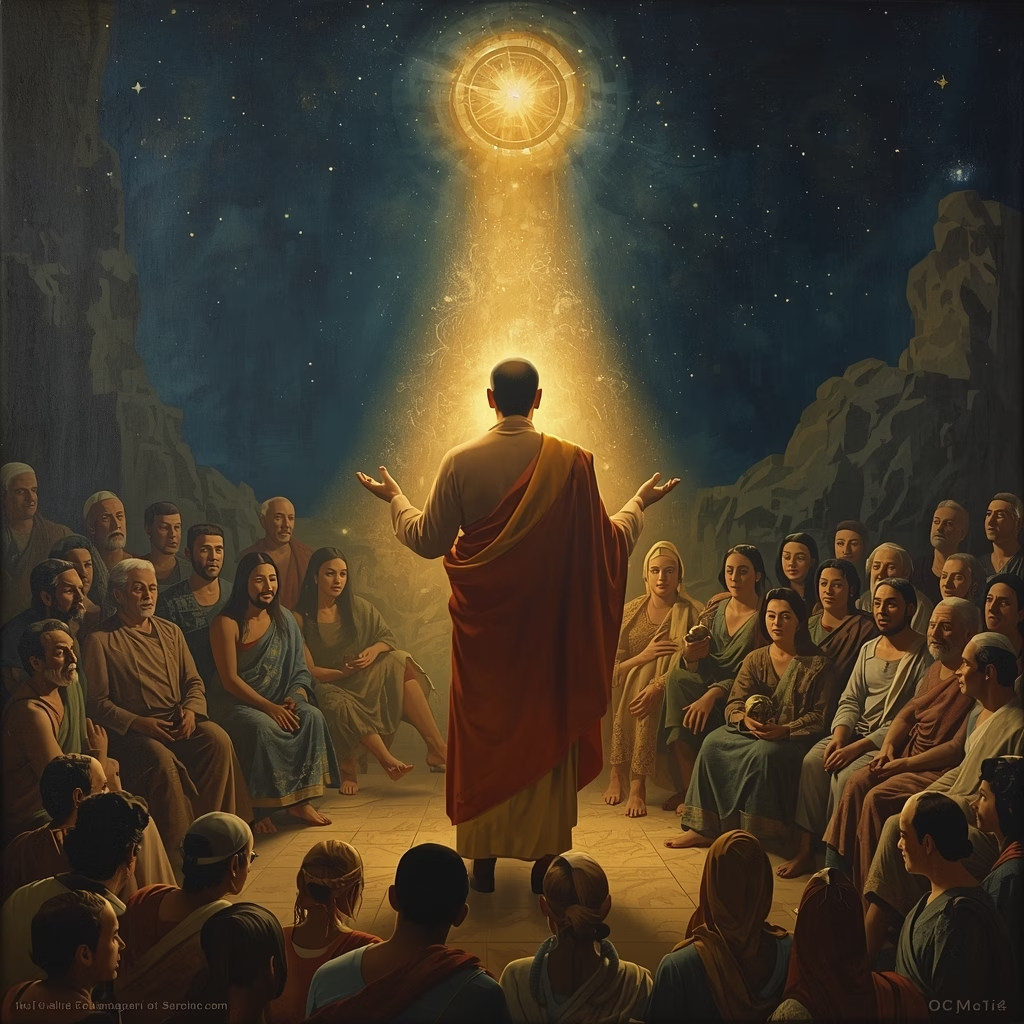
In the thirteenth century, spiritual science reveals, something happened that had no precedent in human evolution. A child was born with a physical body so delicate, so transparent to spiritual forces, that it could barely sustain earthly life. Twelve great initiates recognised this child as the vehicle for an extraordinary event. Each of these twelve carried a distinct stream of ancient wisdom: Egyptian Hermeticism, Persian Zarathustrian light-wisdom, Chaldean star-knowledge, Druidic nature-mysteries, Indian Brahmanical wisdom, and others. Together, their traditions represented the full inheritance of pre-Christian humanity.
Yet each initiate also sensed his own limitation. No single stream, however profound, could speak to the dawning age of individual human consciousness. Furthermore, each felt that the ancient wisdom, in its original form, had reached the end of its natural arc. A synthesis was urgently needed. Consequently, the twelve resolved to do something entirely without historical parallel.
One by one, they transmitted to this dying child everything they carried. This transmission was not an ordinary teaching. Instead, it was a direct bestowal of spiritual substance — forces, living imaginations, and impulses poured directly into the child’s soul before death claimed the fragile body. Shortly after this transmission was complete, the child died. However, death in this case was not an ending but a beginning of another kind. In the spiritual worlds, over a period of years, the child’s soul assimilated this vast wealth of wisdom. It transformed the twelve streams into something new — a thirteenth stream that none of the masters had individually possessed.
Then came a new incarnation — but one unlike ordinary reincarnation. A new kind of human being had entered earthly existence. This was Christian Rosenkreutz. Steiner describes this event in GA 130, “Esoteric Studies,” with careful reverence, emphasising that the individuality born from this process carried a synthesis of all ancient mystery wisdom, now fully transformed by contact with the Christ impulse. This was, in essence, a spiritual chemistry: twelve ancient streams fused into one new, unprecedented being.

The Symbol of the Rose-Cross
From this synthesis arose the foundational symbol of the Rosicrucian mission: the rose-cross. Many have encountered this image without grasping its full depth. Therefore, Steiner’s explanation deserves careful and unhurried attention.
The black cross represents the ancient mysteries — the forces of dying and becoming, the wisdom that humanity drew from nature and from the cosmos before the Mystery of Golgotha. Additionally, the cross stands for the purified physical body itself, with its four members transformed through the disciplines of initiation. The red roses blooming at the centre represent something entirely new: the purified human blood, the forces of the individual “I,” awakened and transformed through the Christ event. Furthermore, the seven roses correspond to the seven planetary spheres and to the spiritual members of the human being as they undergo gradual metamorphosis on the path of inner development.
Christian Rosenkreutz did not merely invent this symbol as an emblem. Rather, he embodied it as a living reality. His very existence was a rose-cross made flesh. Above all, his mission was to carry ancient wisdom through the threshold of Golgotha, allow it to be transformed by the Christ impulse, and offer it — newly alive — to those who would seek in full individual freedom.
The Seventeenth-Century Reappearance
The Rosicrucian Manifestos and Their True Meaning
By the early seventeenth century, Christian Rosenkreutz had incarnated once again. Around him gathered a circle of twelve disciples — individuals of deep spiritual preparation from various parts of Europe. Together they initiated a new cultural impulse. Three remarkable texts appeared in rapid succession: the Fama Fraternitatis, the Confessio Fraternitatis, and the Chymical Wedding of Christian Rosenkreutz.
Modern scholarship often treats these texts as literary inventions or attributes them to a single author, Johann Valentin Andreae. Steiner, however, is explicit in GA 35. He confirms that the Rosicrucian stream was a genuine spiritual current, not a romantic fiction of the literary imagination. Furthermore, he describes the brotherhood as a real organisation — invisible to ordinary society, yet actively working within European cultural life to prepare the ground for a new spiritual science that would arrive only in the twentieth century.
The timing was not accidental. The seventeenth century stood at the great threshold between the age of religious authority and the age of natural science. Steiner notes that the Rosicrucian impulse sought to prevent humanity from falling entirely into a materialistic worldview — not by opposing science, but by carrying within itself a spirituality capable of meeting scientific thinking on its own ground.

The Chymical Wedding: A Document of Modern Initiation
The Chymical Wedding is the most remarkable of the three Rosicrucian texts. Its surface presents an allegory: Christian Rosenkreutz receives a mysterious wedding invitation and journeys to an extraordinary castle where he witnesses a royal wedding of cosmic dimensions. However, beneath this narrative lies a precise description of the modern initiation path.
Significantly, Christian Rosenkreutz presents himself throughout the text as the most bewildered and uncertain of all the guests. He stumbles, doubts, and repeatedly considers turning back. Yet he persists — and each moment of persistence opens a new door. This self-portrait is entirely deliberate. In the ancient mysteries, the initiate was largely passive — led into states of trance in which spiritual experience descended upon him from above. In the modern path inaugurated by Christian Rosenkreutz, however, the initiate works in full wakefulness. He brings his own freedom, his own uncertainty, and his own humility to every threshold.
Consequently, the Chymical Wedding is not a document of power or of special privilege. It is a document of openness — of a soul that does not force its way into the spirit, but instead earns the spirit’s trust through patient and humble striving. This quality of wakeful, humble, freely chosen effort is precisely what the modern age demands of the genuine seeker. Ancient initiatory methods, Steiner emphasises, have become not merely obsolete but actively harmful — because they bypass the human “I” rather than developing it.
The Rosicrucian Path: The Path for Our Time
Freedom as the True Foundation
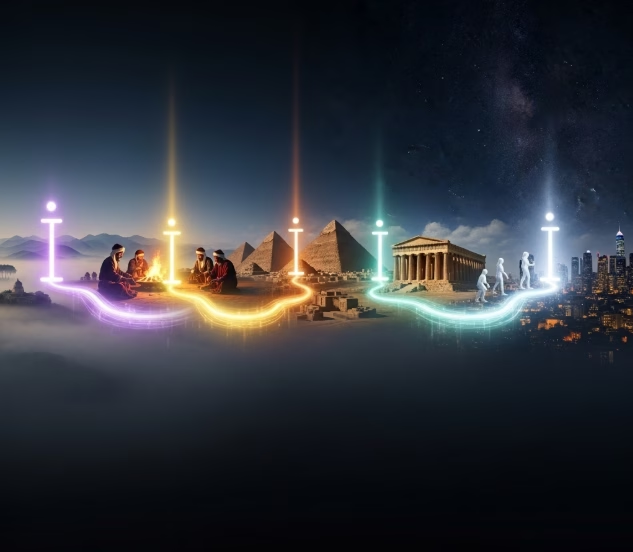
Steiner is very careful to distinguish the Rosicrucian path from all earlier forms of initiation, and his reasons are spiritually significant. The Egyptian mysteries worked through the sacred bloodline and the mystery sanctuaries of a specific people. The Greek mysteries worked through the sacred geography of Eleusis and Delphi. In sharp contrast, the Rosicrucian path works entirely through the freely developing individual human being — independent of birthplace, bloodline, or religious tradition.
In GA 99, “Theosophy of the Rosicrucian,” Steiner describes how this path proceeds in concrete terms. First, the student cultivates systematic thinking — not cold intellectual analysis, but a living, meditative engagement with spiritual ideas. Through consistent practice over months and years, this thinking slowly transforms into a vehicle for higher perception. Moreover, the student develops the moral capacities that Steiner calls the six subsidiary exercises: control of thought, initiative of will, equanimity before joy and sorrow, positivity in meeting the world, openness to new experiences, and finally the harmonious integration of all five. These exercises form the practical backbone of the Rosicrucian path and are as relevant today as when they were first indicated.
Crucially, at no point does the student surrender his or her consciousness. Indeed, everything unfolds in the full daylight of ordinary wakefulness. As a result, the path genuinely serves human freedom rather than eroding it. This is not a coincidence but the central intention of Christian Rosenkreutz from the beginning of his mission.
The Deep Connection to Anthroposophy
Here we arrive at one of the most delicate and profound questions in all of Steiner’s work: what is the true relationship between Christian Rosenkreutz and Anthroposophy itself?
Steiner never claimed to be Christian Rosenkreutz. Nevertheless, he spoke on several occasions of the deep spiritual connection between the Rosicrucian stream and the founding of Anthroposophy. In GA 262 and in various esoteric lessons, he described how the individuality of Christian Rosenkreutz had worked across centuries to prepare the spiritual conditions in which a new science of the spirit could emerge. Anthroposophy is not simply a continuation of Rosicrucianism. However, it could not have come into being without the long preparation carried out by this hidden master.
Furthermore, Steiner speaks of the relationship between the student of Anthroposophy and Christian Rosenkreutz in personal and intimate terms. Genuine study of spiritual science, genuine meditative practice, genuine moral development — these activities create a real connection with this individuality. As a result, the sincere student does not walk alone. Something accompanies every honest effort. And that something, spiritual science reveals, has a name.
The Living Activity of Christian Rosenkreutz in Our Time
Bridging the World of the Living and the Dead
One of Steiner’s most moving revelations concerns what Christian Rosenkreutz accomplished at the threshold of the twentieth century. In GA 130, he describes how this individuality — working primarily from the spiritual world, though capable of physical incarnation — opened entirely new channels of communication between those who have died and those still living on earth.
For centuries, growing materialism had thickened the veil separating the two sides of the threshold. Consequently, the dead could no longer effectively reach the living with their inspirations, and the living could no longer consciously receive what the dead sought to offer. Christian Rosenkreutz worked deliberately to reverse this situation. Through his activity, new pathways between the worlds were opened. Furthermore, Anthroposophy itself is, in part, a direct fruit of this work — a language and a method through which both sides of the threshold can recognise and serve one another.
This insight transforms how one reads Steiner’s many lectures on the life of the soul after death. It also changes how one understands one’s own inner life. The inspirations that arise during genuine spiritual striving are not always solely one’s own. Sometimes they carry the warmth and wisdom of souls who have passed through death and who now work, through the channels that Christian Rosenkreutz has opened, to help those still carrying physical bodies through the challenges of earthly existence.
The New Mysteries Open to All
Christian Rosenkreutz is, in Steiner’s account, the inaugurator of what he calls “the new mysteries.” In sharp contrast to the ancient mysteries — bound to specific places, bloodlines, and priestly transmission — the new mysteries are fully open to all human beings without distinction of race, nationality, religion, or tradition. Any person, anywhere in the world, can approach them. The path is completely free.
Therefore, it demands everything of the individual striving soul. No external authority will carry the student forward. He must carry himself — through his own thinking, through his own moral effort, through his own freely chosen meditative practice. Yet precisely because the path demands so much, it offers something the ancient mysteries could never provide: genuine inner freedom. The soul that develops through the new mysteries does not simply receive spiritual knowledge handed down from above. Instead, it gradually becomes a source of spiritual knowledge in its own right — a being capable of independent spiritual perception.
This transformation — from a soul that receives to a soul that perceives — is the ultimate goal that Christian Rosenkreutz prepares in humanity. It is the goal toward which his mission has pointed from the thirteenth century to the present moment.
The Invisible Guardian of Every Honest Seeker
To contemplate Christian Rosenkreutz is ultimately to contemplate one’s own task as a modern spiritual seeker. The rose-cross stands before us not as a historical curiosity but as a living image of what every human soul is being called to become in this age.
The black cross reminds us of what modern consciousness has necessarily lost — the instinctive clairvoyance of earlier epochs, the immediate sense of the divine in nature, the warmth of group-soul belonging. These losses are real, and Steiner does not minimise them. Nevertheless, they are not tragedies without purpose. They are the necessary precondition for freedom. Furthermore, they are the very soil from which a new, freely chosen and fully conscious spirituality must grow — a spirituality that belongs to no church, no nation, no race, but to every human being simply by virtue of being human.
The red roses speak of what this new spirituality can offer: warmth, life, love — not given from without, but developed entirely from within. The Christ impulse, working through the gradually awakening heart of the modern human being, produces these roses one by one. And Christian Rosenkreutz is, in Steiner’s beautiful image, their gardener.
He does not work loudly or visibly. He makes no public claims and seeks no allegiance. He does not announce himself. Yet spiritual science assures us that his presence accompanies every genuine act of inner striving — in the meditation that slowly bears fruit after months of seeming silence, in the moral effort that quietly transforms a life from the inside outward, in the inexplicable warmth that arises between souls who seek the spirit together with sincerity and humility.
The hidden master remains at his post. The roses are blooming. And for those with sufficient inner stillness to perceive it, the cross and its flowers are already everywhere.