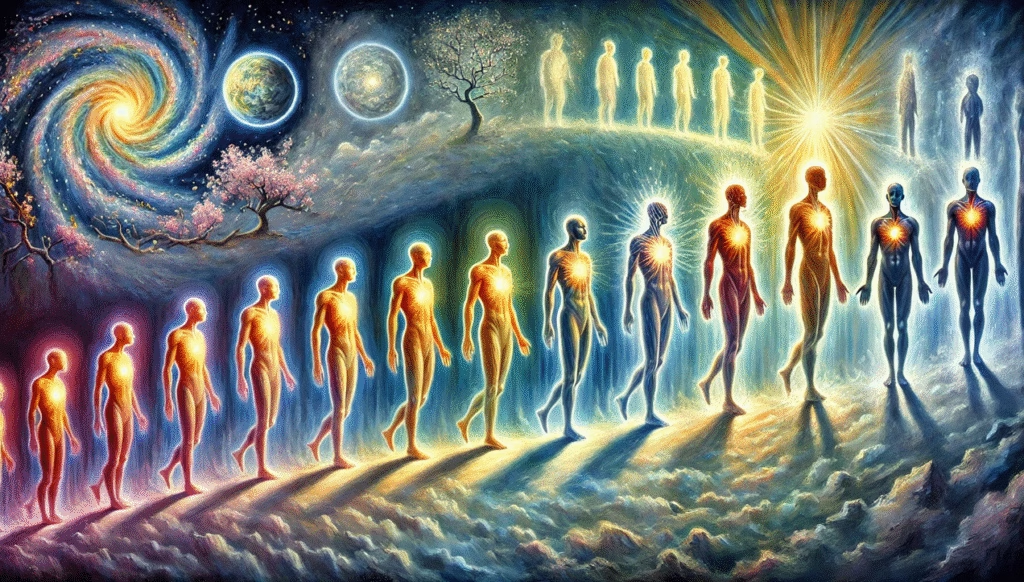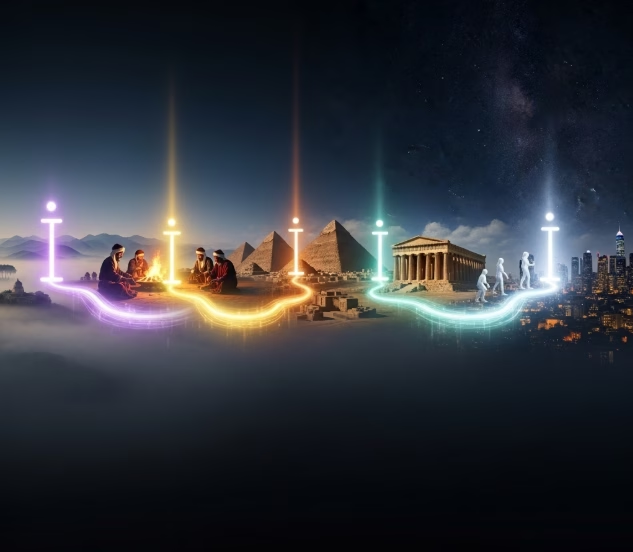
When we look back at the great civilizations of the past, what do we see? From a purely materialistic viewpoint, history is a chronicle of technological progress, economic forces, and political struggles. The ancient Egyptian who built the pyramids and the modern engineer who builds a skyscraper are seen as fundamentally the same, differing only in their tools and knowledge. But is this true? Does the inner world of a person from ancient India, or classical Greece, truly mirror our own? A spiritual-scientific investigation, such as that pioneered by Rudolf Steiner, reveals a far more profound and dramatic truth. It shows that human consciousness itself has undergone a sweeping evolution. This article will explore the evolution of consciousness through the great post-Atlantean cultural epochs.
History, from this perspective, is not just the story of what humanity did, but of how humanity experienced reality. Our way of thinking, feeling, and perceiving the world has fundamentally changed over time. This was not an accidental process, but a guided spiritual development, leading us from a primeval, dream-like union with the divine world to our current state of sharp, intellectual self-awareness. To understand the evolution of consciousness is to understand the meaning of our present age and the unique spiritual task that is set before us. We will journey through the great epochs—from the spiritual nostalgia of ancient India, through the cosmic struggles of Persia, the mythic science of Egypt, the birth of intellect in Greece, and into the challenges and possibilities of our own time—to see this magnificent, unfolding drama of the human spirit.
Before Our Age: The Atlantean Past and a New Beginning
The Dawn of the Post-Atlantean Era
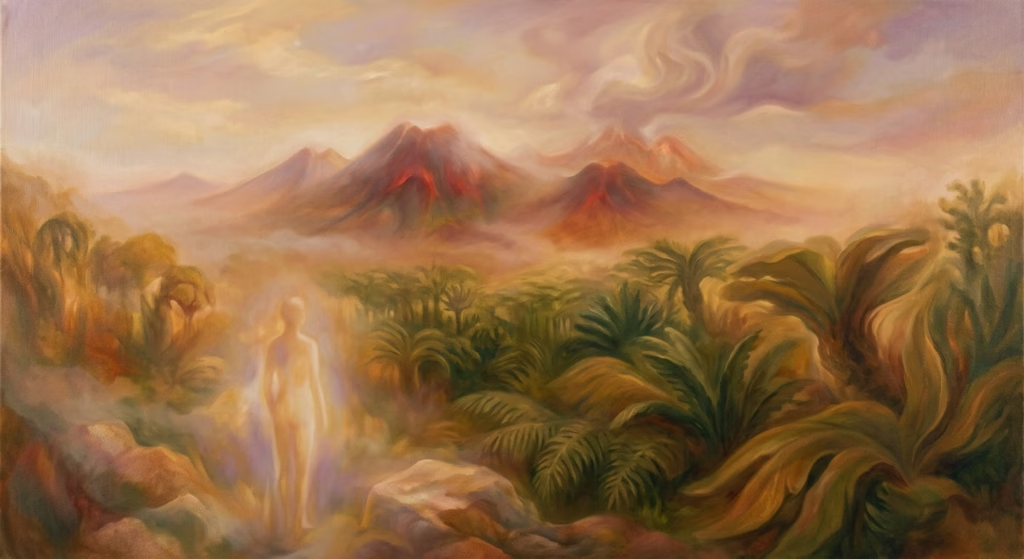
To understand our current great cycle of civilization, we must look briefly at what preceded it. Spiritual science speaks of a great continent, Atlantis, which was home to a humanity whose consciousness was very different from our own. Atlantean humanity did not possess our sharp, intellectual thinking, but they had immense power over the forces of life—the etheric forces—and a powerful, picture-based memory. Their consciousness was more instinctive and dream-like, and they were still in close communion with the divine-spiritual beings who guided them. However, through the misuse of these life-forces, a great catastrophe occurred, and the Atlantean continent was submerged beneath the waves of a great flood, an event dimly remembered in the deluge myths of many cultures.
Before this final catastrophe, a great spiritual leader, known in esoteric tradition as Manu, gathered a small group of the most advanced souls of humanity and led them eastward, to a region in central Asia. This small group carried within them the spiritual seeds for the next great cycle of human evolution: our own post-Atlantean era. From this central point, humanity’s great migrations began, and the first of five great cultural epochs was initiated, with three more to come in the distant future. Each of these epochs had a specific mission: to develop one particular aspect of the human soul and to bring our consciousness one step closer to its goal of self-aware freedom.
The First Post-Atlantean Epoch: Ancient India (c. 7227 BC – 5067 BC)
A Dream of the Spirit
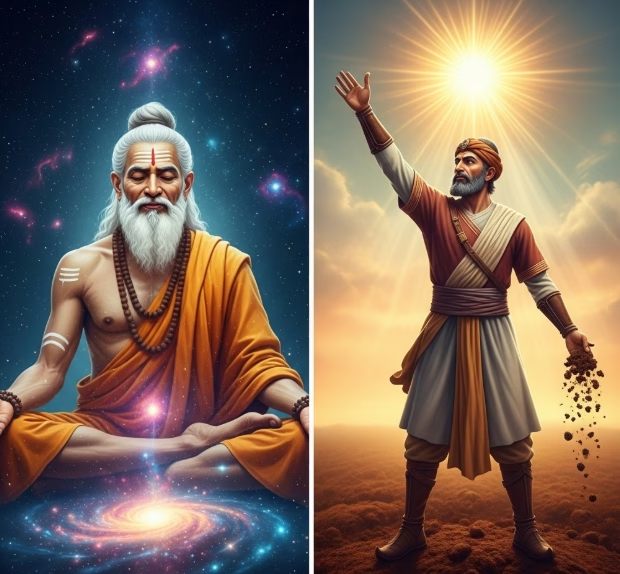
The first great culture to blossom from this seed-group was that of ancient India. The consciousness of this epoch was the closest to the old Atlantean state and the most intensely spiritual of our entire cycle. The ancient Indian did not experience the physical world as we do, as a hard, solid, and primary reality. For them, the world of the senses was a veil, a grand illusion or “Maya.” The true reality was the spiritual world from which they had so recently descended. Their entire consciousness was filled with a profound spiritual nostalgia, a deep yearning for this lost divine home.
The great teachers of this epoch were the seven holy Rishis. These were not ordinary human beings, but highly advanced spiritual individualities who could perceive directly into the spiritual world. They did not need to “prove” the existence of the spirit; they experienced it as a constant, living reality. They taught their pupils that the world of mountains, rivers, and trees was less real than the world of Brahma, the universal spiritual essence that underlies all things. The goal of human life, from their perspective, was to overcome the illusion of the physical world and to find the path back to a blissful union with this spiritual source. The evolution of consciousness began here, with the soul still turned almost completely away from the Earth and towards its spiritual origins. This epoch’s mission was to cultivate a deep memory of our divine home, to plant a seed of spiritual longing in the heart of humanity that would never be entirely forgotten, even in the most materialistic of future ages.
The Second Post-Atlantean Epoch: Ancient Persia (c. 5067 BC – 2907 BC)
The World as a Battlefield of Light and Darkness
In the second great epoch, the consciousness of humanity took a momentous step towards the Earth. Under the guidance of the great teacher Zarathustra, the ancient Persian people no longer saw the physical world as a mere illusion to be escaped. Instead, they began to experience the world as a great battlefield, the arena of a cosmic struggle between two mighty spiritual powers: Ahura Mazdao (later Ormuzd), the great Sun Being of Light and Truth, and Angra Mainyu (later Ahriman), the Spirit of Darkness and Lies.
This represents a profound shift in the evolution of consciousness. For the first time, the human being was called upon not to reject the world, but to actively work upon it. The mission of humanity was to become a co-worker with the forces of light, to till the soil, to domesticate animals, to speak the truth, and in doing so, to help transform the earthly realm and redeem it from the influence of darkness. The physical world was no longer just Maya; it was a field of moral action. Zarathustra directed the gaze of his people to the Sun, not just the physical sun, but the great spiritual Being who lived within it, teaching them that this Sun Spirit would one day descend to the Earth to become its savior. The Persian epoch thus cultivated the human will. It transformed humanity from passive dreamers into active spiritual warriors, taking the first crucial step toward taking responsibility for the earthly world.
The Third Post-Atlantean Epoch: Egypto-Chaldean Civilization (c. 2907 BC – 747 BC)
The Descent into Earthly Science and Soul Life
The third epoch saw humanity descend even more deeply into its relationship with the earthly world. The consciousness of the Egyptian and Chaldean peoples was no longer focused on a cosmic duality, but on the interplay between the heavens and the Earth. This was the birth of earthly science. The Chaldeans looked up to the stars, not with the abstract calculations of a modern astronomer, but with a living, spiritual perception. They experienced the movements of the planets as the gestures of the gods, and they developed astrology as a way of reading the destiny written in the heavens.
The Egyptians, on the other hand, turned their gaze to the earthly sciences of geometry and medicine. They measured the land, developing geometry out of the necessity of re-establishing boundaries after the annual Nile flood. Their knowledge of the human body, developed through the practice of embalming, was profound. But all of this earthly activity was still deeply connected to a spiritual purpose. Geometry was used to build sacred temples aligned with the stars. Medicine was interwoven with religious rites.
This was the epoch in which humanity was tasked with developing what spiritual science calls the “Sentient Soul”—the part of our soul that experiences the world through feelings, sympathies, and antipathies. The rich, pictorial mythology of Egypt, with its stories of Osiris, Isis, and Horus, was a direct expression of this new soul-life. The Egyptians felt the rhythms of the cosmos—life, death, and rebirth—in their own souls. The great Mystery traditions of this age were designed to guide the human soul through a conscious experience of death and resurrection, preparing it for its journey in the after-life. The evolution of consciousness here took a giant leap inward, developing the richness of human emotional and soul experience, while still retaining a living connection to the cosmos.

The Fourth Post-Atlantean Epoch: Greco-Roman Civilization (c. 747 BC – 1413 AD)
The Birth of the Intellect and the Strong Earthly “I”
The fourth epoch represents the central point, the very heart, of our entire cycle of civilization. It is the great turning point of time. This epoch saw the birth of something entirely new in the world: the clear, objective, logical thinking of the intellect. In ancient Greece, the evolution of consciousness took a decisive step away from the pictorial, dream-like perception of the past. Thinkers like Plato and Aristotle began to grasp the world not through myths or divine revelations, but through the power of pure thought. This was the development of the “Intellectual or Mind Soul.” For the first time, the human being began to experience themselves as a thinking individual, separate from the world, who could analyze and understand it through the power of their own mind.
This new faculty of the intellect was a double-edged sword. It allowed for the development of philosophy, democracy, and a new kind of art that celebrated the beauty of the perfected human form. But it also meant that the old, innate clairvoyance, the natural perception of the spiritual world, began to fade. The gods began to fall silent. Humanity was, in a sense, cast out of the spiritual world and had to learn to find its own way on Earth through the power of its own thinking.
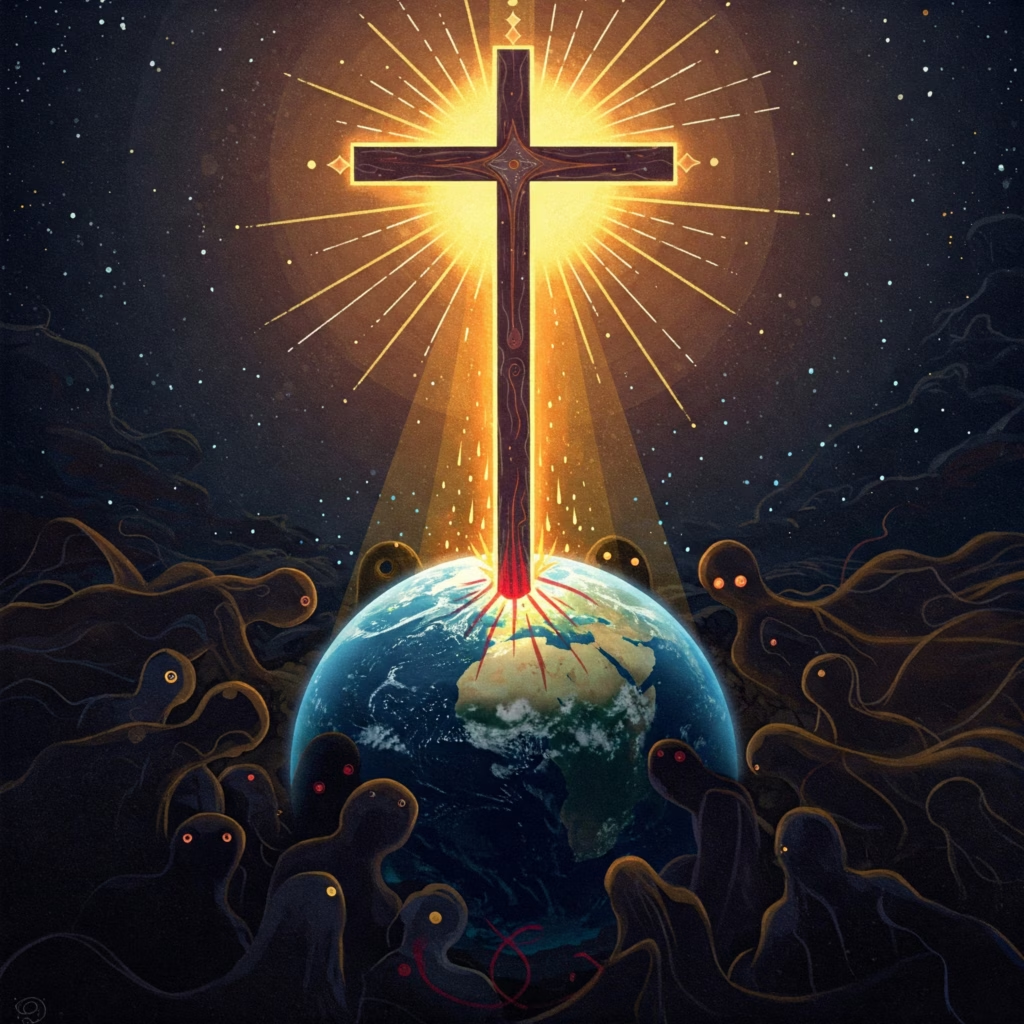
Following the Greek contribution came the Roman. The Romans took the intellect developed by the Greeks and applied it to the practical, earthly world. They developed the concept of law, the structures of the state, and the idea of personal citizenship. The Roman mission was to forge the strong, earthly ego, the personality that could stand firmly on the ground of the physical world. This development of the intellect and the personal ego was the necessary preparation for the central event of all human history, which took place in the midst of this fourth epoch: the Mystery of Golgotha. The Christ Being could only be recognized in His true nature by a humanity that had developed the capacity for individual thought. And His impulse could only be carried forward by individuals who possessed a strong, self-aware “I.”
The Fifth Post-Atlantean Epoch: Our Present Age (c. 1413 AD – 3573 AD)
The Challenge and Opportunity of the Consciousness Soul
We are living in the fifth post-Atlantean epoch. It began around the year 1413 and will last until the middle of the fourth millennium. Its great mission is the development of the “Consciousness Soul” or “Spiritual Soul.” This is the highest and most challenging stage of our development so far. We are tasked in this age with becoming fully self-aware, with developing an “I” that is not just conscious of itself as a personality, but that can, through its own free inner activity, find the way back to a conscious perception of the spiritual world.
The dawn of this epoch was marked by the great voyages of discovery, the invention of the printing press, the rise of modern science, and the Reformation. Humanity turned its gaze with unprecedented intensity towards the physical world. The intellectual power born in Greece was now used to dissect and analyze nature, leading to the immense technological progress of our time. But this has come at a price. We have plunged so deeply into materialism that for many people, the spiritual world has ceased to be a reality at all. This is the great danger of our age.
However, it is also our greatest opportunity. It is only in an age where we are completely free from the old, inherited divine guidance, an age where we are faced with the abyss of a purely material worldview, that we can develop true spiritual freedom. The task of our time is not to return to the dreamy clairvoyance of the past. Our task is to take the clear, scientific thinking we have developed and to spiritualize it. We must learn to think with the same clarity about the soul and the spirit as we do about physics and chemistry. This is precisely the path that spiritual science or anthroposophy seeks to open up. The evolution of consciousness has now brought us to the point where we must, as free individuals, rediscover the spirit through the power of our own conscious, thinking “I.”
Conclusion
The great journey of the evolution of consciousness is a story of a purposeful descent and a future, conscious ascent. From the spiritual reverie of ancient India, humanity was guided step by step into a deeper engagement with the earthly world. The moral will was awakened in Persia. The rich life of the soul was cultivated in Egypt. The clear light of the intellect and the personal ego were forged in Greece and Rome. All of this was a necessary preparation for our current age, an age that challenges us with the deepest darkness of materialism but also offers us the highest prize: the possibility of finding the spirit in full, waking freedom.
To understand this grand panorama is to understand our own lives in a new way. We are not isolated individuals in a random moment of history. We are participants in a magnificent, unfolding spiritual drama. Our souls have journeyed through these past epochs, and the challenges and faculties of our present age live within us. The story of the evolution of consciousness gives our lives meaning and purpose. It shows us that the struggles of our time are not a sign of decay, but the birth pangs of a new, more spiritual form of human consciousness that we ourselves are called upon to build.