On this day, August 6th, the spiritual calendars of both Eastern and Western Christianity direct our hearts and minds toward a singular, mysterious event: the Transfiguration of Christ on Mount Tabor. The Gospel narrative paints a picture of breathtaking majesty. Jesus takes his three most intimate disciples—Peter, James, and John—up a high mountain, where He is suddenly changed before them. His face shines like the sun, his garments become as white as light, and he is seen conversing with the great figures of Moses and Elijah. For many, this story is a testament to Christ’s divinity, a miraculous vision granted to his followers. This article seeks to explore the spiritual meaning of the Transfiguration of Christ from a deeper perspective, drawing upon the insights of spiritual science.
From this viewpoint, the Transfiguration was not simply a vision or a miracle in the ordinary sense. It was a momentary awakening of a higher form of perception in the disciples themselves. It was an event in consciousness. For a brief time, the veil of their physical senses was lifted, and they were permitted to see what was always there, but was normally hidden: the true, cosmic, sun-like nature of the Divine Being who walked with them in the human form of Jesus of Nazareth. We will explore the significance of the chosen disciples, the cosmic conversation with Moses and Elijah, the poignant human misunderstanding of Peter, and how this entire event stands as a profound prophecy of the Resurrection and the future spiritualization of all humanity. The spiritual meaning of the Transfiguration of Christ is a revelation not only of who He was, but of what we are all destined to become.
The Preparation: The Ascent to a Higher State of Consciousness
The Three Disciples and the Holy Mountain
The narrative begins with a deliberate selection. Jesus does not take all twelve apostles; he takes only three: Peter, James, and John. This is not an act of favoritism, but a spiritual necessity. In the ancient mystery schools, such revelations were only given to those who were prepared. These three disciples, in their soul-natures, represented the necessary faculties for witnessing such a supersensible event.
- Peter represents the faculty of faith, devotion, and feeling. He is the rock, the foundation of the outer community, the man of heartfelt, if sometimes impulsive, conviction. He perceives with the heart.
- James, the brother of John, represents the faculty that is deeply connected to tradition and the wisdom of the past. He embodies the heritage of his people, the lineage that has been prepared through generations to receive the Messiah. He perceives with a soul steeped in sacred history.
- John, the “beloved disciple,” represents the faculty of direct spiritual insight, of esoteric wisdom, or Gnosis. He is the one who can perceive the deepest spiritual truths directly, not through outer authority or tradition, but through a purified soul and the power of love. He is the one who can truly “see.”
Together, these three form a complete soul-instrument: the devotion of the heart (Peter), the foundation of sacred tradition (James), and the clarity of spiritual sight (John). It was only through this threefold human lens that the event could be perceived and anchored in the earthly world.
The setting, “a high mountain apart,” is also deeply symbolic. In all spiritual traditions, to ascend a mountain is to undertake an inner journey. It is to leave behind the ordinary, everyday consciousness of the lowlands and to enter a state of greater stillness, clarity, and proximity to the spiritual world. Jesus leads his disciples away from the distractions of the world and into a heightened state of consciousness, preparing their souls for what they are about to perceive.
“His Face Shone Like the Sun”: A Glimpse of the Cosmic Christ
The Revelation of the True Being
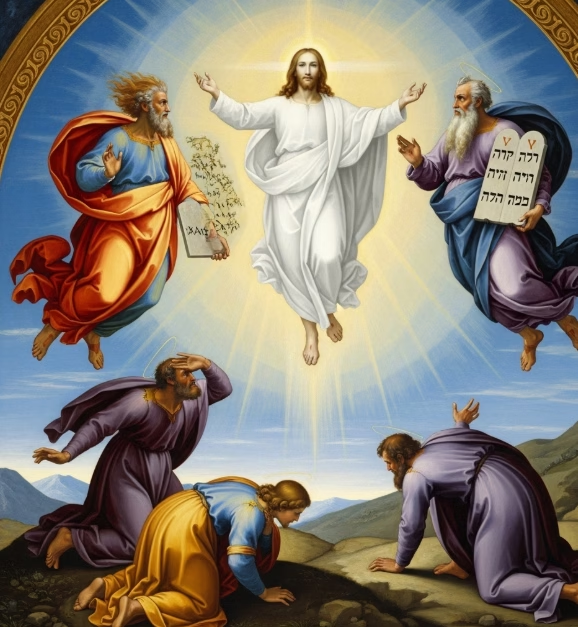
On the mountaintop, the central event occurs: “He was transfigured before them, and his face shone like the sun, and his clothes became dazzling white, as white as light.” What did the disciples truly see? A spiritual-scientific understanding reveals that their spiritual senses were temporarily opened. They were granted a brief perception that pierced through the outer physical sheath of Jesus of Nazareth and beheld the true, supersensible nature of the Being dwelling within.
The Being we call the Christ is the great Sun Spirit, the divine Logos, the creative Word through whom the world was made. For three years, this immense cosmic Being inhabited the specially prepared human bodies of Jesus. What the disciples saw in the Transfiguration was the unveiling of this reality.
- “His face shone like the sun”: This is not a metaphor. The disciples perceived the true spiritual essence of the Christ, whose cosmic home is the Sun and whose nature is of the same substance as spiritual light. They saw His countenance not as a physical face, but as a radiant, creative center of spiritual power.
- “His clothes became dazzling white”: The garments of a human being are a kind of extension of their presence. Spiritually seen, the disciples perceived the glorious, light-filled etheric body of the Christ-Jesus being. A normal human etheric body is interwoven with the consequences of past karmic deeds and personal characteristics. The etheric body of this unique being was utterly pure, a perfect vessel of life-force, and it appeared to their newly opened sight as a garment of pure, dazzling light.
The Transfiguration was, therefore, a momentary shift in the disciples’ perception, allowing them to see the two higher members of the Christ-Jesus being: the glorious, Sun-like nature of His “I” and the perfect purity of His etheric body. They were seeing the truth that this was no ordinary man, but a cosmic being who had clothed Himself in humanity.

Moses and Elijah: The Law and the Prophets Fulfilled
The Convergence of Two Great Streams
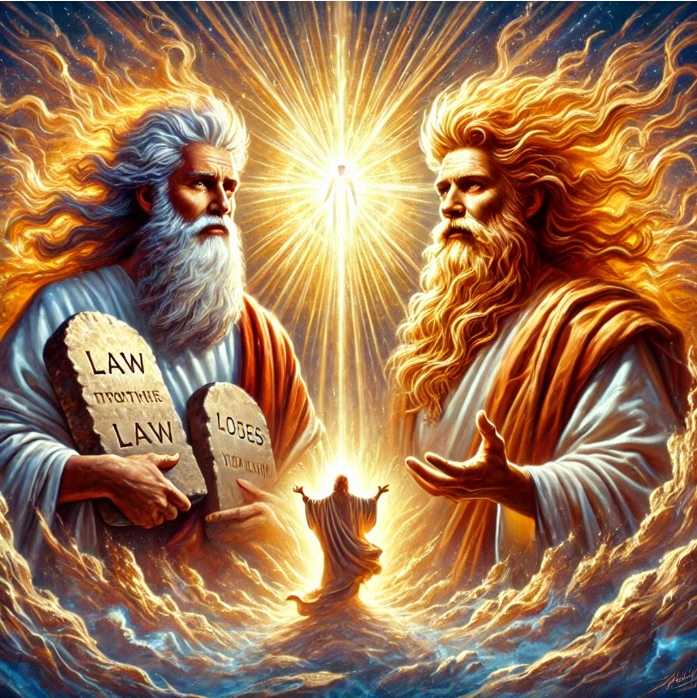
The vision continues with the appearance of two towering figures from Israel’s past, Moses and Elijah, who are seen conversing with Christ. Their presence is of immense spiritual significance. They represent the two great pillars of the entire Old Covenant.
- Moses, the Bearer of the Law: Moses was the great leader who received the Ten Commandments on Mount Sinai. He represents the divine will given to humanity as outer Law, as the Torah. His mission was to shape the social and moral life of his people from the outside in, to create a vessel of community and ethical order that could hold the “I” of the people together. He is the great architect of the outer covenant.
- Elijah, the Spirit of the Prophets: Elijah, as we have explored, represents a different stream. He is the archetypal prophet, the man filled with the direct, fiery inspiration of the spirit. He represents the divine will working from the inside out, as an inner word, a call to conscience, a direct spiritual impulse. He is the great awakener of the individual soul.
That these two figures appear together and speak with Christ reveals a profound truth: the Christ Impulse is the fulfillment and synthesis of both great streams of the Old Testament. He is the fulfillment of the Law, because He brings the power for the human “I” to fulfill the Law not out of outer obligation, but out of inner love. And He is the fulfillment of the Prophets, because He is the very living Word that the prophets could only announce and foresee. The two great paths of the past—outer order and inner inspiration—now converge and find their meaning in the living presence of the Christ. The Gospel of Luke tells us that they were speaking of His “departure” (in Greek, exodos), which he was to accomplish in Jerusalem. The entire spiritual history of the past, represented by Moses and Elijah, was focused on this coming event: the Mystery of Golgotha.
The Voice from the Cloud and Peter’s Misunderstanding
The Shift from Seeing to Listening
Faced with this overwhelming spiritual reality, Peter makes a very human and deeply poignant suggestion: “Lord, it is good for us to be here; if you wish, I will make three booths here, one for you, one for Moses, and one for Elijah.” Peter is so overcome with the glory of the vision that he wants to hold onto it, to preserve it, to build a permanent earthly dwelling place for this spiritual experience. This represents the eternal human tendency to try and institutionalize a living spiritual moment, to turn a dynamic revelation into a fixed, outer religion with its own buildings and structures.
But this experience was not meant to be captured and contained. As Peter is still speaking, a bright cloud overshadows them, and a voice from the highest spiritual realm—the voice of the Father-principle—corrects his understanding. The voice does not say, “Build three booths.” It says, “This is my beloved Son, with whom I am well pleased; listen to him.”
This is the divine command that signals the turning point of the ages. It is a command to shift from beholding the glory of the past (Moses and Elijah) to listening to the living, present Word that speaks through the Son. The age of outer law and preparatory prophecy is over. The new age demands an inner attentiveness, a listening with the soul to the new impulse of love and freedom that Christ brings. The Transfiguration is the moment of the official transfer of authority from the Old Covenant to the New.
The Descent and the Command to Silence: A Foretaste of the Resurrection
A Promise of What Is to Come
As they come down from the mountain, the vision ceases, and the disciples see “no one except Jesus himself alone.” The veil of their physical senses has closed once more. Jesus then gives them a strict command not to tell anyone what they have seen “until the Son of Man has been raised from the dead.”
Why this command to silence? Because the experience was incomprehensible without its ultimate fulfillment. To have told others that they had seen Jesus shining like the sun and talking with long-dead prophets would have been met with utter disbelief or misunderstanding. The disciples themselves could only begin to truly grasp the meaning of what they had witnessed after the even greater revelation of the Resurrection.
The Transfiguration stands as a profound foreshadowing of the Resurrection.
- In the Transfiguration, the disciples are granted a temporary glimpse of the glorious spiritual being within the still-living physical body of Jesus. They see the spirit’s potential to radiate through matter.
- In the Resurrection, the Christ demonstrates this power in its ultimate form. Having passed through death, He appears to them in a spiritualized body (the “Resurrection Body” or Phantom) that has completely overcome the laws of physical decay. The glory that was briefly revealed on the mountaintop has now become a permanent, world-transforming reality.
The Transfiguration was the promise. The Resurrection was the fulfillment. The Transfiguration showed what the Christ Being is. The Resurrection showed what He came to give to all of humanity: the seed of our own future resurrection and the spiritualization of our being.
Conclusion
The spiritual meaning of the Transfiguration of Christ is therefore manifold and immense. It is a revelation of the true, cosmic, Sun-like nature of the Christ Being. It is a demonstration of His role as the fulfillment of the entire spiritual history of the Old Covenant, the point where the Law of Moses and the inspiration of Elijah find their synthesis and purpose. It is a divine confirmation of His unique mission as the Son of the Father. And it is a living prophecy, a foretaste of the glory of the Resurrection and the ultimate destiny of humanity.
For us today, on this Feast of the Transfiguration, the event carries a personal and potent message. It is a picture of our own spiritual potential. The human soul, through inner work, through prayer, meditation, and moral development, can also ascend its own “inner mountain.” It can rise above the consciousness of everyday life and, in moments of grace, experience a transfiguration. In these moments, our own inner darkness can be illuminated by the Christ-light within us, and we can begin to perceive the spiritual world that always surrounds us. The Transfiguration is not just an event that happened once to three disciples. It is an eternal promise that the human being, by uniting with the Christ Impulse, is destined to be transformed, transfigured, from a creature of earth into a citizen of the sunlit heavens.