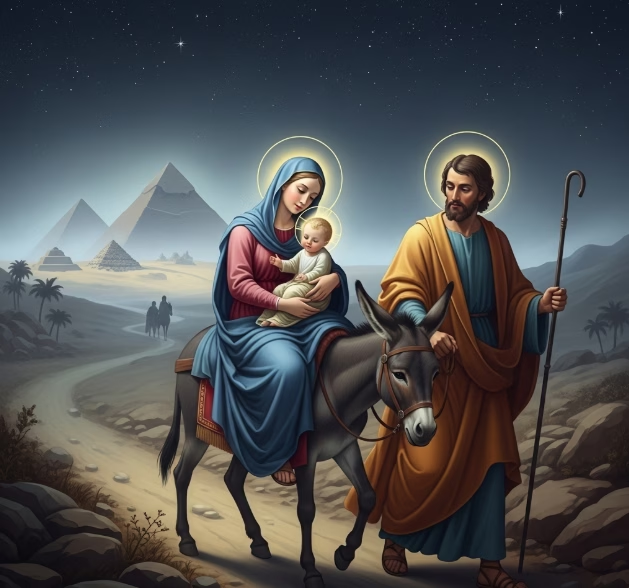
The brief account in the Gospel of Matthew tells a dramatic story: warned in a dream that King Herod seeks to destroy the newborn king, Joseph takes the mother and child and flees into Egypt, remaining there until Herod’s death. Exoterically, it is a story of peril and divine protection. But esoterically, it is a journey into the very memory of the world, a necessary pilgrimage to gather the wisdom of a bygone age. This article delves into the Flight into Egypt spiritual meaning, exploring, from a perspective informed by spiritual science, why this journey was an indispensable chapter in the life of Jesus. It was not an escape from a king, but an embrace of humanity’s past. This journey connects the Gospels to the ancient Egyptian Mysteries, the great sweep of human evolution, and the intricate spiritual preparations for the Mystery of Golgotha itself.
The Two Jesus Children: A Necessary Spiritual Foundation
To begin to grasp the true Flight into Egypt spiritual meaning, one must first approach a concept central to Rudolf Steiner’s Christology: the existence of two Jesus children, as described in the two differing genealogies and nativity stories of the Gospels of Matthew and Luke. This is not a contradiction, but a description of two separate, real streams of human development converging for a cosmic purpose.
- The Solomon Jesus of Matthew’s Gospel: The genealogy in Matthew traces the lineage of Jesus back through the royal line of David, through Solomon. The child described in this Gospel was the bearer of a highly advanced and ancient individuality: the ego of the great Persian spiritual teacher, Zarathustra, reincarnated. This soul brought with it the immense wisdom of the ancient Persian cultural epoch, a wisdom connected to the struggle between light and darkness and the knowledge of the great Sun Being. It was to this child, the bearer of ancient kingly wisdom, that the Magi, his spiritual kin from the East, came to pay homage.
- The Nathan Jesus of Luke’s Gospel: The genealogy in Luke, however, traces the lineage back through Nathan, another son of David, all the way to “Adam, which was the son of God.” This points to a different stream of humanity. The child of the Lukan Gospel was a soul of immense purity and innocence, a being whose inner nature had been held back in the spiritual worlds, preserved from the complexities and burdens of repeated earthly incarnations. His soul was like a pristine vessel, embodying the uncorrupted life forces of primeval humanity, the original “Adamic” nature. It was to this humble, heart-filled child that the simple shepherds, with their innate, dreamy clairvoyance, were drawn.
Spiritual science reveals that it was this second child, the Nathan Jesus of Luke’s Gospel, who was taken by his parents on the profound journey into Egypt. The Zarathustra-soul in the Solomon Jesus did not need this journey; he already contained the wisdom of his stream within his very being. The Nathan child, however, needed to absorb into his pure but “empty” soul-sheaths the spiritual essence of humanity’s past. The Flight into Egypt spiritual meaning is, therefore, specifically the story of the spiritual education of the Nathan Jesus.
Why Egypt? Recapitulating the Consciousness of Humanity
The choice of Egypt as the destination was anything but arbitrary. Spiritual science explains that the development of every individual human being is a microcosm that recapitulates the macrocosmic evolution of humanity as a whole. Just as an embryo passes through stages that echo the evolutionary history of life, the soul of a developing child passes through states of consciousness that mirror the great cultural epochs of the past. For the special being of the Nathan Jesus, this recapitulation had to be a conscious, profound, and world-historical process.
The third great post-Atlantean cultural epoch was the Egypto-Chaldean civilization. This was the epoch that followed the ancient Indian and Persian periods. For the soul-vessel of the Nathan Jesus to become a complete reflection of the human journey, it had to be immersed in the spiritual atmosphere of Egypt. It needed to absorb the essence of that specific stage of human consciousness directly from its source.
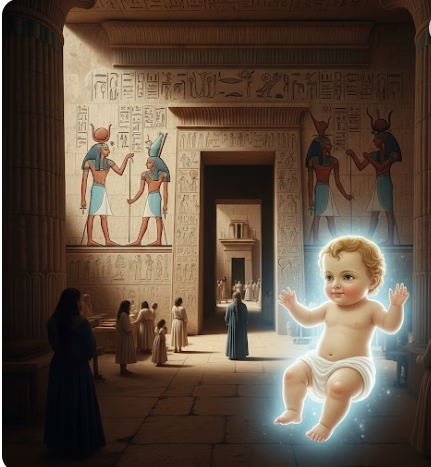
What was the nature of this Egyptian consciousness? It was a consciousness very different from our modern, abstract, intellectual thinking. It was a profoundly imaginative, pictorial, and dream-like consciousness. The ancient Egyptian did not think about the divine in abstract concepts; he perceived it in mighty, living images. The spiritual world was not a matter of belief, but of direct, albeit dream-like, experience. The great myths of Osiris, the suffering, dying, and resurrected god; of Isis, the sorrowing widow and goddess of divine wisdom; and of their son Horus, the avenger and rightful heir, were not mere allegories. They were the forms through which the Egyptians experienced the spiritual realities of the cosmos, the rhythms of life and death, and the journey of the human soul. It was a consciousness deeply connected to the etheric world, the world of life forces that lies just behind the veil of the physical senses.
The Nathan Jesus child, with his uniquely pure and receptive etheric body, was brought into this land so that this spiritual atmosphere could “imprint” itself upon him. He absorbed, not intellectually but through direct spiritual osmosis, the culmination of Egypt’s ancient wisdom. This was an essential part of his education, preparing his soul-vehicle for the immense task that lay ahead. The Flight into Egypt spiritual meaning, therefore, is that of a targeted spiritual imprinting, a deep soul-education in the picture-consciousness of a vital past age of humanity.

The Gathering of Ancient Wisdom: Preparing the Human Vessel
The wisdom of the Egyptian Mysteries was itself a great gathering point. It contained echoes of even older, Lemurian and Atlantean knowledge, and it was the source from which later Greek wisdom would draw inspiration. By taking the Nathan Jesus to Egypt, his spiritual guides were allowing his soul to integrate the entire sum of pre-Christian human striving and wisdom into its very constitution. It was a process of gathering the spiritual nectar of the past into a single, perfect vessel.
This was not a process of a child learning lessons in a school. It was a supersensible communion. The great spiritual beings who had guided the Egyptian people, who had inspired the building of the pyramids and the rites in the temples, could now work directly upon the soul of this uniquely prepared child. The figure of Hermes Trismegistus, the “Thrice-Greatest,” the legendary founder of Egyptian wisdom, represents the spiritual intelligence that was active in that culture. The Nathan Jesus was, in a sense, brought into the “Mystery School of Hermes” on a spiritual level, to receive a direct initiation into the secrets of the cosmos as they had been understood by the third cultural epoch.
This stands in fascinating contrast to the Solomon Jesus child. As the reincarnation of Zarathustra, he already carried the wisdom of the Persian epoch within his “I.” He did not need to absorb it from the outside. The Nathan child, with his fresh soul, needed to receive this wisdom from the spiritual environment. Thus, the Flight into Egypt spiritual meaning is about perfecting a receptacle, imbuing the human sheaths—the physical, etheric, and astral bodies—with the totality of past human experience, making them a true microcosm of humanity’s journey. This made his soul-body a vessel capable of later holding both the ancient wisdom of the Zarathustra-ego and, ultimately, the universal being of the Christ.
The Return and the Union: A New Stage of Development
After a number of years, when the spiritual imprinting was complete, the family of the Nathan Jesus returned from Egypt. This return brought this stream of development back into proximity with the other stream, that of the Solomon Jesus child in Nazareth. The culmination of this preparatory phase is described in the famous story from Luke’s Gospel, where the twelve-year-old Jesus is found in the temple, astonishing the doctors with his wisdom.
Spiritual science reveals that at this moment in the temple, a momentous spiritual event took place. The highly developed and wise “I” of Zarathustra, which had been incarnated in the Solomon Jesus child, passed over into the body of the Nathan Jesus child. The physical body of the Solomon child, its mission now complete, subsequently faded, and his mother also died soon after. The now perfectly prepared soul-vessel of the Nathan Jesus—a vessel imbued with the primal purity of Adam and enriched by the deep picture-wisdom of Egypt—received the mature, world-historical ego of Zarathustra.
From the age of twelve onward, we are no longer dealing with the simple Nathan soul, but with a unique, composite being. This being possessed the most perfect, uncorrupted human life-sheaths, now filled with the profoundest wisdom of the ancient world. This was the being who lived from the age of twelve to thirty. He was the human individual so uniquely prepared that he could, at the Baptism by John in the Jordan, offer up his threefold human nature as a vehicle for the cosmic Christ Spirit to enter earthly evolution for the first and only time.
Conclusion: The Fulfillment of the Past, The Seed of the Future
Viewed through this lens, the Flight into Egypt spiritual meaning becomes clear and profound. It was not a historical accident or a simple escape. It was a deliberately guided and essential stage in the most important spiritual process in human history. It was the “higher education” of the soul-vessel of the Nathan Jesus, a deep immersion that allowed him to recapitulate and absorb the wisdom of the foundational Egypto-Chaldean epoch.
This understanding reveals the incredible economy and wisdom of spiritual guidance in world history. The Christ event did not simply erase or negate the past. It gathered up all the great streams of pre-Christian wisdom—the Persian stream embodied in the Zarathustra-ego and the Egyptian stream absorbed by the Nathan-vessel—and brought them to a point of synthesis and fulfillment. In the being of Jesus of Nazareth, the past found its culmination. In the being of the Christ who entered him, the future of humanity found its seed. The journey into Egypt was the sacred act of gathering the treasures of the old world to build the foundation for the new, a foundation strong enough to bear the weight and radiance of a God.