The figure of Yahweh, the God of the Old Testament, presents a powerful and often paradoxical image to the modern soul. In one passage, He is a loving creator, a protector of His people. In another, He appears as a wrathful, jealous God, demanding strict obedience to an exacting law. This seeming contradiction has led many, both in ancient Gnostic schools and in contemporary spiritual discussions, to view Him critically—as a lesser, perhaps even harsh or flawed, creator-god. But is this view complete? To truly understand this mighty being, one must move beyond simple human judgments and look at his role from a cosmic, evolutionary perspective. Instead of asking if Yahweh is “good” or “bad,” a more fruitful question, approached through the lens of spiritual science, is: What was Yahweh’s specific mission for humanity, what were the necessary limitations of that mission, and how was it destined to be fulfilled and transformed by a greater impulse?
This article delves into the perspective of Rudolf Steiner on Yahweh. This view does not see him as a malevolent demiurge, but as a sublime spiritual being with a crucial, yet preparatory, mission. This mission is profoundly connected to the spiritual forces of the Moon, the establishment of heredity and law, and the forging of a proper vessel for the human ego. Understanding this cosmic context allows us to see why his influence was both absolutely necessary for a certain period of human history and why it had to be superseded by the universal impulse of Christ for humanity to progress toward its true goal of freedom and love. The full picture of Rudolf Steiner on Yahweh is one of immense cosmic drama, wisdom, and evolutionary necessity.
Moving Beyond Dualism: Yahweh in the Spiritual Hierarchies
A fundamental step in understanding Yahweh from a spiritual-scientific standpoint is to place him correctly within the cosmic order. In the view articulated by Rudolf Steiner, Yahweh is not the ultimate, unknowable Godhead, the source of all being. Rather, he is a member of the hierarchy of the Spirits of Form, known in Christian esotericism as the Elohim (or Exousiai in the Greek). These are the great spiritual beings whose task it was, during the evolutionary stage of Old Sun, to pour their own substance of form into the cosmos. During the subsequent phase of Earth’s evolution, it was their mission to shape and form our planet and the beings upon it. The book of Genesis speaks of creation with the plural word, “Elohim,” saying, “Let us make man in our image, after our likeness.” This points to a group of creative beings.
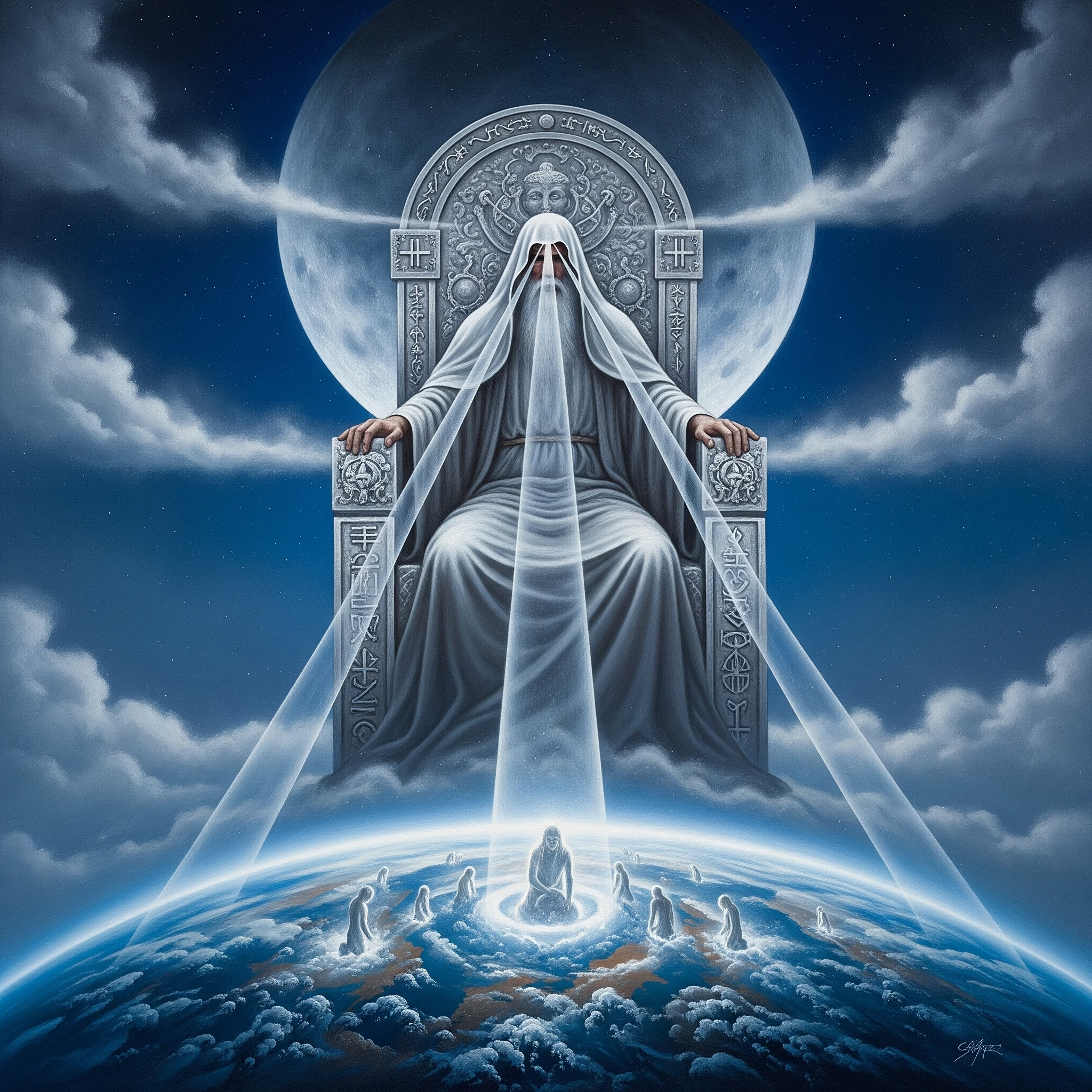
Within this rank of the seven Elohim, a unique event occurred. Six of these Spirits of Form directed their forces towards the Earth from the Sun. The Sun, in spiritual science, is the source of the direct, life-giving, universal spiritual light and love. One of these seven Elohim, however, took a different path. During the cosmic event that separated the Moon from the Earth in a very ancient past, this being, Yahweh, chose to establish his sphere of influence on the Moon. He became the great regent of the Moon sphere.
This is a point of immense significance. It immediately refutes any simplistic “good vs. bad” dualism. Yahweh is not a demon; he is a divine Spirit of Form, a creator-god. However, his perspective and influence became different from those of his Sun-dwelling brethren. He became a specialist, a master of specific forces necessary for humanity, but forces that were, by their very nature, limited and preparatory. To understand the perspective of Rudolf Steiner on Yahweh, one must begin by seeing him not as an isolated God, but as a member of a divine council who undertook a very specific, solitary, and necessary task from the lunar sphere.

The Moon Sphere and Yahweh’s Mission: The Gift of Form and Heredity
What, then, are the forces of the Moon? In ancient wisdom, the Moon was always associated with reflected light, with generation and birth, with form, and with the past. The Moon does not have its own light; it reflects the light of the Sun. This provides a perfect picture of Yahweh’s initial cosmic role. Before the Sun Spirit, the Christ, could incarnate on Earth directly, His spiritual light needed to be reflected to humanity. Yahweh, from his lunar sphere, was the great reflector. He was the “face” of the divine that a still-immature humanity could bear to look upon. He mediated the cosmic wisdom of the Sun in a form that humanity could receive in that epoch.
Furthermore, the Moon governs the forces of physical generation and heredity. Just as the Moon’s phases influence the tides and the reproductive cycles in nature, its spiritual forces govern the way life passes down through the generations. Yahweh’s great mission was to work with these forces. His primary gift to humanity was the stabilization of the human physical form. He worked through the blood, establishing the principle of heredity and the succession of generations. The constant refrain, “I am the God of thy fathers, the God of Abraham, the God of Isaac, and the God of Jacob,” is a direct expression of this mission. He was the God who worked through the bloodlines, through the tribe and the nation, to prepare a suitable physical vessel.
This work was absolutely essential. In earlier epochs of evolution, the human form was much more fluid and spiritual. It was in danger of dissolving into the spiritual atmosphere, of being drawn away from the Earth by what spiritual science calls Luciferic influences—forces that tempt the soul towards a dreamy, ungrounded spirituality, a premature escape from earthly tasks. Yahweh’s Moon-force was the great counter-impulse. He gave humanity weight. He hardened the physical body, solidified the skeleton, and anchored the human being firmly to the laws of physical existence through heredity. Without this anchoring work of Yahweh, the human “I” would never have had a stable enough instrument to incarnate properly and undergo its necessary evolution on Earth. The perception of Rudolf Steiner on Yahweh is thus one of profound gratitude for this foundational, form-giving work.
The Law and the Nation: Forging a Vessel for the Developing “I”
Connected directly to his work with form and heredity was Yahweh’s mission as the great giver of the Law. The Ten Commandments, and the intricate legal code of the Old Testament, can be understood as an “outer skeleton” for the still-developing human soul. At that time in history, the human “I” was still in its infancy. It was not yet capable of generating its own moral guidance from within. It was largely driven by the passions and instincts of the astral body. Therefore, morality had to be given from the outside, as a divine command: “Thou shalt” and “Thou shalt not.”
This divine Law, given with such authority and power from Mount Sinai, acted as a spiritual disciplining force. It provided a rigid framework that contained the chaotic soul forces of humanity, allowing for the development of a stable social order and a coherent culture. This external scaffolding was necessary for the “I” to grow within a protected space.
To accomplish this preparation in the most focused way, Yahweh concentrated his influence upon a particular people, the ancient Hebrew people. This was not an act of arbitrary favoritism, as it might appear to modern consciousness. It was a spiritual-evolutionary necessity. By working intensely through a specific, carefully guided bloodline, Yahweh could cultivate a physical and soul-heredity that was uniquely receptive to his impulses. The endogamy (marriage within the group) so strictly prescribed was a means of keeping this bloodline pure from other influences, preserving it as a vessel. The ultimate goal of this intense, focused preparation was to create a human body so perfectly and purely formed through generations of guidance that it could serve as the vehicle for the incarnation of the Christ Being. As described by Rudolf Steiner, this culminated in the Nathan Jesus child described in the Gospel of St. Luke, whose being provided the perfected physical-etheric vessel for the Christ at the Baptism in the Jordan. The seeming harshness and exclusivity of Yahweh’s law and guidance find their justification in this cosmic goal: the forging of a perfect physical chalice for a universal divine being.
The Limitation of the Moon Force: Why Yahweh’s Influence Had to be Surpassed
Here we arrive at the core of why Yahweh is often perceived as a severe or “bad” figure. His mission, while necessary, was by its very nature limited and one-sided. The very forces he bestowed upon humanity would become a hindrance, a prison, if they were not transcended and transformed by a new spiritual impulse. If humanity were to remain solely under the influence of the Moon-being Yahweh, the consequences would be dire for our future evolution.
-
Bondage to Blood and Race: The Yahweh-impulse binds the human spirit to heredity, blood, and nation. It emphasizes what separates one group from another. While this was necessary to create a specific vessel, the ultimate goal of Earth evolution is to overcome these divisions. Humanity is meant to develop a universal consciousness, a sense of brotherhood where spiritual kinship, not blood kinship, is what matters. To cling to the Yahweh-impulse in an un-renewed form leads directly to nationalism, racism, and the conflicts that arise from them. It is an out-of-date impulse that holds humanity back from its universal future.
-
External Law Instead of Inner Freedom: The Yahweh-impulse governs through external law. It tells the human being what to do from the outside. The Christ Impulse, in contrast, seeks to awaken morality from within the “I” as an act of free insight and love. The Sermon on the Mount replaces the external “Thou shalt not” with an internal transformation of the soul. To remain solely under the old covenant of law prevents the development of true moral freedom, which is humanity’s highest calling. It keeps humanity in a state of spiritual childhood.
-
Reflected Light, Not Direct Sunlight: As the regent of the Moon, Yahweh offers reflected spiritual light. He is a mediator, a reflection of the Sun-God. To remain with Yahweh alone is to be satisfied with a reflection when the source itself is now accessible. It is to mistake the Moon for the Sun. After the Christ Being incarnated on Earth, the direct path to the Sun Spirit was opened. To reject this new, direct path in favor of the old, mediated one is to turn away from the fullness of spiritual truth.
-
A Hardening, Materializing Force: The lunar forces that were necessary to give humanity a solid physical form have a downside. If they are not constantly counteracted by spiritualizing forces, they lead to an excessive hardening and materialism. They bind consciousness ever more tightly to the physical brain and the sense-world. The Ahrimanic powers, those spirits of darkness and materialism, find a perfect entry-point through an over-emphasis on the Yahweh-impulse. They can use this tendency to convince humanity that only the physically inherited, material world is real, thus cutting the soul off from its spiritual origins entirely.
This nuanced critique is at the heart of the perspective of Rudolf Steiner on Yahweh. The “bad” aspects are not inherent in Yahweh himself, but are the consequences of his necessary, form-giving impulses continuing to work in an epoch where they are no longer appropriate, where they must be balanced and spiritualized by a higher principle.
Christ and Yahweh: Fulfillment and Transformation
It is a profound mistake, therefore, to see Christ and Yahweh as enemies. The relationship is one of fulfillment and transformation. The purpose of the Moon is to light the night until the Sun itself rises. Once the Sun is in the sky, the Moon’s light, though still present, is no longer the primary source of illumination. Yahweh prepared the way for Christ. His work created the stage upon which the Christ could act.
The Christ Being is the universal Sun Spirit, belonging to all humanity. When He spoke the words, “Before Abraham was, I AM,” He was declaring His identity as this eternal, universal Being, distinct from the God of Abraham, Isaac, and Jacob who guided a specific lineage. At the Baptism in the Jordan, the Sun Spirit united with the human vessel so perfectly prepared by the forces of Yahweh. At the Mystery of Golgotha, this Sun Spirit poured His own being into the spiritual life of the Earth.
This event inaugurated a new covenant. The old covenant of blood, passed down through heredity, was fulfilled and replaced by a new covenant of spirit, accessible to every individual “I” regardless of race or nation. The external law written on stone tablets was fulfilled and replaced by the impulse of love, which could be written into every human heart. Yahweh’s mission was accomplished. Now, humanity was given the possibility to move from the reflected light of the Moon to the direct, life-giving light of the Sun, the Risen Christ.
Conclusion: A Great Preparatory Being
In the final analysis, the spiritual-scientific view of Rudolf Steiner on Yahweh is one of deep reverence for a great, preparatory creator-being. Yahweh is not “bad.” He is the sublime Moon-regent who undertook the difficult mission of grounding humanity in the physical world. He gave us our enduring physical form through the forces of heredity. He gave us the discipline of the Law when we were still children in our evolution. He prepared the very body that could one day house the universal Spirit of the Sun.
The perception of him as harsh, exclusive, or limiting arises when his impulses—which are by nature tied to blood, race, and external law—are carried into a modern age that cries out for their opposite: universal brotherhood, inner freedom, and a morality born of love. These are the gifts of the Christ Impulse. The mature spiritual path for modern humanity involves consciously recognizing the great gift we received from Yahweh, the gift of a stable “I” in a physical body. But it then requires us to consciously grow beyond the preparatory stage he presided over. We must step out of the reflected light of the Moon and into the direct sunlight of the Christ, who lives as the spirit of freedom and love in every seeking human soul.