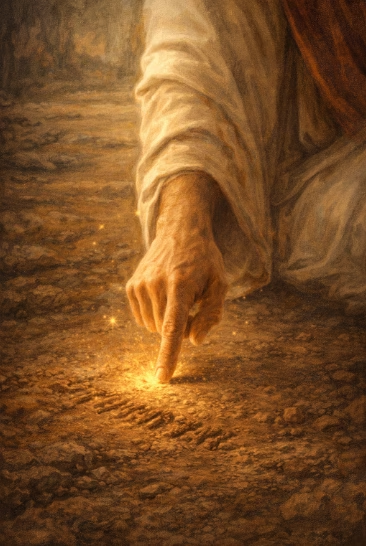
Among the most mysterious and inwardly powerful scenes in the Gospels is the moment when Christ bends down and writes with His finger on the earth while a woman accused of adultery stands before Him, condemned by the law and surrounded by men ready to stone her. The Gospel narrative is striking not only for what Christ says, but for what He does not say. Faced with a direct challenge—whether He will uphold Mosaic law or contradict it—Christ responds first with silence, with a gesture that seems almost unrelated to the drama unfolding around Him. He writes on the ground.
For centuries, theologians have speculated about what Christ wrote. Yet Rudolf Steiner redirected attention away from the content of the writing and toward its spiritual meaning. According to spiritual science, this gesture is not incidental. It is a decisive cosmic act that reveals the nature of Christ’s mission on Earth, the transformation of karma, and the shift from external law to inner conscience. To understand why Christ wrote on the earth is to understand how divine judgment descended from the heavens into human freedom.
The Context of the Law and the Threat of Stoning
The scene unfolds within the strict framework of Mosaic law. According to that law, adultery was a capital offense. The law functioned as an external moral order imposed upon the people from above. Its authority did not arise from individual conscience but from divine command received through Moses. In earlier stages of human evolution, such external guidance was necessary. Humanity had not yet developed a fully independent moral center.
Steiner explained that the Old Testament law was given at a time when the human “I” was still developing. The law functioned as a scaffold for moral life. It restrained instinctual impulses and preserved social order, but it did so by imposing judgment from without. The scribes and Pharisees, standing around the accused woman, represent this stage of consciousness. They are not personally cruel; they are executors of a cosmic necessity that has now reached its limit.
By bringing the woman to Christ, they intend to trap Him. If He condones the stoning, He contradicts His message of mercy. If He rejects it, He undermines the law. What they do not realize is that they are confronting a being who stands beyond the law because He has come to transform its very foundation.

Christ’s Silence and the Descent into the Earth
Christ does not answer immediately. Instead, He bends down and writes on the earth. Steiner emphasized that this movement downward is essential. Christ does not remain standing as a judge. He does not pronounce verdict from above. He turns toward the Earth itself.
In spiritual science, the Earth is not merely physical matter. Since the Mystery of Golgotha, it has become the bearer of Christ’s own being. Even before Golgotha, Christ’s descent into earthly existence signaled a turning point in cosmic evolution. The gesture of writing on the ground indicates that judgment is no longer issued from the heights of heaven but must now be inscribed into the earthly realm and into human individuality.
Christ’s writing on the earth symbolizes the grounding of moral judgment in human freedom. What was once written on tablets of stone by divine command is now written into the substance of human life. The law is no longer external; it is becoming internal.
The Earth as the Bearer of Karma
Steiner taught that karma is not an abstract moral bookkeeping system. It is a living reality woven into the fabric of Earth existence. Human deeds do not vanish; they imprint themselves into the etheric and astral forces of the world. The Earth itself becomes a karmic archive.
When Christ writes on the ground, He addresses this deeper reality. He does not condemn or absolve through words. He brings the karmic forces involved into balance by touching the very medium in which karma unfolds. This is why the Gospel does not preserve what He wrote. The act itself is the meaning.
By writing on the earth, Christ acknowledges that the woman’s deed belongs to a karmic process that cannot be resolved through immediate punishment. Karma unfolds across time, across lives, and across inner transformation. The stoning would have cut this process short. Christ’s gesture protects the future possibility of redemption.
“Let Him Who Is Without Sin Cast the First Stone”
When Christ finally speaks, His words do not contradict the law directly. Instead, they turn it inward. “Let him who is without sin cast the first stone.” With this sentence, Christ does something unprecedented in human history. He awakens conscience.
Steiner emphasized that conscience is not merely a social or psychological phenomenon. It is a newly emerging spiritual organ of perception. Through Christ, humanity receives the capacity to judge itself from within rather than being judged exclusively from without.
The accusers are suddenly confronted with their own karma. The law they wish to apply externally now mirrors itself inwardly. Each individual must ask not whether the law is correct, but whether he himself stands in moral purity. This is unbearable for the old consciousness. One by one, they leave.
The Withdrawal of External Judgment
The departure of the accusers is not a moral victory but a spiritual necessity. External judgment can no longer function in the same way once conscience awakens. Steiner described this moment as one of the great turning points in Earth evolution. Humanity is no longer governed primarily by collective law but begins the painful path toward individual moral responsibility.
Christ does not say that the woman’s act was good. He does not relativize morality. What He removes is the right of collective violence to enforce morality without inner understanding. The stone is a symbol of dead judgment. Christ dissolves its authority.
This moment anticipates the entire future of Christian civilization, in which moral law must be inwardly realized or it becomes destructive.
Christ and the Transformation of Karma
After the accusers leave, Christ addresses the woman directly. “Neither do I condemn you. Go, and sin no more.” This sentence reveals the deepest dimension of the event. Christ does not erase karma. He transforms it.
Steiner explained that Christ does not remove the consequences of human actions but gives the strength to bear and transform them. The woman is not absolved in the sense of being freed from responsibility. She is given a future. Her karma is redirected rather than terminated.
This is a fundamental difference between pre-Christian and post-Christian morality. Before Christ, karma unfolded through external consequences. After Christ, karma can be consciously transformed through inner change.
Writing on the Earth and the Incarnation of the Word
The Gospel of John begins by stating that the Word became flesh and dwelt among us. The act of writing on the earth is a continuation of this incarnation. The divine Logos, once spoken from the heavens, now touches the soil.
Steiner emphasized that Christ’s mission was to unite spirit and matter without destroying either. Writing on the earth is an act of cosmic humility. The highest spiritual being bends down to inscribe meaning into the lowest realm. This gesture sanctifies the Earth itself.
From this point onward, moral truth is no longer merely spoken; it must be lived, borne, and written into existence through human action.
The Feminine Soul and the Possibility of Redemption
Steiner often pointed out that the feminine soul principle is especially connected with the future of humanity. The woman in this story is not an individual case but a representative figure. She embodies the human soul caught between instinctual forces and moral awakening.
Her rescue from stoning is not favoritism but a recognition that humanity itself stands in this position. Humanity has “betrayed” its higher calling, yet it is not to be destroyed but redeemed.
Christ’s interaction with the woman shows that redemption begins with recognition, not annihilation. He restores her dignity by addressing her directly, not as an object of judgment but as a responsible being capable of change.
The Earthly Writing and the New Covenant
In the Old Covenant, the law was written on stone tablets. In the New Covenant, it is written on human hearts. Christ’s act on the earth stands exactly between these two realities. He does not write on stone, and He does not yet write on hearts. He writes on the ground, on the living Earth that mediates between spirit and human existence.
Steiner saw this as a prophetic act. Humanity is being prepared to receive moral truth inwardly, but this capacity must be cultivated gradually. The Earth becomes the transitional medium through which the divine will enters human freedom.
Conclusion
Christ wrote on the earth because judgment could no longer come from above. He wrote on the earth because karma had to be transformed rather than executed. He wrote on the earth because the law had to descend into human conscience. And He wrote on the earth because the Earth itself was becoming the bearer of redemption.
This silent gesture contains the essence of Christianity. It marks the moment when external authority yields to inner responsibility, when punishment yields to transformation, and when divine truth enters the realm of human freedom.
The woman is not saved by indulgence but by being given a future. The accusers are not condemned but awakened. And humanity receives, through this act, the burden and dignity of moral selfhood.
Christ does not abolish the law. He fulfills it by making it human.