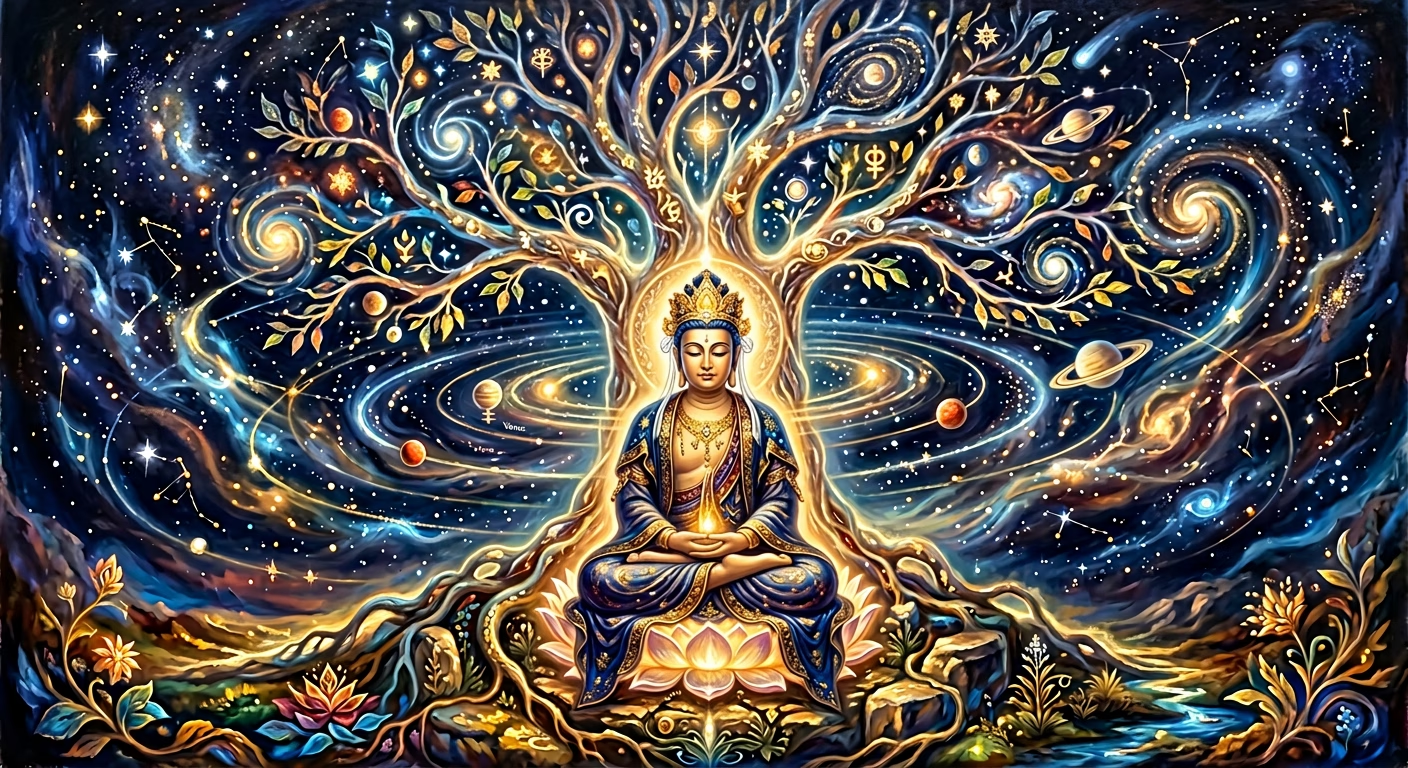
Among all the great spiritual figures of human history, few are as universally loved as Gautama Buddha. His image — serene, luminous, inwardly still — speaks across all cultural boundaries. Many sincere seekers today sense that the Buddha and the Christ point to the same truth. They feel the two paths lead to the same summit.
This feeling is understandable. But spiritual science gently shows us that it is incomplete. Not because one teacher is greater than the other. Rather, each fulfilled a specific, irreplaceable cosmic mission. Their relationship is not one of sameness. It is something far more beautiful — a deliberate cosmic partnership, prepared across vast stretches of time, for the sake of humanity’s future.
Rudolf Steiner explored this relationship in depth in his lecture cycle “The Gospel of Luke” (GA 114, 1909) and in “Spiritual Guidance of the Individual and Humanity” (GA 15, 1911). What he reveals there changes everything we thought we knew about both figures.
The Bodhisattva: A Being Who Chose to Return
The Great Compassionate Vow
Spiritual science reveals that Gautama Buddha did not simply appear in a northern Indian palace in the sixth century before Christ. Long before that birth, he was a Bodhisattva — one of the great spiritual beings who had made a solemn vow to accompany human evolution. He incarnated again and again, across immeasurable stretches of time, working toward a single mighty mission.
Bodhisattvas are not ordinary souls working through personal karma. Their repeated incarnations are free, conscious acts of cosmic service. They live simultaneously in the physical world and in the higher spiritual community that guides human evolution from above.
Each lifetime of the future Buddha was a step in ripening this mission. Each incarnation refined the vessel. Then, in the historical figure of the Shakya prince, the long preparation reached its culmination. The vessel was ready. The time had arrived.
The Night of Enlightenment
When a Cosmic Task Was Completed
The story of the prince who renounced his kingdom to seek the root of human suffering is among the most moving in all of spiritual history. Spiritual science does not read it merely as one man’s biography. It reads it as the outer expression of a vast inner, cosmic event.
When Gautama sat beneath the Bodhi tree and rose as the Awakened One, the great Bodhisattva completed his earthly mission. He achieved Buddhahood. This means he burned through the last bonds tying him to the cycle of earthly rebirth. His task in the physical world was finished.
But before this moment of liberation arrived, something dramatic happened. A great adversarial power stood in his way.

The Battle with Mara: Meeting the Adversary
The Threshold Every Initiate Must Cross
Ancient Buddhist texts describe how, during that decisive night, the demon Mara attacked Gautama with three weapons: desire, fear, and the illusion of a permanent separate self. His armies assaulted the meditating prince from every side. Only after this battle was won did the dawn of full enlightenment break.
From a spiritual-scientific perspective, this is no mere legend. Mara represents real adversarial forces — forces that Steiner connects with the Luciferic stream. Their goal was to seize this threshold moment and prevent the liberation of a great cosmic being.
The parallel with the Christ is exact and deliberate. Before Christ began his public mission, he endured three temptations in the wilderness. Both the Buddha and the Christ faced the adversary at the very threshold of their world-historical work. Both victories opened something new for all of humanity.
The Teaching Born from the Battle
In the Buddha’s case, his victory over Mara directly shaped his teaching. Mara’s three weapons — desire, fear, and false selfhood — are precisely what the Four Noble Truths address. The inner battle and the later teaching are one single deed. The cosmic experience came first. The spoken word came after.
Steiner speaks of these adversarial forces in “The Influences of Lucifer and Ahriman” (GA 191, 1919). Understanding them helps us see that the Buddha’s enlightenment was not a quiet, passive event. It was a hard-won victory over real spiritual opposition.
The Sermon at Benares: A Teaching for Every Human Soul
The First Universal Moral Path
Shortly after his enlightenment, the Buddha gathered five disciples in the Deer Park near Benares. He delivered his first great teaching: the Four Noble Truths and the Noble Eightfold Path. These words shaped the inner lives of hundreds of millions of people across twenty-five centuries.
But what was truly happening in that deer park?
Spiritual science reveals that this teaching worked directly upon the astral body of humanity — the body of soul in which thinking, feeling, and willing all live. The Four Noble Truths named the root of suffering with surgical precision. Desire — the soul’s clinging to what is transient — was identified as the source of all pain. The Eightfold Path then offered a complete purification of every soul faculty.
Why This Teaching Was Revolutionary
For the first time in recorded history, a moral path was laid out with no reference to tribal loyalty, blood lineage, or national deity. The Buddha spoke to every human being, simply as a human being. His teaching crossed all boundaries of caste, birth, and culture.
This was a seed planted into the astral body of all humanity. Its effects would ripen across centuries. It also prepared the ground for an even greater event that was still six centuries away.
The Secret the Gospel of Luke Conceals
The Nathan Jesus and the Wisdom of the Buddha
Here spiritual science reveals one of its most astonishing discoveries. It is a mystery that directly connects the Buddha stream to the Christ event — not as parallel paths, but as two rivers that deliberately converge.
Steiner’s investigations, described in detail in “The Gospel of Luke” (GA 114, 1909), reveal that there were two distinct children named Jesus at the time of the Nativity. Each Gospel describes a different child. Matthew’s Gospel describes the Solomon Jesus — a soul rich in ancient wisdom, descended from the royal Solomonic line of David. Luke’s Gospel describes an entirely different child — the Nathan Jesus — born of the other, priestly branch of the same family.
The Soul That Was Kept Pure
The Nathan Jesus was a being of extraordinary purity. His soul had been preserved since the very beginning of Earth evolution. It had never passed through repeated earthly incarnations. He carried within him a pristine, unconditional love — a love that had never been hardened by the struggles of earthly life.
Anyone who reads Luke’s Gospel with open eyes senses this unique quality. Luke is the Gospel of mercy and compassion. It contains the Magnificat, the parable of the Prodigal Son, and the Beatitudes in their most tender form. It addresses shepherds, the poor, and the outcast. Its tone throughout is one of all-embracing, boundless love — love that opens its arms to every human being without condition.
Yet precisely because of this virginal purity, the Nathan soul lacked something crucial. It lacked the moral richness and practical wisdom that souls acquire through long centuries of striving, suffering, and growth.
The Buddha’s Greatest Gift
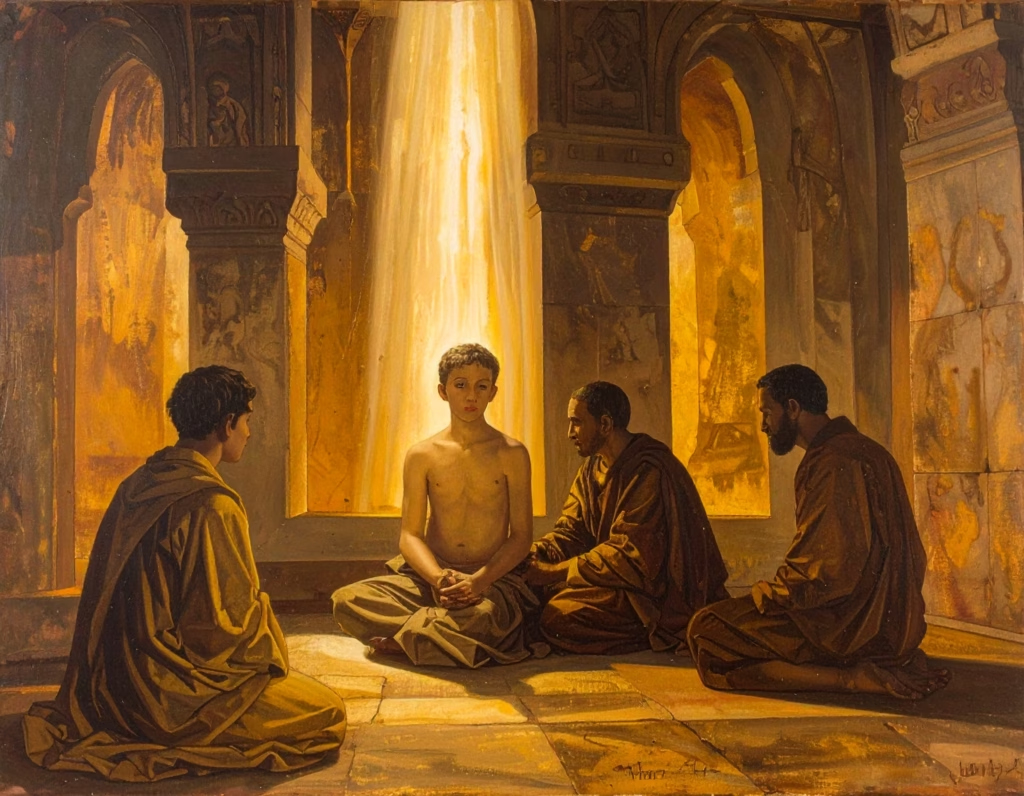
This is where the Buddha’s post-enlightenment mission begins. In the twelfth year of the Nathan Jesus — the very episode Luke records of the young Jesus astonishing the teachers in the Temple — something of immense significance occurred. The soul of Gautama Buddha, now working entirely from the spiritual world, united with the soul-sheath of this child.
He poured into it the full, distilled treasure of his centuries of preparation. He gave this pure vessel the wisdom of his great teaching — the fruit of his achieved Buddhahood — as a completely free gift.
The Buddha gave his greatest spiritual treasure not to a future incarnation of his own, for he would never incarnate again. He gave it freely, to prepare a vessel for Another. He offered the fullness of wisdom so that love, its great complement, might have the preparation it required.
This is cosmic generosity of the highest order. The path of the Buddha and the path of the Christ are not rivals. At the deepest level, they form a single sacred preparation.
The Mission to Mars: Compassion Carried to the Stars
A Buddha Among the Spheres
After this mighty deed, the being of the Buddha did not rest. Steiner reveals in “Spiritual Guidance of the Individual and Humanity” (GA 15) that the Buddha was then entrusted with a mission that carried him outward — to the sphere of Mars.
Mars, in spiritual science, is not merely a physical planet. It is the dwelling place of specific spiritual forces connected with outward-driving will and the impulse of courage. Before the Christ event, these forces had developed a one-sided, hardening quality. What had once been purposeful had grown aggressive and spiritually barren.
The Buddha’s mission was to bring to the Mars sphere the same gift he had brought to humanity on Earth: the transforming power of compassion. He became, in a real spiritual sense, the redeemer of that cosmic sphere. He breathed into its forces a new and healing impulse.
Nothing in the cosmos is wasted. The Bodhisattva who spent long ages preparing the moral inner life of humanity now carried that achievement into the wider cosmic order. Liberation from the Earth was not a departure from service. It was the beginning of a vaster service.
Buddha and Christ: Two Paths, One Cosmic Drama
Where One Ascends, the Other Descends
We can now see, in its full grandeur, the true relationship between the Buddha and the Christ. They are not identical figures in different cultural costumes. They are two great poles of a single cosmic drama. Each fulfills what the other, by the nature of his mission, could not.
The Buddha’s path moves upward and outward — away from material entanglement, toward the pure light of the spirit. The Eightfold Path leads, in its final stage, to liberation from the necessity of physical incarnation. The Buddha showed humanity how to transcend the suffering inherent in material life.
The Christ’s path moves in exactly the opposite direction — downward and inward. It is a willing descent into the densest and most suffering-filled point of material existence. Where the Buddha rose above matter, the Christ plunged into it. Where the Buddha’s path ends in liberation from the Earth, the Christ’s path binds itself to the Earth forever.
The Two Pillars of a Single Gateway
These are not contradictory truths. They are the two pillars of a single gateway. Humanity needs the wisdom that recognizes the nature of suffering. It also needs the love that freely descends into that suffering to transform it from within.
The Buddha gives us the clear inner map. The Christ gives us the strength to walk it all the way to its transfigured center. To have one without the other is to have either a light with no warmth, or a warmth with no light.
Steiner expressed this distinction with great care in “From Jesus to Christ” (GA 131, 1911) — a lecture cycle that repays careful study by anyone wishing to understand this relationship more deeply.
The Future Buddha: The Maitreya
The Next Great Messenger Is Already at Work
The stream of the Bodhisattvas does not end with Gautama. Spiritual science reveals that a great Bodhisattva is working within human evolution even now. This being will one day, in the fullness of cosmic time, become the Maitreya Buddha — the Buddha of the future.
This being does not currently work through a physical incarnation visible to ordinary sight. He works from the spiritual world, and periodically through chosen impulses, guiding the moral development of humanity in quiet but decisive ways.
The Maitreya Buddha will not repeat the mission of Gautama. His work will be connected with the power of the human Word — with the capacity of speech to carry spiritual truth with such directness and transforming force that it works upon souls in ways we can barely conceive today.
This is not a distant abstraction. We live in a time of preparation. The seeds planted by the Buddha’s teaching, and by the Christ event that teaching helped prepare, are still ripening within the human soul. The full harvest lies ahead — and it asks for our conscious participation.
Conclusion
The figure of the Buddha, seen through the light of spiritual science, is immeasurably richer than the image of a wise man sitting peacefully beneath a tree. He is a great cosmic being who journeyed through vast reaches of time, fulfilling a mission of world-historical importance at every stage.
He brought to humanity the first universal moral teaching, one that crossed all tribal and national boundaries. He won a real battle against adversarial forces at the threshold of his liberation. He stood in a sublime cosmic collaboration with the Christ event, offering the distilled fruit of his wisdom to the vessel being prepared for the great Sun Spirit. He continued his service among the stars, carrying compassion to realms far beyond our Earth.
The relationship of the Buddha and the Christ is not one of sameness. Nor is it one of rivalry. It is the deepest cosmic complementarity — wisdom and love, ascent and descent, liberation and transformation.
The Buddha showed us the nature of suffering. The Christ showed us the love that descends into that suffering to transform it from within. Together, they form the two pillars of a single gateway — through which a humanity that has freely walked through darkness may pass, at last, into light.