The ancient Greek myth recounting the abduction of Persephone by Hades, Lord of the Underworld, and the subsequent grief of her mother Demeter, the Earth Goddess, is far more than a charming explanation for the changing seasons. It is a narrative imbued with deep esoteric significance, a powerful imaginative picture revealing profound truths about the human soul, the nature of life and death, and the spiritual realities experienced within the sacred Eleusinian Mysteries. The Rudolf Steiner Persephone Hades perspective, grounded in spiritual science, allows us to decode this myth, seeing it as a reflection of the soul’s journey into earthly existence and its cyclical connection to the spiritual world.
The Narrative: A Goddess Lost and Found
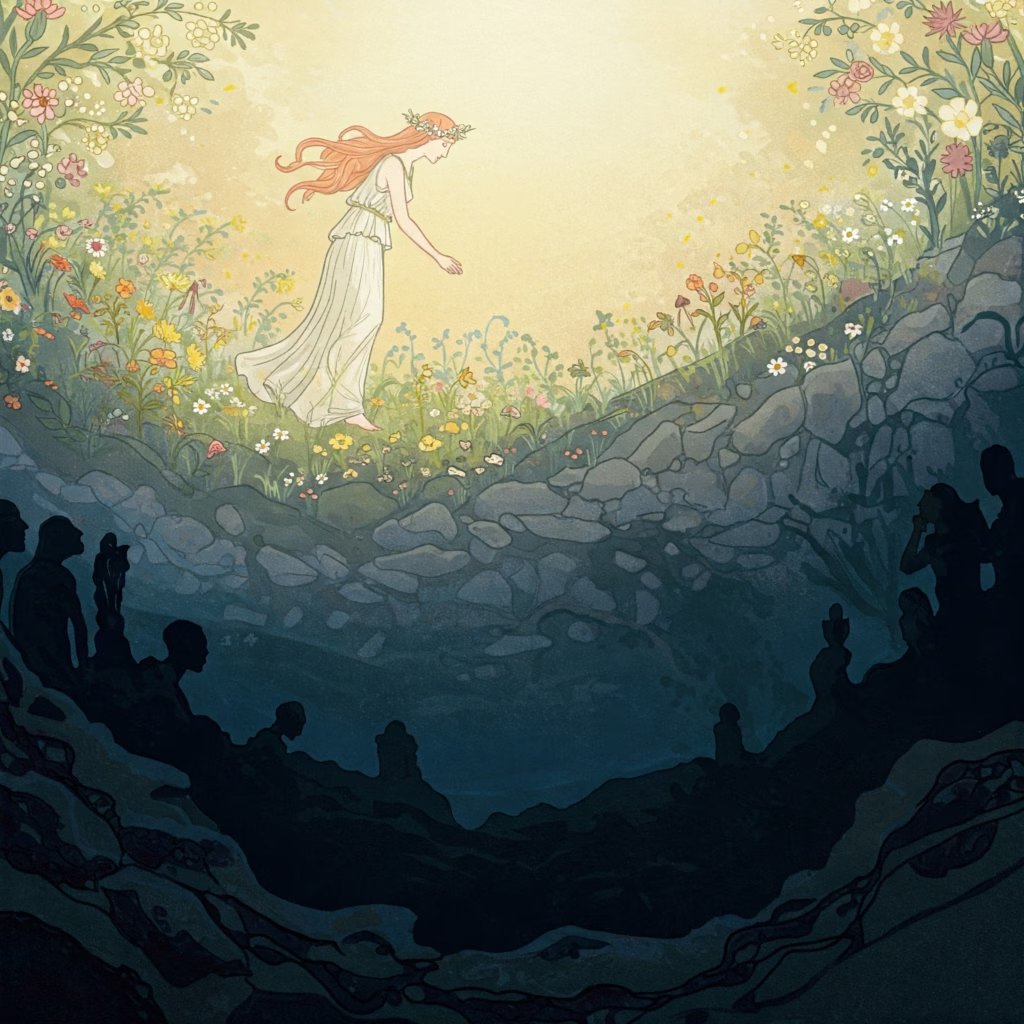
The core story is well-known. Persephone (also called Kore, the Maiden), daughter of Demeter, goddess of grain and earthly fertility, is gathering flowers in a meadow. Suddenly, the earth opens, and Hades (Pluto), ruler of the dark underworld, emerges in his chariot and carries her away to be his queen. Demeter, distraught, searches relentlessly for her daughter. Her immense grief causes her to withhold her life-giving powers, and the earth becomes barren, threatening humanity with famine.
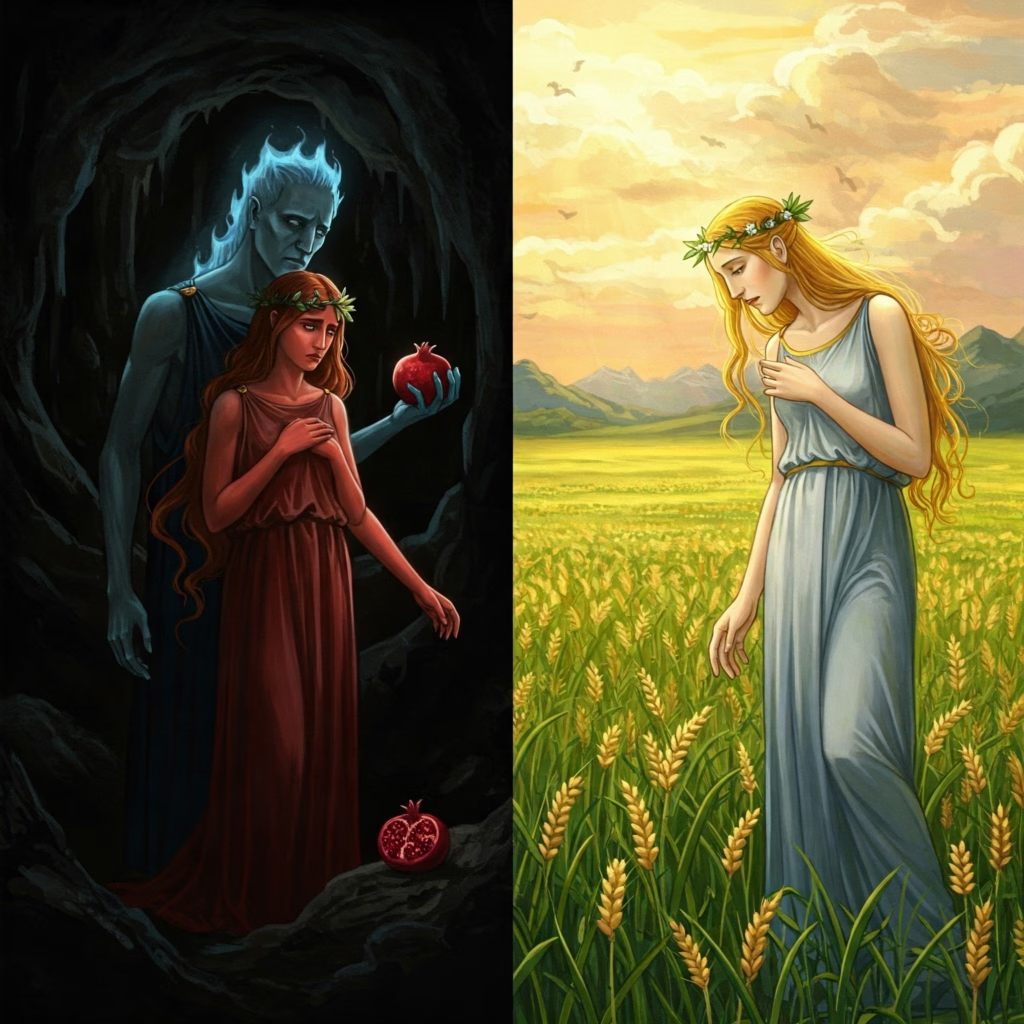
Eventually, through the intervention of Zeus, king of the gods, a compromise is negotiated. Since Persephone had eaten a few pomegranate seeds while in the underworld, she could not be entirely freed. Consequently, it was decreed that she must spend a portion of the year (typically identified with autumn and winter) with Hades below, and the remaining portion (spring and summer) with her mother Demeter upon the Earth. Her annual return brings life and fertility back to the world.
Spiritual Interpretation: The Soul’s Journey
From the Rudolf Steiner Persephone Hades viewpoint, this myth serves as a profound allegory for the human soul’s experience and its relationship with different levels of existence.
- Persephone (Kore): The Human Soul: Persephone represents the human soul, particularly in its pre-earthly state or its connection to the life-giving forces. As Kore, the Maiden, she embodies the soul’s original purity and connection to the spiritual world, dwelling in the meadows nurtured by the divine-etheric forces represented by her mother, Demeter. Her picking flowers can be seen as the soul being drawn towards the beauty and allure of earthly, sensory existence.
- Demeter: The Earth Mother and Etheric Forces: Demeter is the great Earth Mother, the source of earthly fertility and life. Spiritually, she represents the nurturing forces of the etheric world, the realm of formative life forces that sustains the physical body and connects the soul to the living processes of nature [cite: Rudolf Steiner – Theosophy – An Introduction to the Spiritual Processes in Human Life.pdf]. Her grief signifies the sorrow inherent in the spiritual world when the soul descends into the limitations and potential darkness of physical incarnation, seemingly lost to the direct influence of these higher life forces. The resulting barrenness of the Earth reflects how the outer world can appear devoid of spirit when the soul’s connection is obscured.
- Hades (Pluto): The Lord of Physicality and the Threshold: Hades is often misunderstood as a figure of evil. However, spiritual science sees him more accurately as the ruler of the underworld—which represents the realm of physical incarnation, the mineral kingdom, the forces of death, and the subconscious depths associated with the physical body and earthly existence [The occult truths of myths and legends]. His abduction of Persephone is not an act of malice, but an imaginative picture of the powerful forces that draw the soul downwards into embodiment, into the “underworld” of material form. He represents the necessary grounding in the physical, the confrontation with the forces of limitation and dissolution inherent in earthly life.
- The Abduction: Incarnation and Loss of Vision: Persephone’s descent into the underworld vividly portrays the process of human incarnation. The soul leaves its spiritual home and is drawn into the physical body, experiencing a separation from the encompassing spiritual world. This involves a dimming of consciousness, a loss of the direct clairvoyant perception of spiritual realities enjoyed in pre-earthly life. The soul becomes bound, for a time, to the conditions and forces governing physical existence, ruled by “Hades.” The Rudolf Steiner Persephone Hades interpretation emphasizes this experience of descent and the subsequent veiling of spiritual sight.
- The Pomegranate Seed: Binding to Earthly Experience: The detail of Persephone eating the pomegranate seeds is crucial. It symbolizes the soul taking earthly experience into itself. Once the soul has truly engaged with physical life, tasted its fruits (even if only a few seeds), it becomes interwoven with earthly destiny and the cycle of karma. It cannot simply return unchanged to its purely spiritual state. It must carry the imprint of earthly experience, binding it cyclically to the “underworld” of incarnation.
- The Cycle of Return: Life, Death, and Rebirth: Persephone’s annual return to the upper world represents the cyclical nature of existence and the soul’s journey. On one level, it clearly mirrors the seasonal cycle of nature—death in winter, rebirth in spring—reflecting the withdrawal and return of etheric life forces influenced by the soul’s state. On a deeper level, it reflects the human soul’s journey between death and a new birth [Between Death and Rebirth]. After death (leaving the physical underworld), the soul ascends through spiritual realms (reuniting with the spiritual ‘mother’), before eventually being drawn back towards earthly life (returning to Hades) for a new incarnation, carrying the fruits of its spiritual journey. The Rudolf Steiner Persephone Hades myth thus encapsulates the rhythm of reincarnation.
Connection to the Eleusinian Mysteries
The myth of Persephone and Demeter formed the sacred core of the Eleusinian Mysteries, the most revered initiation rites of ancient Greece [Christianity as Mystical Fact]. Spiritual science understands these Mysteries not as mere symbolic rituals, but as carefully guarded processes designed to induce controlled, conscious experiences of the spiritual world and the soul’s journey beyond the physical body.
- Initiation as Conscious Experience: Initiates at Eleusis underwent profound inner experiences designed to replicate, in full consciousness, the soul’s journey through death and its encounter with spiritual realities. They experienced the “abduction” (separation from the physical body), the descent into “Hades” (encountering threshold realities), and the eventual “return” or rebirth into spiritual light, gaining direct knowledge of the soul’s immortality and its connection to the divine [The Mysteries of the East and of Christianity GA 144].
- Myth as Exoteric Veil: The myth served as the exoteric, public narrative that veiled the deeper truths experienced directly by initiates within the sanctuary. It provided a framework of understanding for the populace and prepared candidates for the inner experiences of the Mysteries. The profound emotional impact of the myth stemmed from its resonance with these genuine spiritual processes. The Rudolf Steiner Persephone Hades connection highlights the Mysteries as the living source from which the myth drew its enduring power. [Mythology]

Persephone and the Evolution of Consciousness
The prominence of this myth in Greek culture also reflects the specific stage of consciousness prevalent during that epoch (the fourth post-Atlantean, or Greco-Roman). Humanity was developing the Intellectual or Mind Soul, moving away from the instinctive clairvoyance of earlier times towards clearer thinking, but still retaining a connection to the imaginative, pictorial perception of spiritual truths [The riddles of philosophy].
The Greeks experienced the threshold between life and death, the reality of the soul’s journey, and the influence of spiritual forces more vividly than is common today. The Persephone myth provided a perfect imaginative vessel for expressing these experiences—the poignant sense of loss associated with earthly existence, the reality of the spiritual world underlying nature, and the cyclical journey of the soul. It captured the soul’s awakening awareness of its dual citizenship: belonging both to the bright world of spirit (Demeter) and the necessary darkness and limitation of earthly embodiment (Hades). The Rudolf Steiner’s Persephone Hades understanding places the myth’s power firmly within this context of evolving consciousness.
Enduring Relevance for the Modern Soul
Does this ancient myth still speak to us today? Absolutely. While our modern consciousness is more intellectual and less naturally clairvoyant, the fundamental experiences depicted in the Persephone myth remain relevant to the human condition.
- The Experience of Incarnation: Every human soul undergoes the “abduction” into earthly life, experiencing the limitations and challenges of the physical body and the dimming of direct spiritual memory.
- Feeling of Separation: Many modern individuals experience a deep, often unconscious, longing for spiritual connection, a sense of exile from a spiritual home—an echo of Demeter’s grief and Persephone’s separation.
- Confronting Materialism: The “underworld” today can be seen not just as physical death, but also as the realm of hardened materialism, where the spirit is denied or forgotten. Hades represents the powerful forces that bind the soul to purely sense-based reality.
- The Hope of Renewal: Persephone’s cyclical return embodies the enduring hope for spiritual renewal, the possibility of reconnecting with the life-giving forces of the spirit even amidst earthly existence, and the promise of the soul’s continued journey beyond physical death.
- The Path of Inner Development: The myth implicitly points towards the need for inner work, for a conscious journey (like that of the Eleusinian initiates) to bridge the gap between the physical and spiritual worlds and achieve a conscious understanding of life, death, and rebirth.
Conclusion: A Timeless Image of the Soul’s Journey
The myth of Persephone and Hades, interpreted through the Rudolf Steiner Persephone Hades perspective, transcends simple allegory. It stands as a profound, inspired imagination arising from ancient clairvoyant perception and Mystery wisdom. It vividly portrays the human soul’s descent into earthly incarnation, its necessary engagement with the forces of physicality and death, its cyclical journey between the spiritual and material worlds, and the enduring connection to the life-giving forces of the spirit. It reflects the experiences undergone in the Eleusinian Mysteries and speaks to the evolving consciousness of the Greek people. For us today, it remains a timeless symbol of the soul’s journey, reminding us of our spiritual origins, the challenges and necessities of earthly life, and the ever-present potential for spiritual renewal and conscious connection across the threshold.