The four Gospels offer humanity unique pathways to the Christ event. Each illuminates different facets of His being and mission. St. Mark’s Gospel stands out immediately. It presents a narrative of striking energy, immediacy, and powerful action. It is the shortest Gospel. Yet, it moves with incredible speed, focusing on Christ’s mighty deeds rather than lengthy sermons or complex genealogies. Rudolf Steiner’s spiritual science, known as Anthroposophy, provides profound insight into Mark’s dynamic account. The Steiner Gospel of Mark interpretation reveals this text as a potent chronicle. It shows the Christ impulse entering earthly evolution. This impulse manifests as world-transforming cosmic power. Understanding the Anthroposophy’s perspective about he Gospel of Mark awakens us. It reveals the active, energetic reality of the spirit dramatically intervening in the material world. This view offers a vital complement to the other Gospels. It contrasts with Matthew’s historical focus, Luke’s compassionate tone, or John’s cosmic depth.
Mark: The Gospel of Manifest Cosmic Power
Steiner frequently emphasized Mark’s unique beginning and central theme. The Gospel opens directly, without preamble: “The beginning of the gospel of Jesus Christ, the Son of God.” This immediate declaration establishes the core focus. Mark presents Christ primarily through the lens of His divine power and authority. Steiner explained that Mark unveils the Christ Being as the bearer of immense, world-shaping cosmic forces. These forces originate beyond the earthly sphere. They manifest directly through Christ’s presence and actions.
This power is not merely abstract potential. It actively confronts earthly limitations. It challenges entrenched spiritual opposition. Mark vividly portrays this power calming chaotic natural forces, commanding spirits with undeniable authority, healing seemingly incurable conditions, and speaking with a wisdom that silences conventional scribal learning. The Gospel vibrates with this inherent spiritual energy. Steiner suggested that Mark’s perspective, perhaps reflecting the dynamic memories of the Apostle Peter, uniquely captures the sheer impact of the Christ Being entering the physical world. Mark focuses less on Christ’s human development or inner feelings. Instead, he concentrates on the objective reality of His divine power transforming earthly existence. This perspective is fundamental to the Rudolf Steiner Gospel of Mark interpretation. It portrays the Christ impulse not just as an influence, but as an active, world-engaging force.
The Dynamic Christ Impulse: Force Entering Evolution
The narrative pace in Mark is notably swift. Events unfold rapidly, often linked by simple words like “immediately” or “straightway.” Christ moves from baptism to temptation, then directly into His potent ministry in Galilee. Disciples are called and immediately follow. Healings occur with commanding words or touch. There is a powerful sense of forward momentum, of spiritual energy breaking into the world without pause.
Steiner interpreted this narrative style as a direct reflection of the Christ impulse itself. This impulse, he explained, is not a static teaching or a passive presence. It is a living, dynamic spiritual stream actively entering earthly evolution to counteract stagnation and initiate transformation. Mark portrays this impulse overcoming the inertia, the resistance inherent in the dense physical world and in hardened human thinking and feeling. The dynamic action throughout the Gospel shows this force at work.
Furthermore, Mark repeatedly highlights the authority (Greek: exousia) Christ wields. He teaches “as one who had authority” (Mark 1:22). He commands unclean spirits “with authority,” and they obey Him (Mark 1:27). This authority, Steiner clarified, is not derived from earthly position or tradition. It flows directly from the cosmic spiritual source embodied by Christ. Mark’s Gospel powerfully conveys the reality of this divine authority manifesting through Christ’s deeds and words. It presents a Christ whose actions initiate immediate change, demonstrating the power of the Spirit to actively reshape earthly conditions.
Healing Miracles: Christ’s Power Over Adversarial Forces
Mark’s Gospel is rich with accounts of healing, often presented dramatically. Consider the man with the unclean spirit in the Capernaum synagogue (Mark 1), the healing of the leper (Mark 1), the paralytic lowered through the roof (Mark 2), the man with the withered hand (Mark 3), the Gadarene demoniac (Mark 5), or the boy with the ‘dumb spirit’ (Mark 9). While Luke emphasizes the compassion motivating these acts, and John might reveal their connection to initiation, the healing miracles interpretation focuses primarily on these events as demonstrations of divine power overcoming specific spiritual opposition.
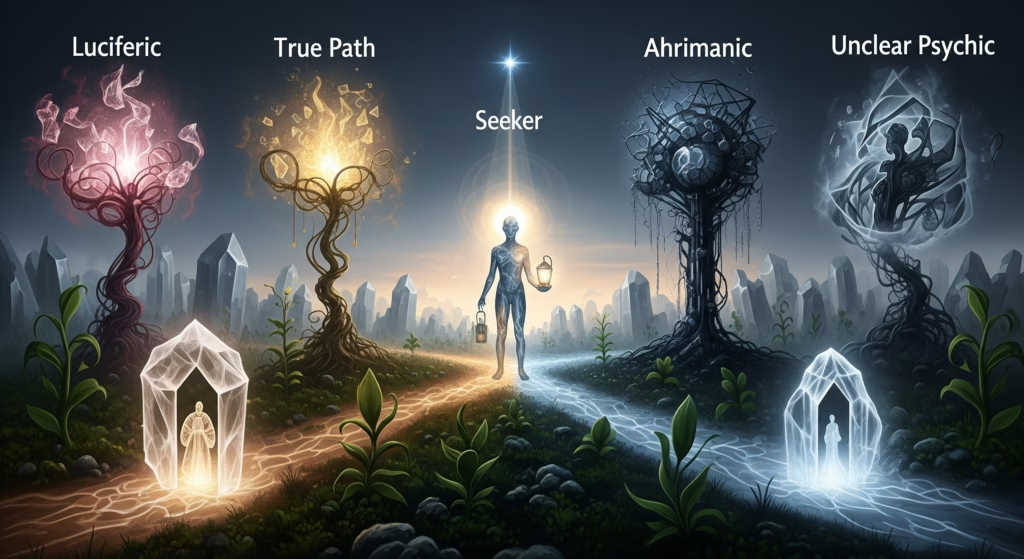
From the perspective of spiritual science, many illnesses and afflictions, especially those involving mental or spiritual disturbance (‘possession’), are understood as manifestations of hindering spiritual influences. Steiner identified these as Luciferic forces (leading away from earth, causing inner agitation or dissolution) and Ahrimanic forces (binding too strongly to matter, causing hardening, darkness, illusion). Christ’s healings in Mark often depict direct confrontations with these adversarial beings or the forces they wield.
He addresses the ‘unclean spirit’ directly, commanding it to leave. He confronts the legion of spirits in the Gadarene demoniac. He rebukes the spirit causing the boy’s seizures. These are not merely acts of gentle restoration; they are displays of superior spiritual authority and power. Christ demonstrates mastery over the forces that distort human nature and hinder spiritual progress. The healings are often immediate, forceful, and undeniable, underscoring the objective power of the Christ impulse to liberate humanity from the grip of these adversarial influences. Mark thus portrays Christ as a spiritual warrior, using His inherentcosmic power to restore health and spiritual freedom. This emphasis on power distinguishes Mark’s portrayal of healing within Esoteric Christianity.
Hidden Wisdom: Parables and the Messianic Secret
While dynamic action is central, Mark also includes vital teachings and parables. However, Steiner noted Mark’s tendency to present wisdom often veiled, hinting at deeper meanings accessible primarily through inner understanding. Christ teaches the crowds extensively in parables, yet explains their inner significance only privately to His disciples (Mark 4:10-12, 33-34). This points towards different layers of spiritual truth. Some truths are suitable for general dissemination as pictures, while others require deeper preparation and esoteric insight.
Steiner viewed Mark’s parables—such as the Sower, the Seed Growing Secretly, and the Mustard Seed—as potent imaginative depictions of spiritual realities. They illustrate the nature of the Kingdom of God. They show it as a spiritual force that grows dynamically, often initially unseen, within the world and the receptive human soul. However, understanding requires effort; the seed falls on different kinds of ground.
Related to this is the “Messianic Secret” motif prominent in Mark. Christ repeatedly instructs those He heals or the spirits He commands not to make Him known (e.g., Mark 1:34, 1:44, 3:12, 5:43, 7:36). Steiner interpreted this complex motif in several ways. Partly, it reflected the need for the Christ impulse to work dynamically, transforming reality through deeds before premature intellectual understanding or fixed Messianic expectations could hinder its true impact. It allowed the power to manifest objectively, preparing the ground for later comprehension. The wisdom in Mark is often concentrated, revealed through the context of powerful action, demanding active spiritual engagement from the reader.
Mark’s Reflection of the Deeper Spiritual Record (Fifth Gospel)
Rudolf Steiner taught that the four Gospels reflect a deeper spiritual reality: the “Fifth Gospel” recorded in the Akasha Chronicle. Each Gospel highlights different aspects of this comprehensive spiritual archetype. Thefifth Gospel connection emphasizes Mark’s role in capturing the dynamic impact and objective force of the Christ impulse entering Earth evolution. Mark reflects the ‘event’ character, the sheer power of the spiritual breaking into the physical. He focuses on the deed, the manifest struggle, and the transformative effect of Christ’s presence and actions. His account provides the most direct reflection of the Christ impulse as a world-initiating force.
Golgotha in Mark: Cosmic Struggle, Darkness, and Powerful Victory
Mark’s narrative of the Passion is stark, swift, and filled with cosmic intensity. He emphasizes the disciples’ failure, Peter’s denial, and Christ’s profound isolation during the trial and crucifixion. Steiner pointed especially to the Aramaic cry from the Cross uniquely recorded by Mark: “Eloi, Eloi, lama sabachthani?” – “My God, my God, why hast thou forsaken me?” (Mark 15:34). This utterance, Steiner explained, signifies the deepest point of the Christ Being’s descent into the human condition. It marks His full identification with humanity’s feeling of separation from the divine source. It is a moment of profound cosmic sacrifice.
The accompanying signs—the darkness over the land, the tearing of the temple veil—demonstrate the event’s world-altering significance. The old ways are disrupted. The Roman Centurion’s spontaneous recognition, “Truly this man was the Son of God!” (Mark 15:39), shows the objective power of Christ’s being impressing itself even upon an unprepared outsider. Mark’s Resurrection account is notably brief and powerful. It focuses on the objective evidence: the empty tomb, the angelic pronouncement, “He is risen; he is not here” (Mark 16:6). Mark emphasizes the accomplished fact of the victory over death. It is the ultimate demonstration of the cosmic power inherent in the Christ impulse, confirming His divine nature through the conquest of death itself.
Mark’s Value for Spiritual Science and Modern Life
Why is Mark’s Gospel particularly vital for spiritual science today? Steiner stressed its unique ability to awaken an understanding and experience of the Christ impulse as a real, active force. It is not merely a historical memory, a comforting feeling, or an intellectual concept. It is a dynamic power continuously working within the world and accessible to the striving human soul. Mark’s Gospel serves as a powerful antidote to passivity, lethargy, and overly abstract intellectualism in spiritual life. It inspires courage, decisiveness, and the will to actively engage with the spiritual world and bring its impulses into earthly reality.
Studying Mark, guided by the Rudolf Steiner’s Gospel of Mark interpretation found in works like his lecture cycle (GA 139 Gospel of Mark), can help cultivate the inner will forces needed today. It helps counter the Ahrimanic influences that promote inertia, doubt, and materialism. It encourages us to recognize Christ not just as a historical teacher but as a living, dynamic presence. Mark empowers us to become active participants in spiritual evolution.
Conclusion: Embracing the Christ of Dynamic Power
The Steiner’s Gospel of Mark interpretation reveals a Gospel pulsating with spiritual energy and cosmic might. It presents Christ wieldingcosmic power. It demonstrates theChrist impulse through immediate, decisive dynamic action. Its accounts of healing miracles depict the forceful overcoming of adversarial spiritual powers. Mark’s unique reflection of thefifth Gospel emphasizes the objective impact of the divine breaking into earthly reality. Through the lens of Anthroposophy, we discover a path that requires not only understanding and feeling but also strength, courage, and active spiritual striving. Mark’s Gospel calls us to awaken to the living, dynamic power of Christ. It inspires us to engage actively with the spiritual world and become co-workers in the ongoing transformation of the Earth.