
No book in the biblical canon has inspired more awe, more fear, and more fervent speculation than the final book of the New Testament: the Apocalypse, or the Book of Revelation of St. John. With its vivid imagery of multi-headed beasts, celestial warfare, and world-altering cataclysms, it has often been read as a literal prophecy of the end times. For the modern mind, this has created a stark choice: either accept these visions as a future physical reality or dismiss them as the fevered dream of a first-century mystic. This article will explore a third path, unveiling the prophetic mysteries of the Apocalypse from a spiritual-scientific perspective.
Drawing upon the esoteric Christian tradition and the spiritual research of Rudolf Steiner, we will discover that the Apocalypse is not primarily a prophecy of outer events, but a magnificent, symbolic map of the inner evolution of human consciousness. Its author, the beloved disciple John, was an initiate who was granted a direct vision into the spiritual workings of history. The opening of the Seven Seals and the sounding of the Seven Trumpets are not future catastrophes; they are pictorial revelations of the great spiritual struggles and transformations that our post-Atlantean cultural epochs must pass through. By unlocking these sacred symbols, we move beyond fear and speculation, and begin to see the Apocalypse for what it truly is: a profound initiation text that reveals the grand, divine plan for humanity’s long journey towards freedom and love.
The Author and the Vision: A Glimpse into the Spiritual World
The Initiation of the Beloved Disciple
To understand the Apocalypse, we must first understand its author and the nature of his vision. Spiritual science reveals that the author was none other than John, the “beloved disciple,” the same soul who wrote the Gospel of John. After the events of the Gospels, John lived to a great old age, eventually being exiled to the island of Patmos. It was here, in a state of profound spiritual initiation, that the veil between the worlds was lifted for him.
What John saw was not the physical future. He was lifted into a state of higher consciousness where he could perceive the spiritual archetypes, the great divine “thoughts” or plans that stand behind physical history. He was looking into the “workshop” of the spiritual hierarchies who guide human evolution. The dramatic and often terrifying images he describes are the outer, pictorial clothing for these inner, spiritual realities. He had to translate his supersensible perceptions into the symbolic language available to him, the rich imagery of the Old Testament prophets. To read the Apocalypse is to learn to read these sacred hieroglyphs, to see the spiritual events that they conceal and reveal.

The Seven Seals: Unveiling the Spirit of the Cultural Epochs
The Book of Destiny and the Lamb
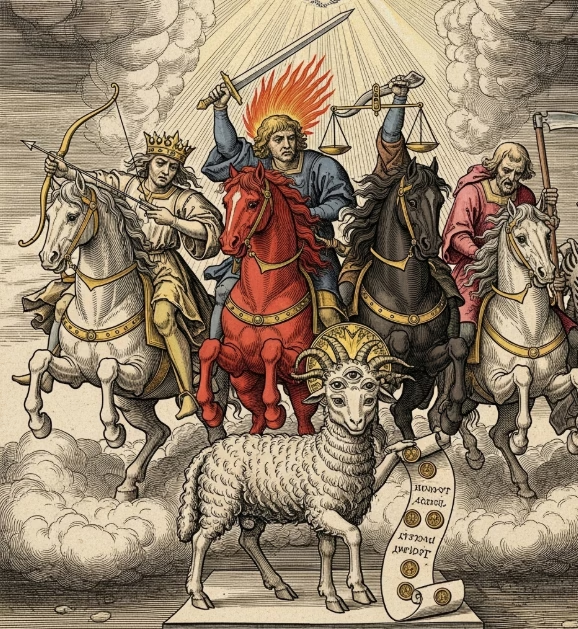
The vision begins with a mighty being holding a scroll sealed with Seven Seals. This scroll is the “Book of Destiny,” the divine plan for our current great cycle of civilization, the post-Atlantean era. No one in heaven or on earth is found worthy to open the seals except “the Lamb that was slain.” This is the Christ, the only being who, through His sacrifice on Golgotha, has earned the right to guide human evolution and unveil its meaning.
The opening of each of the Seven Seals reveals a new, powerful image. From a spiritual-scientific perspective, the first four of these seals correspond to the spiritual character of the first four great cultural epochs that followed the Atlantean catastrophe.
The First Seal: The Rider on the White Horse (Ancient Indian Epoch) When the first seal is opened, a white horse appears, and its rider has a bow and is given a crown, and he rides forth “conquering and to conquer.” This is a magnificent picture of the first post-Atlantean epoch, the ancient Indian culture.
- The White Horse: White is the color of the spirit, of wisdom that has not yet fully descended into matter. It represents the intensely spiritual nature of this first culture.
- The Rider and the Crown: The rider represents the great spiritual guides of that age, the seven holy Rishis. They were filled with the original, pure divine wisdom. Their “conquering” was not a military conquest, but the power of their sublime spirituality to shape their culture completely, a culture that looked back with profound nostalgia to its lost spiritual home.
The Second Seal: The Rider on the Red Horse (Ancient Persian Epoch) The second seal reveals a fiery red horse, and its rider is given a great sword with the power to take peace from the Earth. This is a picture of the second cultural epoch, the ancient Persian civilization under the guidance of Zarathustra.
- The Red Horse: Red is the color of will, of struggle, of bloodshed. The Persian consciousness no longer saw the world as a peaceful spirit to be dreamed of, but as a great battlefield between the forces of Light (Ahura Mazdao) and Darkness (Ahriman).
- The Great Sword: This represents the new human task: to take up the sword and actively engage in this cosmic battle, to work upon the Earth and transform it. Peace was taken from the Earth because humanity was now called to be an active participant in a great spiritual war.
The Third Seal: The Rider on the Black Horse (Egypto-Chaldean Epoch) The third seal unveils a black horse, and its rider holds a pair of scales. This is a picture of the third cultural epoch, the great civilizations of Egypt, Babylonia, and Chaldea.
- The Black Horse: Black is the color of the earth, of the descent into matter. This epoch saw humanity plunge deeply into the earthly sciences of geometry, astronomy, and law.
- The Pair of Scales: The scales represent the principles of weight, measure, and justice. This was the age when humanity began to measure the land, to weigh goods in commerce, and to create the first great legal codes. The “voice” that speaks of measures of wheat and barley points to the birth of an economy and a society governed by earthly laws. The spiritual was now to be found by measuring and understanding the material world.
The Fourth Seal: The Rider on the Pale Horse (Greco-Roman Epoch) The fourth seal reveals a pale (or sickly green-yellow) horse, whose rider is named Death, and Hades follows with him. This powerful and terrifying image represents the fourth cultural epoch, the Greco-Roman age.
- The Pale Horse: This color signifies the death of the old, natural clairvoyance. It was in this epoch that the intellect was born. Humanity, in developing the power of logical, rational thought, lost its innate connection to the spiritual world. The gods fell silent. This was a spiritual “death.”
- The Rider Named Death: This is not about physical death alone, but the death of the old spiritual vision. The intellect, in its power to analyze and dissect, “kills” the living wholeness of the world. This was a necessary death, however, as it was the birth of the individual human ego, the “I” that could think for itself. It was into this age of spiritual darkness that the Christ event itself had to take place, bringing a new kind of life to conquer this spiritual death.
The breaking of these four seals unveils the great spiritual plan for the evolution of consciousness. The next seals, and the trumpets and bowls that follow, reveal the further spiritual struggles and transformations that humanity must undergo as we progress through our own fifth epoch and into the future.
The Seven Trumpets: The Voice of the Spirit Echoing in the Soul
Cosmic Events as Inner Experiences
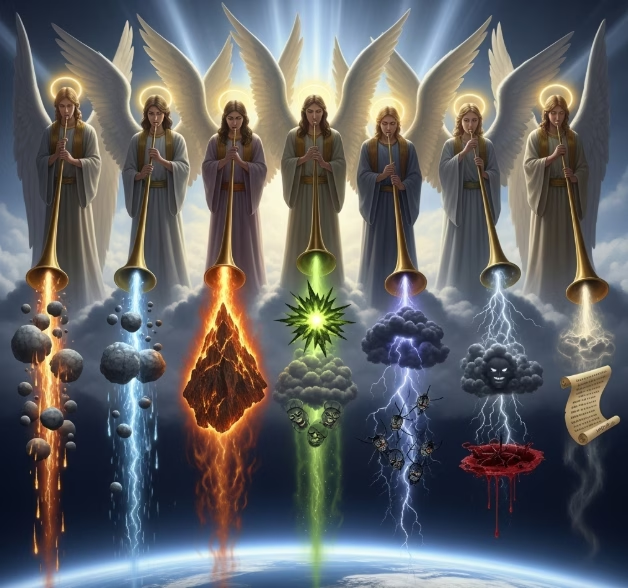
After a period of celestial silence and ritual following the opening of the seventh seal, seven angels are given Seven Trumpets. In sacred symbolism, a trumpet’s sound is a call to awakening, a revelation that penetrates the soul. While the seals revealed the outer spiritual character of the epochs, the trumpets describe the inner, soul-consequences of these developments. They are a picture of how the great cosmic events echo within the human soul, often as experiences of loss and crisis.
The first four trumpets describe a progressive desolation of the natural world, a “third part” of the earth, sea, rivers, and heavens being struck. This is not a literal, physical destruction. It is a picture of the consequences of the rise of the materialistic intellect that was born in the fourth epoch and comes to its peak in our fifth.
- The First Trumpet (Hail and Fire on the Earth): This represents the hardening of human thinking. The living, intuitive perception of the Earth (as in the Egyptian age) is replaced by a cold, dead, mineralogical view. The “hail and fire” are the forces of abstract, lifeless thought that “burn up” our living connection to the vegetable kingdom of the etheric world.
- The Second Trumpet (The Burning Mountain in the Sea): The “sea” is a symbol for the flowing, feeling life of the human astral world. The “burning mountain” is a picture of human egoism and passion, which, when it falls into the soul-world, “kills” a third of the life within it. It represents the rise of selfishness that poisons the feeling life of humanity.
- The Third Trumpet (The Star Wormwood on the Rivers): The “rivers and fountains of water” symbolize all that should flow as living wisdom and truth into humanity. The star “Wormwood” (which means “bitterness”) represents a wisdom that has become poisoned by lies, by clever but soulless intellectualism. It is the wisdom of Ahriman, which tastes bitter to the soul because it is devoid of spirit.
- The Fourth Trumpet (The Darkening of Sun, Moon, and Stars): This is the culmination of the process. The Sun, Moon, and Stars are symbols for the highest spiritual realities. Their darkening represents the great spiritual blindness of a fully materialistic age, where the human soul, through its own intellectual development, has lost the ability to perceive the spiritual light of the cosmos. This is a description of the peak of the Kali Yuga, the “dark age” from which humanity is only now beginning to emerge.
The Three Woes: The Great Spiritual Crises After the first four trumpets, an eagle cries out, announcing “Three Woes” for the final three trumpets, which represent great spiritual crises humanity must face.
- The Fifth Trumpet (The First Woe): This trumpet releases monstrous, locust-like beings from the “bottomless pit.” This is a powerful vision of the forces of human egoism and materialistic science run rampant, creating technologies and ideologies that torment the human soul without killing the spirit entirely. It is the age of a science that understands the physical but has no grasp of the soul or spirit.
- The Sixth Trumpet (The Second Woe): This trumpet unleashes vast, destructive armies from the “river Euphrates.” This is a prophecy of the rise of brutal, materialistic conflicts, wars fought not for honor or tribe, but with the cold, destructive power of a technology divorced from all morality. It is a picture of the self-destructive potential of a humanity that has immense power but has forgotten its spiritual purpose.
The seventh trumpet, the final “woe,” heralds the ultimate turning point, the moment when the Christ Impulse begins to truly take hold of the Earth’s spiritual life, leading to the great spiritual battles and transformations described in the remainder of the book.
Conclusion: A Book of Hope and a Call to Action
To read the Apocalypse with the eyes of spiritual science is to have it transformed. It ceases to be a book of terror and becomes a book of profound hope and immense responsibility. It is a book of hope because it reveals that human history is not a chaotic accident. There is a great, divine plan at work, a plan that guides us through every trial and darkness towards a glorious spiritual future. It shows us that even the most terrifying events and the most destructive human impulses are foreseen and are woven into a larger tapestry that leads ultimately to the good.
It is also a profound call to action. The Apocalypse is not a script that we are doomed to passively watch unfold. It is a revelation of the spiritual battlefield upon which we stand. It shows us the nature of the forces at work in our time—the deadening forces of materialism, the seductive power of egoism. And by revealing these forces, it gives us the power to consciously confront them. The visions of John are a wake-up call. They ask us to strengthen our own “I,” to purify our souls, and to consciously align ourselves with the healing, balancing power of the Christ Impulse. The opening of the seals and the sounding of the trumpets are not just events in the past or future; they are processes that are happening within our own souls, right now. By understanding these prophetic mysteries, we are empowered to become conscious co-workers in the divine plan for the future of humanity.


I have been following your Substack from the beginning and find these modern day interpretations of Steiner’s work inspiring and uplifting. I’ve been studying Dr Steiner through Anthroposophy study groups in Victoria Australia for 35 years. The translations of his books are sometimes difficult so these Substacks have been enormously helpful. I have a request – is there any possibility of getting copies (either digital or hard copy) of them all right from the very first one? They would be so helpful for my study group. I am happy to pay for any cost involved. Thank you for reading to the end and much gratitude for all the work that has gone into these spiritual insights.
Mavis Urwin Melbourne Australia
I have been following your Substack from the beginning and find these modern day interpretations of Steiner’s work inspiring and uplifting. I’ve been studying Dr Steiner through Anthroposophy study groups in Victoria Australia for 35 years. The translations of his books are sometimes difficult so these Substacks have been enormously helpful. I have a request – is there any possibility of getting copies (either digital or hard copy) of them all right from the very first one? They would be so helpful for my study group. I am happy to pay for any cost involved. Thank you for reading to the end and much gratitude for all the work that has gone into these spiritual insights.
Mavis Urwin Melbourne Australia
I may have commented before but this just emphasises how important consider these insights. Thanks.