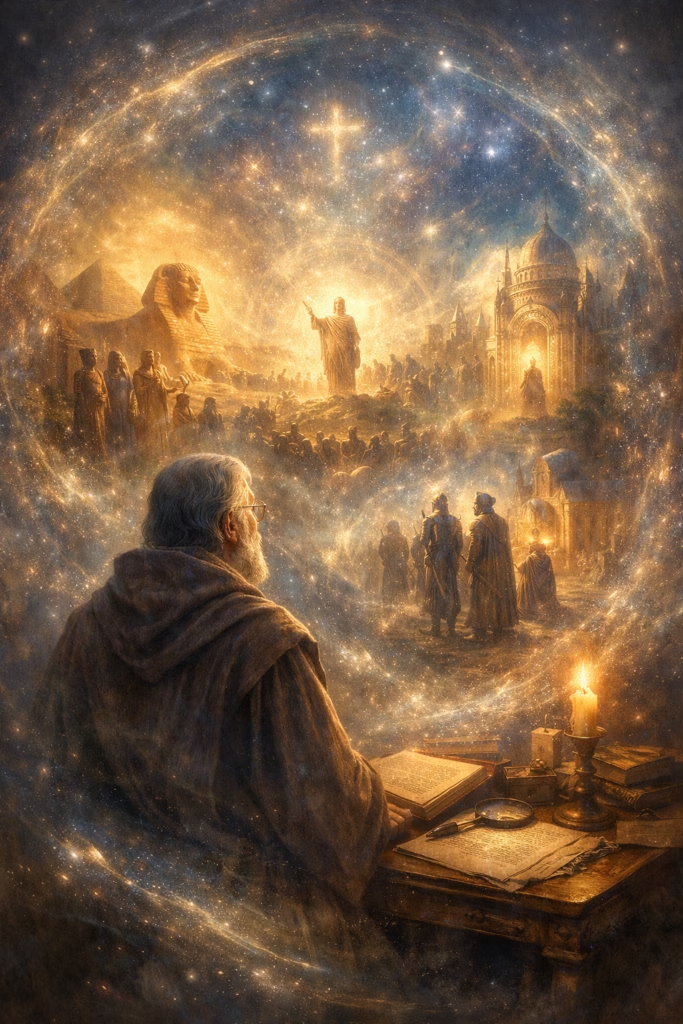
Heraclitus of Ephesus left behind barely more than a hundred surviving fragments, scattered across other people’s quotations, cryptic enough that ancient tradition nicknamed him “The Obscure” and later historians have argued for centuries over what half of them even mean. Rudolf Steiner read him as something considerably more specific than an eccentric proto-scientist musing about fire and change. He read Heraclitus as a genuine initiate of the ancient Mysteries, someone whose famous obscurity was not confusion but discretion — writing for readers not yet ready to understand him.
The Philosopher Called “The Obscure”
In Christianity as Mystical Fact (GA 8), Steiner opened his account with an old description of Heraclitus’s own writing: his thoughts were “an impassable road,” offering only “dimness and darkness” to anyone entering unprepared, yet “brighter than the sun” to anyone already introduced to the Mysteries. Heraclitus is said to have deposited his book in the temple of Artemis — not, on Steiner’s reading, pious donation, but a statement about who the book was actually written for. The great Greek philosophers before Plato, Steiner argued, rested on exactly the same foundation as the Mystery cults, not casual speculation available to anyone with enough leisure to think hard.
You Cannot Step in the Same River Twice
Heraclitus’s most famous line survives only in paraphrase: we do not dip twice into the same wave, nor touch twice the same mortal being. Steiner’s reading pushes past the common modern gloss — “everything changes” — into something sharper. Heraclitus had “penetrated the nature of transitory things” precisely because he measured them against the eternal. “Life and death, waking and sleeping, youth and age are the same,” Heraclitus wrote; “this in changing is that, and that again this.” A person who has genuinely absorbed this no longer values life more highly than death out of unexamined habit.
Life and Death Are the Same Thing
Steiner draws out one of Heraclitus’s starkest fragments: “Hades and Dionysos are one and the same.” Dionysos, god of joyful growth; Hades, god of destruction — identified, flatly, as a single reality. Only someone who sees death in life and life in death, and beyond both the eternal that neither can touch, is in a position to judge existence rightly. Even apparent imperfection is justified this way — illness makes health sweet, hunger makes food appreciated, toil makes rest worth having.
The Bow and the Lyre
Steiner singles out one image as carrying the deepest content of Heraclitus’s outlook: “The harmony of the world returns upon itself, like that of the lyre and the bow” — both instruments working by holding opposite tensions taut against each other, and it is precisely this opposition, not its absence, that produces the sound. This becomes Heraclitus’s famous and frequently misunderstood claim that Strife is the “Father of things,” though — Steiner is careful to note — only of things, the world of becoming, never of the eternal itself. What strife reveals, properly understood, is not chaos. It is harmony, achieved through tension rather than through its absence.
The full article on Substack covers why Steiner insists Heraclitus’s fire was never simply a physical element or simply a symbol but genuinely both at once, his reading of “eternity is a child at play” as the hinge of the philosopher’s entire ethics, and the far-reaching claim Steiner draws from the idea that “a man’s daimon is his destiny” — where reincarnation, he argues, emerges directly from Heraclitus’s own premises. Free to read on Substack.
Read the full article free on Substack →