What does it mean to truly know the world? For the past several centuries, the dominant answer has been provided by the method of mainstream, quantitative science. It is a method of immense power, one that has allowed us to analyze matter into its smallest parts, to understand physical laws with incredible precision, and to build the technological world we inhabit. Yet, for all its power, this approach comes at a cost. In its quest for objectivity, it has created a chasm between the observer and the observed, between the human soul and the living world of nature. It teaches us about the world, but it often leaves us feeling like strangers within it. This article will provide an introduction to Goethean science, a different path of knowing that seeks to heal this divide.
Developed by the great German poet and scientist Johann Wolfgang von Goethe, and later elaborated by Rudolf Steiner as the epistemological foundation for spiritual science, this approach is a qualitative, phenomenological science. It is a path that seeks to understand the living wholeness of a phenomenon, rather than just its dead parts. It is a method that requires the active, inner participation of the scientist, training the human mind to become a sensitive instrument of perception. Through this “delicate empiricism,” we can learn to see not just the outer forms of nature, but the living, spiritual archetypes at work within them. This introduction to Goethean science is an invitation to embark on a journey of seeing, a path that can lead to a conscious perception of the spirit that is alive and active in the world all around us.
The Limits of a Quantitative Worldview
When Knowing Kills
To appreciate the revolutionary nature of Goethe’s approach, we must first understand the method it seeks to complement and correct. The standard scientific method, born in the age of Galileo and Newton, is based on several key principles. It isolates a phenomenon from its context, it breaks it down into its smallest measurable parts, it formulates an abstract hypothesis or mathematical model, and then it tests that model through repeatable experiments. This method is perfectly suited for understanding the non-living, mineral world. The laws of physics that govern a falling stone are universal and quantifiable.
The problem arises when this same method is applied to the world of living beings. When a biologist seeks to understand a living plant by dissecting it, analyzing its chemical components, and sequencing its genome, they undoubtedly learn many true and important facts about the plant. But in the very act of this analysis, the one thing they lose is the essential quality of the plant: its life. The living, growing, developing wholeness has vanished, leaving only a collection of dead parts. The approach that seeks to know life ends up studying only its corpse.
This creates a profound alienation. The scientist, as a conscious, thinking, feeling observer, is taught to distrust their own experience. The vibrant color of the flower is dismissed as “just” wavelengths of light; the beauty of its form is reduced to the expression of genetic code. The living “Thou” of nature is turned into a dead “It.” This leads to the great paradox of our time: we know more about the world than any previous generation, yet we often feel less connected to it. Goethe saw this danger unfolding in his own time and dedicated a huge portion of his life to forging a different way of seeing, a science that could know the world without killing it.
The Goethean Method: A Science of Living Wholeness
The Conversation with Nature
Goethe called his method a “zarte Empirie,” which can be translated as a “delicate” or “gentle empiricism.” It is empirical because it begins, like all true science, with the most exact and careful observation of the sense-perceptible phenomena. But it is delicate because it does not immediately leap to an abstract theory or try to force the phenomenon into a pre-existing model. Instead, it calls for a new kind of inner activity from the scientist. The path of Goethean science can be seen as a four-step process.
- Exact Sense Perception: The first step is to observe with the utmost care, using all the senses. One draws the plant from every angle, at every stage of its growth. One notes the texture of its leaves, the scent of its flower, the way it relates to the light and the soil. One gathers a wealth of pure, untheorized observations.
- Exact Sensorial Imagination: In the second step, the scientist moves from the outer world to the inner. They close their eyes and, in their mind’s eye, try to re-create the plant in vivid, living pictures. They move in their imagination from the seed to the seedling, to the unfolding leaves, to the flower, to the fruit, and back to the seed. They are not just remembering a static image; they are re-living the plant’s entire life-process of growth and decay within their own consciousness. This requires a disciplined and mobile imagination.
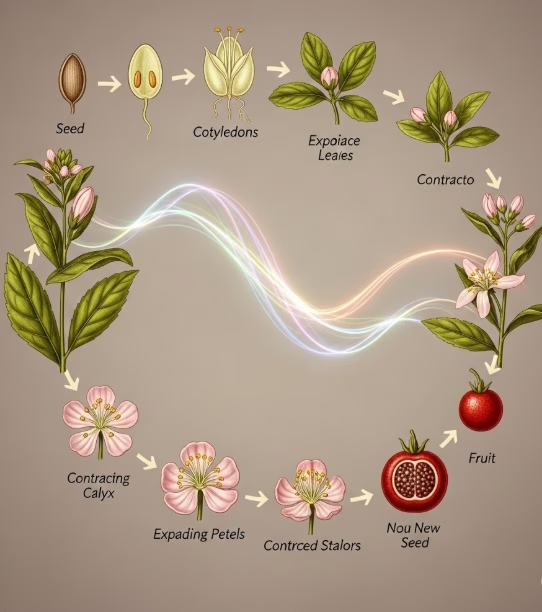
- Seeing the Gesture (Inspiration): Through this sustained inner activity, a new level of perception can dawn. The scientist begins to perceive the underlying gesture, the dynamic principle that is at work. In the case of the plant, they might perceive a continuous rhythm of expansion and contraction. The seed is a point of extreme contraction. The green leaves expand outwards into space. The flower calender (the calyx) is a contraction. The flower petals are a radiant expansion. The stamens and pistil are another contraction, which then leads to the expansive fruit, which in turn contains the contracted seed. The scientist begins to “feel” or “hear” the formative principle at work. This is a moment of what spiritual science calls Inspiration.
- Beholding the Archetype (Intuition): At the highest stage, the scientist can, in a moment of insight, directly behold the pure, non-physical archetype that is manifesting itself in all these varied forms. They perceive the Urpflanze, the Archetypal Plant, which is not a physical ancestor but a living, spiritual “idea” or formative principle. This is a moment of Intuition, a loving union of the knower with the inner, creative essence of the thing known. At this stage, thinking itself becomes a perceptual organ. The scientist does not think about the plant; their thinking becomes one with the creative thinking of nature itself. This introduction to Goethean science is, therefore, also an introduction to a path of inner development.
The Archetypal Plant: Seeing the One in the Many
Goethe’s Journey to Italy
The most famous example of Goethe’s method is his discovery of the metamorphosis of plants. During his journey to Italy in the 1780s, he was overwhelmed by the rich diversity of plant life. But his scientific mind was not satisfied with just cataloging different species. He felt an inner certainty that behind this immense variety, there must be a unifying law, a single principle. He searched tirelessly for an Urpflanze, an Archetypal Plant, from which all others could be derived.
At first, he looked for it as a physical plant, thinking he might find it in some hidden corner of a botanical garden. But he gradually came to realize that the Archetypal Plant was not something that could be found with the physical eyes. He wrote from Naples: “The Archetypal Plant will be the most wondrous creation in the world, for which Nature herself shall envy me. With this model and the key to it, one can invent plants endlessly which, even if they do not exist, could exist… The same law will be applicable to all that lives.”
His great breakthrough was the realization that the archetype lives not in a single form, but in the process of transformation itself. He saw that all the different organs of a flowering plant are, in essence, modified leaves. The seed-leaf (cotyledon), the green foliage leaf, the sepal of the calyx, the colorful petal of the corolla, the stamen, and the pistil—all are metamorphoses of one and the same fundamental organ. The plant rhythmically transforms this single “leaf” idea, now expanding it, now contracting it, now refining it for photosynthesis, now coloring it for reproduction. The whole plant is a symphony played on a single note. The Urpflanze is this law of metamorphosis, a dynamic spiritual principle that can be grasped by a thinking that has made itself as mobile and alive as nature itself.

The Theory of Colors: The Deeds and Sufferings of Light
Rescuing the Phenomenon
Goethe’s other great scientific work was his Theory of Colors, a book he considered more important than all his literary works. He launched a direct challenge to the prevailing Newtonian theory of optics. Newton, in his famous experiment, had darkened a room, allowed a single beam of sunlight to pass through a prism, and observed the resulting spectrum of colors on the wall. From this, he concluded that white light is a composite of all the colors, which are revealed when it is broken apart.
Goethe saw this as a form of torture. He argued that by isolating the light and forcing it through an artificial apparatus, Newton had created a special case and mistaken it for the whole truth. Goethe’s approach was to look at color where it actually appears in the world, in the rich phenomena of our everyday experience. This introduction to Goethean science shows us a method that respects and values human experience.
Goethe’s fundamental discovery was that color is not something in the light itself, but is born from the dynamic interplay of Light and Darkness. Color is a phenomenon that arises at the boundaries, at the edges where light and shadow meet. He performed thousands of experiments, always working with whole phenomena. He looked through prisms at bright walls against dark backgrounds, and dark walls against bright backgrounds.
He discovered two primary poles of color:
- The Yellow Pole (The Plus Side): When we look at light through a turbid or dense medium, it appears yellow, then orange, then red. Think of the sun at sunset, its light passing through a greater density of atmosphere. Yellow, for Goethe, is light that has been slightly overcome or “darkened” by darkness. It is an active, advancing color.
- The Blue Pole (The Minus Side): When we look at darkness through an illuminated medium, it appears blue, then indigo, then violet. Think of the darkness of space seen through the sunlit atmosphere of the Earth—the sky is blue. Blue, for Goethe, is darkness seen through light. It is a passive, receding color.
Green, the color of the plant world, arises as a living balance when the yellow pole and the blue pole meet and harmonize. Magenta (a color not present in Newton’s linear spectrum) arises as an intensification, a “glorification,” when the two ends of the spectrum, red and violet, are brought together in a circle.
For Goethe, color was not a subjective illusion created by our eyes, nor a mere mechanical property of light waves. Colors were the “deeds and sufferings of light,” living qualities that revealed a cosmic drama. His science of color is a science that includes the human being as a participant, not just a detached observer.
Conclusion: A Science for the Future
An introduction to Goethean science is an introduction to a new relationship with the world. It is a path of knowledge that seeks to heal the rift between the human spirit and the spirit in nature. It does not reject the findings of quantitative science, but it seeks to embed them within a larger, more living context. It shows us that true knowing is not a passive reception of data, but an active, creative, and transformative process. To study nature in the Goethean way is to enter into a conversation with it.
This method is more than just a historical curiosity. It is the necessary foundation for any future science that wishes to understand life. It is the basis for a truly holistic medicine, an ecological agriculture, and an education that can nurture the whole human being. The journey of Goethean science is a path of inner development. By learning to observe the world with “delicate empiricism,” by re-creating its processes within our own mobile thinking, we not only come to know the world more deeply, but we also transform ourselves. We learn to think the creative thoughts of the cosmos, and in doing so, we begin to perceive the spirit that lives and weaves through all things. It is a path that leads, ultimately, from knowing about the world to a loving communion with it.