The economic life of modern humanity is beset by contradictions. It has generated unprecedented material wealth, yet it has produced staggering inequalities. It has connected the globe through trade, yet it has pitted human beings against one another in ruthless competition. It has given us immense technological power, yet it threatens to exhaust the very planetary life upon which it depends. These are the symptoms of a deep sickness in our social organism, a sickness that arises from a fundamental error in our thinking: the belief that economic life can be understood and managed on its own, through purely material laws of supply, demand, and self-interest.
This article will explore the principles of a spiritual economy, drawing upon the insights of the social science inaugurated by Rudolf Steiner. We will discover that a healthy economy cannot exist in isolation, but can only thrive as one of three autonomous yet interwoven spheres of a “Threefold Social Organism.” We will unveil the fundamental moral law that must stand as the guiding principle of this sphere—the law of brotherhood. We will explore the practical means of its realization through “associative economics,” and we will come to a new, spiritual understanding of the true nature of labor, capital, and money. To contemplate a spiritual economy is not to dream of a utopia, but to recognize the objective spiritual laws upon which a just, sustainable, and truly human social future must be built.
The Threefold Social Organism: The Foundation for a Healthy Economy
The Three Spheres of Social Life
To heal the economic life, we must first correctly diagnose the illness of the entire social body. A spiritual-scientific view of society sees it not as a monolithic entity, a “state,” but as a living, threefold organism, analogous to the threefold constitution of the human being (head, rhythmic system, and metabolic system). For the social organism to be healthy, its three distinct spheres of life must be recognized and allowed to function autonomously, each according to its own guiding principle.
- The Cultural-Spiritual Sphere: This is the sphere of the “head.” It includes education, art, science, and religious or spiritual life. Its guiding principle must be Freedom. The human spirit can only flourish where it is free to create, to teach, and to learn, unconstrained by the dictates of the state or the pressures of the economy.
- The Political or Rights Sphere: This is the sphere of the “rhythmic system,” the heart of social life. It is the proper domain of the state, concerned with law, justice, and the protection of human rights. Its guiding principle must be Equality. In this sphere, and only in this sphere, every person is to be treated as absolutely equal before the law.
- The Economic Sphere: This is the sphere of the “metabolic system.” It concerns the production, circulation, and consumption of all goods and services. Its guiding principle must be Brotherhood or cooperation.
The crises of our time stem directly from the fact that we have pathologically entangled these three spheres. The state (the rights sphere) attempts to manage and control education and culture, stifling their freedom. And most pervasively, the economic sphere has hypertrophied, growing like a cancer and imposing its principles of profit and utility upon both the state and the cultural life. We have turned our governments into managers for corporate interests and our universities into training centers for the economy. A spiritual economy can only arise when it is disentangled from the other two spheres, when it is allowed to operate according to its own true, brotherly nature.
The Law of Brotherhood: Overcoming the Profit Motive
The Reversal of Self-Interest
What is the fundamental law of a healthy economic life, when it is freed from the alien principles of state control or the abstract pursuit of freedom (as in pure libertarianism)? The fundamental law of a spiritual economy, the objective principle upon which its health depends, is a complete reversal of the motive of self-interest. It can be formulated thus:
The well-being of a community of people working together will be the greater, the less the single individual claims for himself the proceeds of his work, i.e., the more of these proceeds he makes over to his fellow-workers, and the more his own needs are satisfied, not out of his own work, but out of the work of others.
This is not a sentimental appeal for charity or a call for altruistic self-sacrifice within our current, egoistic system. It is a description of an objective spiritual fact. It is the principle of the division of labor taken to its moral and spiritual conclusion. In a healthy organism, the eye does not see for itself; it sees for the whole body. The hands do not work to feed themselves; they work to feed the whole body, which in turn nourishes the hands.
So it must be in the economic organism. The farmer does not, in a healthy economy, farm in order to acquire profit for himself. He farms to provide food for the community, for the tailor, the teacher, and the doctor. The tailor, in turn, does not make clothes to enrich herself, but to clothe the farmer and the others. Each person works for all the others, and in turn, has their own needs met by the work of all the others. This principle of brotherhood, of working consciously for the needs of others, is the only moral foundation for a truly human economy.

Associative Economics: The Conscious Management of Production and Consumption
The Visible Hand of Human Cooperation
How can such a principle of brotherhood be put into practice? It is not through state decree (as in communism) nor through the chaotic workings of the “invisible hand” of the free market (as in capitalism). Both of these systems are abstract and inhuman, treating the human being as a cog in a machine or a commodity to be exploited.
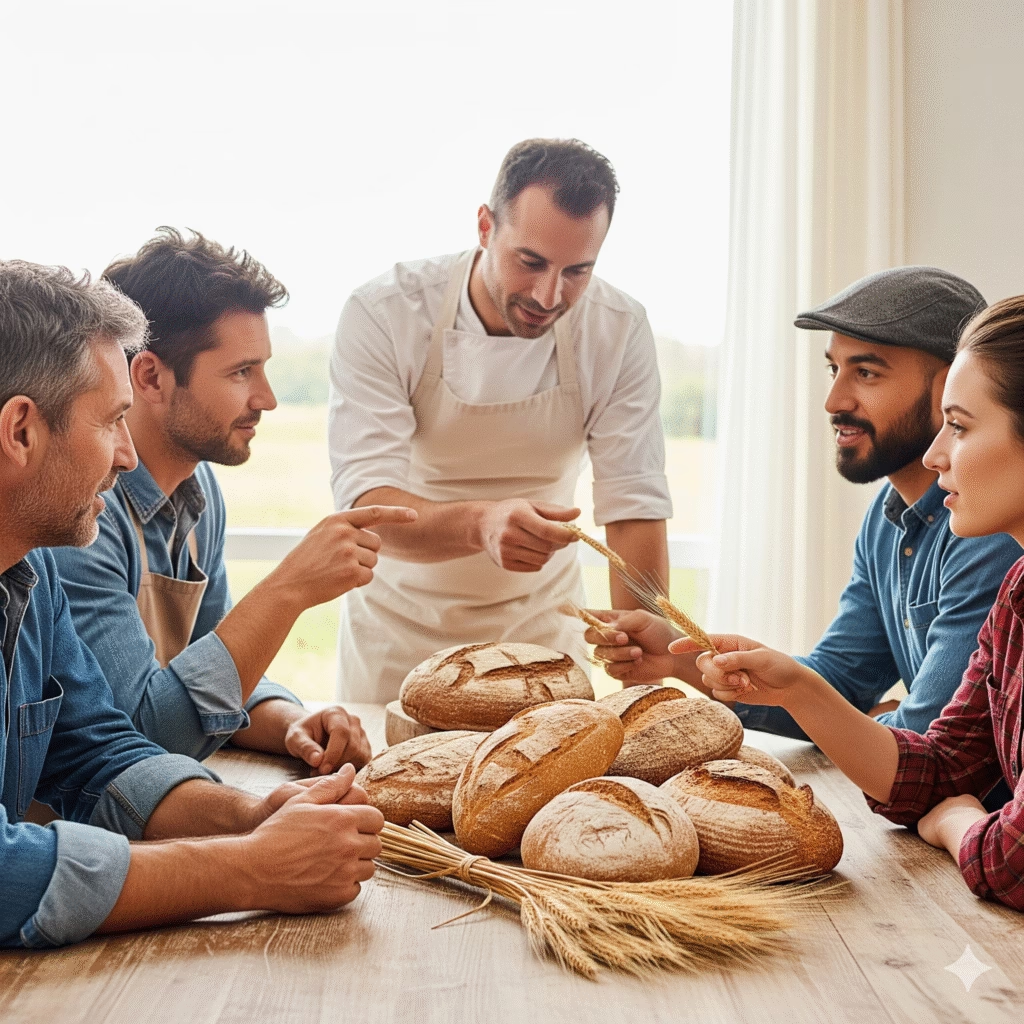
The practical mechanism for a spiritual economy is Associative Economics. This means that within each branch of industry, free Associations would be formed, consisting of representatives of the three key groups: the Producers, the Distributors (or traders), and the Consumers. An association for the production of bread, for example, would include farmers, millers, bakers, shippers, retailers, and the consumers of bread.
The task of these associations would not be to fix prices or to form cartels, but to bring a living, conscious, and transparent understanding to the entire economic process. Through open dialogue, they would seek to gain a real insight into the genuine needs of the community and the true realities of production. They would ask the essential questions: What is the real need for this product? What is its true cost, not just in money, but in human labor and in its effect on the Earth? What constitutes a just price, a price that allows the consumer to buy, the distributor to function, and the producer to live a dignified human life and to properly care for their land and workers?
Associative economics replaces the blind, egoistic, and often destructive force of competition with the conscious, intelligent, and collaborative cooperation of the human beings who are actually involved in the process. It is the means by which brotherhood can be practically realized.
The True Nature of Money, Capital, and Labor
Redeeming the Elements of Economic Life
A spiritual economy requires a complete re-imagining of its core components, freeing them from the illusions that have grown up around them.
- Labor: Human labor is not a commodity to be bought and sold on a market. The creative capacity and the life-time of a human being belong to the sphere of inalienable human rights. In a threefold society, the concept of a “wage” would disappear. Instead, each individual would receive an income based on their right, as a human being, to a dignified existence and the means to participate in the cultural life. This income is determined by the rights-sphere, not by the economic bargaining of the market. The work one does is one’s contribution back to the community that supports one’s existence.
- Capital: Capital, in its true sense, is spirit applied to economic life. It is the insight, the creativity, and the intelligence that directs labor and resources. The right to direct capital should therefore not be based on hereditary ownership, but on the proven spiritual and practical capacity of an individual to use it for the good of the community. Capital should be seen as a trust, a “loan” of resources from the community to the capable individual for a specific task. When that individual retires or the task is complete, the capital and the right to direct it should flow back to the social organism, to be placed in the hands of the next most capable person, not passed down to an heir who may have no such ability.
- Money: Money, in its true nature, is not wealth to be hoarded. It is the “blood” of the economic organism, and its health depends on its constant, unimpeded circulation. Money is a social convenience, a tool that allows the deed of one person to be connected to the need of another. When it is taken out of circulation and hoarded as a commodity, it is like a blood clot in the social body, causing sickness and decay. A truly spiritual understanding of money would lead to forms of currency that encourage its flow rather than its accumulation.
Land and Property: A Question of Stewardship
Finally, a spiritual economy must come to a new understanding of our relationship to the Earth itself. Land, the basis of all economic life, is, like the air we breathe and the water we drink, a common inheritance of all humanity. It cannot, in a moral sense, be “owned” as a commodity to be bought and sold for speculative profit.
The concept of private ownership of land must be replaced by the concept of stewardship. The right to use a piece of land should be entrusted to the individual or the community that is most capable of working it in a healthy and productive way for the good of the whole society. This right of use would last for as long as the land is being properly cared for and is serving a genuine social need. It is a right based on competence and service, not on a deed of ownership that can be held in perpetuity, regardless of how the land is used or abused.
Conclusion
The principles of a spiritual economy present a radical and challenging vision, one that calls into question the most basic assumptions of our modern world. Yet, it is a vision that is not a utopian fantasy, but is based on a deep and realistic insight into the spiritual laws that govern social life. It recognizes that the economic sphere is a sphere of human relationships, and that it can only be healthy when it is guided by the most human of principles: brotherhood.
The economic crises that rack our world, the social unrest, and the ecological devastation are the Earth’s cry of pain, a call for humanity to awaken from its materialistic slumber. They are a summons to begin the great and difficult work of rebuilding our social life on a new and spiritual foundation. The path to this future is the threefold path of a free culture, a democratic state of rights, and an economy of true, associative, and brotherly cooperation. The task of our age is to transform the economy from a battlefield of egoism into a living expression of our shared humanity.