Many people today feel a deep yearning. They long to understand realities beyond our everyday physical senses. Is it possible to consciously develop faculties for spiritual perception? Rudolf Steiner’s spiritual science, Anthroposophy, answers with a resounding “yes.” He outlined a clear, modern path. This path enables individuals to awaken slumbering spiritual capacities. It allows them to gain direct knowledge of higher worlds. Understanding the “Rudolf Steiner Path to Higher Worlds and spiritual perception” offers a systematic approach. It is a journey of inner development and transformation. This article explores Steiner’s practical steps. It details the moral qualities needed. It also describes the stages of higher cognition. Furthermore, it highlights the relevance of this path for contemporary spiritual seekers.
A Modern Path of Initiation: Conscious Spiritual Development
Rudolf Steiner emphasized that the path to higher knowledge in our time must be a modern path. This means it is suitable for individuals fully engaged in contemporary life. It does not require withdrawal into seclusion. Instead, it involves conscious effort. It relies on clear thinking. It also demands ongoing moral development. (See GA 10, Knowledge of the Higher Worlds and Its Attainment). This contrasts with some older spiritual traditions. Those might have involved more passive methods or different states of consciousness. Steiner’s path cultivates an enhancement of waking consciousness. It expands it to include perception of soul and spirit. It is a path of active inner work.
Foundations for the Journey: Essential Moral Qualities
Before embarking on specific exercises, Rudolf Steiner stressed the importance of certain foundational moral qualities. These qualities prepare the soul. They make it a suitable vessel for spiritual experiences. Without them, attempts at esoteric development can be unfruitful or even harmful.
- Reverence and Veneration: A deep feeling of reverence for truth and knowledge is crucial. This includes veneration for the great spiritual truths and beings. This attitude opens the soul to receive higher influences.
- Inner Calm and Composure: The ability to find inner quietude amidst life’s distractions is essential. This allows subtle spiritual impressions to be perceived.
- Patience and Perseverance: Spiritual development is a gradual process. It requires steadfast effort over time. Quick results are rarely the case. Impatience can be a significant hindrance.
- Truthfulness and Honesty: Absolute inner truthfulness towards oneself and others is a cornerstone. The spiritual world is a world of truth. Only a truthful soul can approach it.
- Love for Humanity and All Beings: A selfless interest in and love for the world and its creatures is vital. Egotistical motives obstruct true spiritual perception.
Cultivating these qualities creates a healthy soul foundation. This foundation supports safe and fruitful esoteric training. These are not just preliminary steps. They are ongoing attitudes to be nurtured throughout the path.

The Six Basic (Ancillary) Exercises: Strengthening the Soul Faculties
To further strengthen the soul for higher cognition, Rudolf Steiner gave six “basic” or “ancillary” exercises (Nebenübungen). These exercises cultivate control over thinking, feeling, and willing. They bring harmony to the soul life. (See Six basic exercises Rudolf Steiner and GA 245/42, Guidance in Esoteric Training).
- Control of Thought (Concentration): For about five minutes daily, focus the mind on a simple, self-chosen object (e.g., a pin, a seed, a simple concept). Exclude all other thoughts. This strengthens mental focus.
- Control of Will (Initiative of Action): Perform a small, new action each day. This action should be chosen freely by oneself. It should be something one would not ordinarily do. This strengthens the will.
- Equanimity of Feeling: Strive to maintain inner balance in the face of fluctuating feelings. Observe strong emotions of joy and sorrow without being overwhelmed by them. This cultivates mastery over the feeling life.
- Positivity (Affirmation): Practice seeking the good, true, and beautiful in all experiences, beings, and even in challenging situations. Suspend negative judgment where possible. This opens the soul to positive spiritual realities.
- Open-mindedness (Unprejudicedness): Approach new ideas and experiences with an open mind. Be willing to listen and learn, even if something seems strange or contrary to existing beliefs. This fosters flexibility of thought.
- Harmony of the Soul Faculties (Often described as a result of the first five): Strive to bring these cultivated capacities of thinking, feeling, and willing into a balanced, harmonious interplay in daily life.
Regular practice of these exercises brings greater inner stability. It also enhances concentration. Furthermore, it prepares the soul for the more specific meditative work involved in attaining spiritual perception.
The Three Stages of Higher Cognition: Unveiling Spiritual Worlds
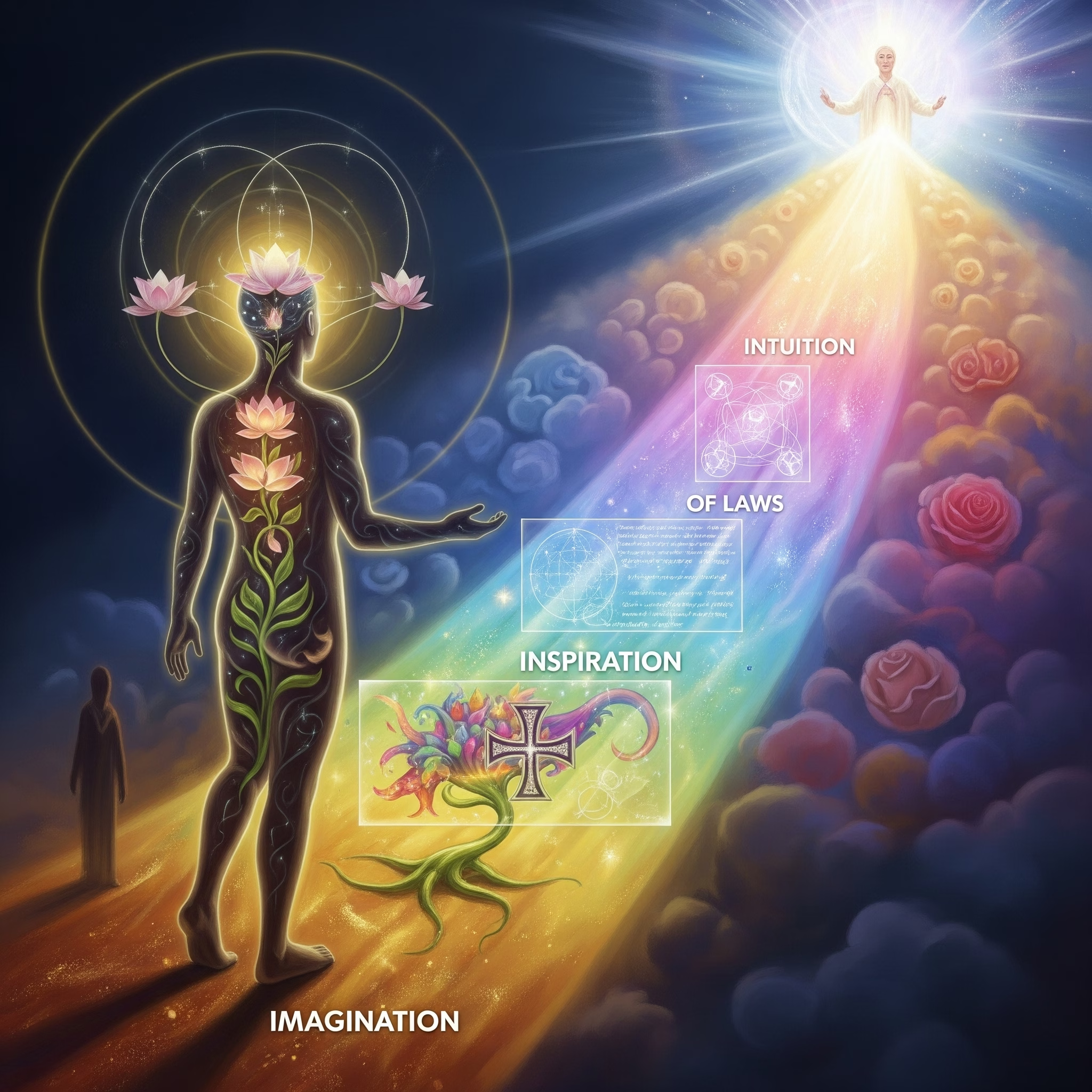
Rudolf Steiner described three main stages of conscious spiritual perception. These are attained through specific meditative practices. These stages are Imagination, Inspiration, and Intuition.
Stage 1: Imagination – Seeing the Soul-Spiritual World
The first stage is Imagination. In Steiner’s specific sense, this is not fantasy or ordinary mental picturing. It is a higher form of perception. It is a conscious, pictorial clairvoyance. The student learns to perceive spiritual realities as living, mobile, symbolic images. These images are not arbitrary. They are objective expressions of spiritual beings and processes.
Exercises to awaken Imaginative perception often involve meditating on:
- Symbols: Such as the Rosicrucian cross, or other universal symbols.
- Natural Processes: For example, the growth and decay of a plant, followed by its arising from a seed. Visualizing this cycle in vivid inner pictures.
- Specific Thoughts or Mantras: Given by a qualified spiritual teacher.
Through such practices, the student gradually awakens spiritual sense organs. Steiner called these “lotus flowers” (chakras). These are located in the etheric and astral bodies. As these organs develop, the soul world (astral world) and the world of life forces (etheric world) begin to open up to conscious perception. The individual starts to see the soul-auras of beings. They perceive the formative forces in nature. This is a new way of experiencing reality.
Stage 2: Inspiration – Reading the Occult Script and Hearing the Cosmic Word
The next stage is Inspiration. This stage leads beyond the pictorial world of Imagination. The student learns to penetrate behind the spiritual images. They begin to grasp the underlying spiritual laws, relationships, and beings. It is like learning to read an “occult script.” The meaning behind the symbols and images is unveiled.
Exercises for Inspiration often involve a further intensification of meditation. The student may learn to “efface” the imaginative pictures. This allows the underlying spiritual reality to speak directly to the soul. At this stage, one may begin to experience a kind of spiritual hearing. This is an understanding of the “cosmic word” or Logos. It is the creative spiritual sound that underlies existence. One perceives the inner connections between spiritual beings and their creative activities. This brings a profound understanding of cosmic harmony.
Stage 3: Intuition – Becoming One with Spiritual Beings and Processes
The highest of these three stages is Intuition. Here, the distinction between the perceiver and the perceived spiritual reality diminishes. The student achieves a direct, loving union with spiritual beings and processes. It is no longer a matter of “seeing” or “hearing” the spiritual world from a distance. It is an immersion within it. One experiences the true being of other entities from within. This includes spiritual hierarchies.
Intuition brings the most profound self-knowledge. It also brings cosmic knowledge. The individual experiences their own ‘I’ as a spiritual being among other spiritual beings. They directly perceive the spiritual currents that flow through evolution. This stage represents a deep merging with the spiritual foundations of existence. It is a state of profound wisdom and selfless love.
Key Experiences on the Path: The Guardians of the Threshold
As the student progresses on the path to higher worlds, they encounter certain spiritual experiences. Among the most significant are the meetings with the Guardians of the Threshold.
- The Lesser Guardian of the Threshold: This is a being the student meets as they begin to cross from the sensory to the supersensible world. The Lesser Guardian is, in a sense, an objective manifestation of the student’s own unredeemed karma. It is the sum of their past errors, weaknesses, and the consequences of their negative actions across lifetimes. Meeting this Guardian can be challenging. It requires courage and self-honesty. However, it is a necessary step for true self-knowledge. It also shows what must still be transformed within the soul.
- The Greater Guardian of the Threshold: At a later stage, usually after passing through Inspiration, the student encounters the Greater Guardian. This is a sublime, radiant spiritual Figure. This Guardian reveals the divine standard of spiritual perfection. He shows what humanity is ultimately destined to become. This encounter can be awe-inspiring. It also instills a deep sense of responsibility. It strengthens the resolve to continue the path of spiritual development.
These encounters are not meant to deter. They are meant to purify and strengthen the seeker. They ensure that progress into the spiritual world is made with full consciousness and moral responsibility.
Practical Guidance and Safeguards in Esoteric Development
Rudolf Steiner always emphasized the importance of certain safeguards for those undertaking esoteric training:
- Maintaining a Healthy Connection to Earthly Life: Spiritual development should not lead to detachment from everyday responsibilities or common sense.
- Sound Judgment: The ability to think clearly and critically must be preserved and even enhanced.
- Moral Development: This must always accompany spiritual exercises. Without it, newly awakened faculties can be misused or lead to illusion.
- Patience and Avoiding Egoism: Spiritual pride is a significant danger. True progress is marked by humility and a desire to serve.
- The Role of Guidance: While the path is one of individual effort, the guidance of a trustworthy spiritual teacher or well-tested spiritual traditions can be invaluable, especially in the early stages. Steiner’s written works themselves offer such guidance.
The Fruits of Spiritual Training: Transformation for Self and World
The path to higher worlds is not pursued for selfish reasons. Its fruits are transformative for both the individual and, ultimately, for humanity. Through such training, one can attain:
- Deepened Self-Knowledge: Understanding one’s own spiritual nature, karma, and destiny.
- Direct Perception of Spiritual Realities: Experiencing the etheric and astral worlds, and the beings within them.
- Understanding of Cosmic Laws: Grasping the spiritual principles behind evolution, history, and human life.
- Moral Strength and Compassion: The path inherently cultivates higher moral qualities.
- The Capacity for Spiritual Service: Awakened spiritual faculties can be placed in the service of human progress and healing.
Ultimately, this path of modern initiation is connected to the Christ impulse. The Christ Being, who incarnated in Jesus of Nazareth and accomplished the Mystery of Golgotha, is seen by Steiner as the great Prototype for human development. He is also the supreme Helper on the path to the Spirit. His impulse works to awaken the divine potential within each human ‘I’. This reflects reverence for His divine being.
Conclusion: Awakening to Our Full Human Potential
Rudolf Steiner’s “Path to Higher Worlds” offers a clear, conscious, and systematic approach. It is for modern individuals who seek direct experience of spiritual realities. It is a path of rigorous inner work. It involves moral development and the careful cultivation of new perceptive faculties. Understanding Rudolf Steiner’s Path to Higher Worlds and spiritual perception opens the door. It allows us to see that these higher worlds are not distant or inaccessible. They are all around us and within us.
The journey through Imagination, Inspiration, and Intuition is a transformative one. It leads to profound self-knowledge. It fosters a deep understanding of the cosmos. It awakens the capacity to serve humanity with new spiritual insight and strength. It is a call to every individual. It encourages us to awaken our slumbering spiritual capacities. It urges us to embark on the adventure of becoming fully conscious citizens of both the physical and spiritual worlds. This is a path towards realizing our highest human potential.