Of the three soul faculties — thinking, feeling, and willing — the will is the most mysterious. Thinking is at least partially transparent to itself. Feeling is less accessible but still perceptible. The will, however, operates almost entirely in darkness. We do not experience ourselves willing in the moment of willing. We experience the result — the action is done, the choice is made — but the actual impulse of will that produced the action remained below the threshold of consciousness throughout.
Rudolf Steiner regards this unconsciousness of the will as one of the most significant facts about the human being at the present stage of evolution. He addresses it in GA 4 (“The Philosophy of Freedom”), GA 293 (“Study of Man”), and GA 170 (“The Riddle of Humanity”). The will is the most powerful faculty the human being possesses. Yet it is the faculty over which he exercises the least genuine conscious control. Understanding the will — and the path through which it can be developed toward genuine freedom — is one of the most practically significant tasks of the Anthroposophical path.
The Will as Sleep Within Waking Life
Steiner makes a remarkable statement in GA 293. The three soul faculties correspond to three states of consciousness. Thinking corresponds to waking — most active, most fully in the light of the “I.” Feeling corresponds to dreaming — less fully conscious, more fluid and emotionally charged. Willing corresponds to sleeping — operating in complete darkness, as unconscious as the metabolic processes that carry it.
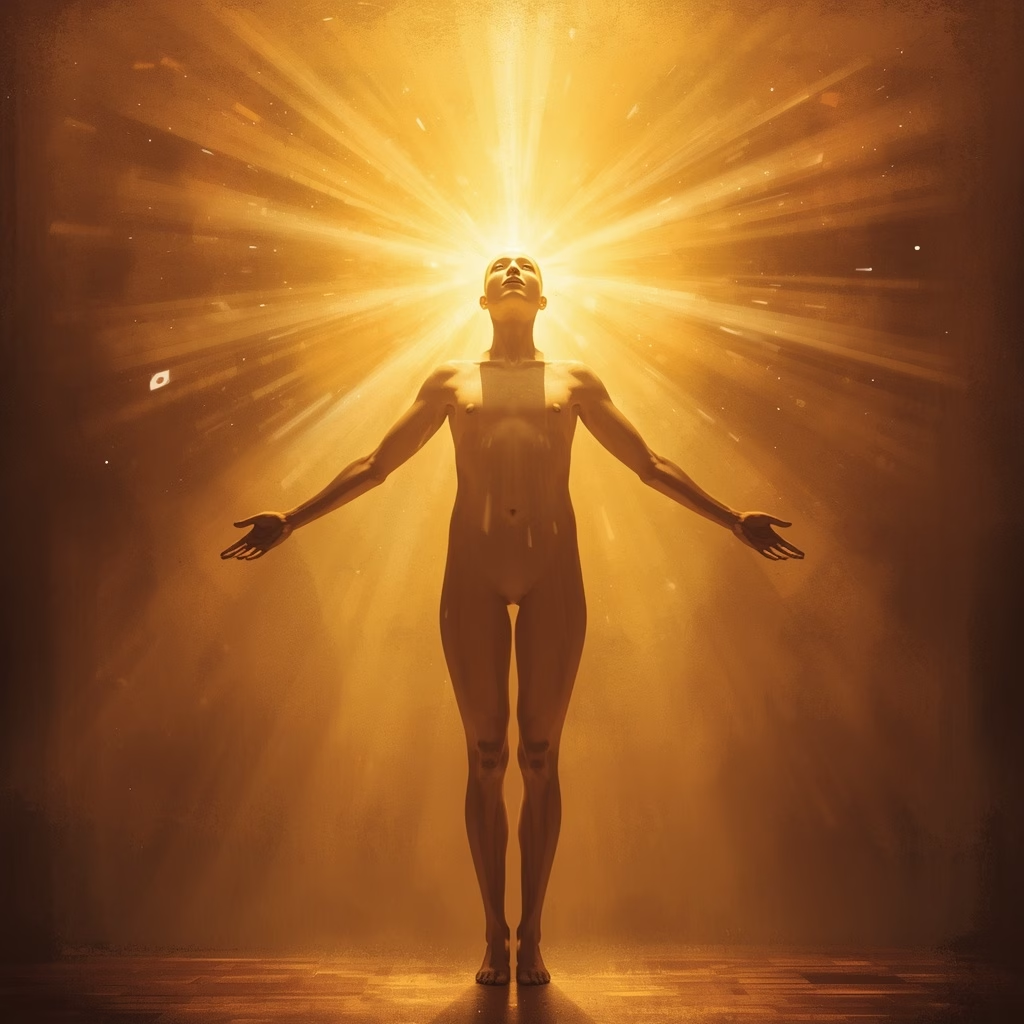
When a human being wills something, the actual process takes place in a condition equivalent to deep sleep. The “I” experiences the result but not the process. Consequently, the human being who has not developed his will is, in a specific sense, only half awake. His thinking moves in the light. But his will — the faculty that actually connects his inner life to the outer world — moves in complete darkness, driven by impulses whose origins he cannot examine.
Levels of Willing
Steiner distinguishes in GA 4 (“The Philosophy of Freedom”) between several levels of willing. At the lowest stands pure instinct — the automatic impulse acting without conscious participation. Above this stands drive, then desire, then wish. At the highest level stands pure moral intuition — willing that arises not from instinct, habit, or desire, but from a genuine, freely formed inner perception of what is right in this specific situation.
This hierarchy is a map of the developmental task. The human being at the present stage lives predominantly in the lower levels — driven by instincts, habits, and conditioned responses. The task of inner development is to raise the will progressively toward the highest level — toward the point where action arises not from unconscious compulsion but from freely formed, consciously perceived moral intuition.
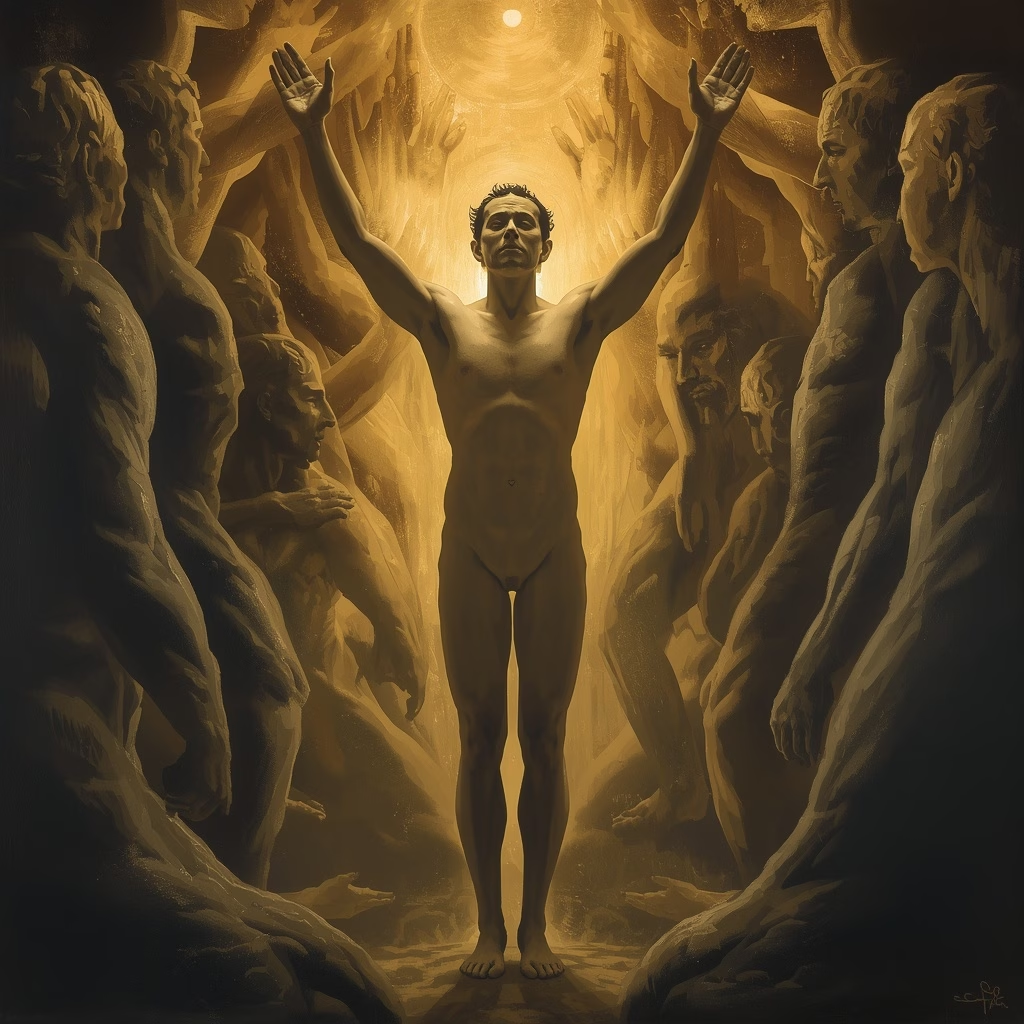
Genuine freedom — real moral freedom, not simply the absence of external constraint — is only possible when the will is governed by pure moral intuition. A person who acts from instinct is not free. A person who acts from habit is not free. Even a person who follows a general moral principle adopted from outside is not fully free — because he is following a rule rather than perceiving a specific moral reality directly. Genuine freedom is the condition in which the specific right action in this specific situation arises from direct, individual, creative moral perception. Steiner calls this ethical individualism — the highest expression of what it means to be an individual human being.
Practical Will Development
The most directly practical tool Steiner offers is the second subsidiary exercise — described in GA 10 (“How to Know Higher Worlds”). The exercise consists of performing one small, freely chosen, entirely trivial action at a fixed time each day — moving a specific object, performing a brief gesture — without external reminder.
The triviality is essential. The exercise works precisely because the action carries no other value or reward. Only freely chosen, freely remembered, and freely executed initiative of this specific kind builds the dimension of the will that genuine spiritual development requires.
Furthermore, Steiner emphasises that this exercise produces genuine fruits only through sustained practice over months and years — not through occasional engagement. The undeveloped will seeks the dramatic and immediately rewarding. The developed will sustains quiet, unspectacular effort across long periods without needing external reward. The very difficulty of maintaining a simple daily exercise is itself the developmental challenge — and the resistance encountered is the most precise indicator of how much genuine will development remains to be done.
Steiner also indicates that the will responds to rhythm more directly than to any other principle. A will impulse attached to a specific daily rhythm gains momentum that isolated, unrhythmical impulses cannot achieve. This is why every great tradition of inner development has organised its practices around specific rhythms — daily meditation, weekly gathering, annual festival. These are practical applications of the principle that the will develops most effectively through living rhythmic engagement.
The Will and the Future
Steiner indicates in GA 170 (“The Riddle of Humanity”) that the will is the soul faculty most connected with the future of human evolution. Thinking is most fully developed in the present. The will — most unconscious — belongs primarily to future evolutionary stages. The human being who develops genuine conscious will in the present age is anticipating, in a small but real way, a stage of development that will one day become the general human condition.
Furthermore, the will carries, in its depths, the seed of the future capacity for love. As the sleeping, instinctive impulse is gradually transformed into freely formed, consciously perceived moral action, it simultaneously becomes capable of the kind of selfless, freely chosen, creatively responsive love that is the ultimate goal of Earth evolution.
The full article on Substack covers the complete hierarchy of will levels from instinct to moral intuition, the deep connection between the will and the physical organism, and Steiner’s complete account of ethical individualism and genuine human freedom. This is a paid article.
Read the full article on Substack — paid subscribers only →
Paid subscribers receive all articles in full plus an exclusive monthly guided reading of a Steiner text. Join here →https://anthroposophist.substack.com/