
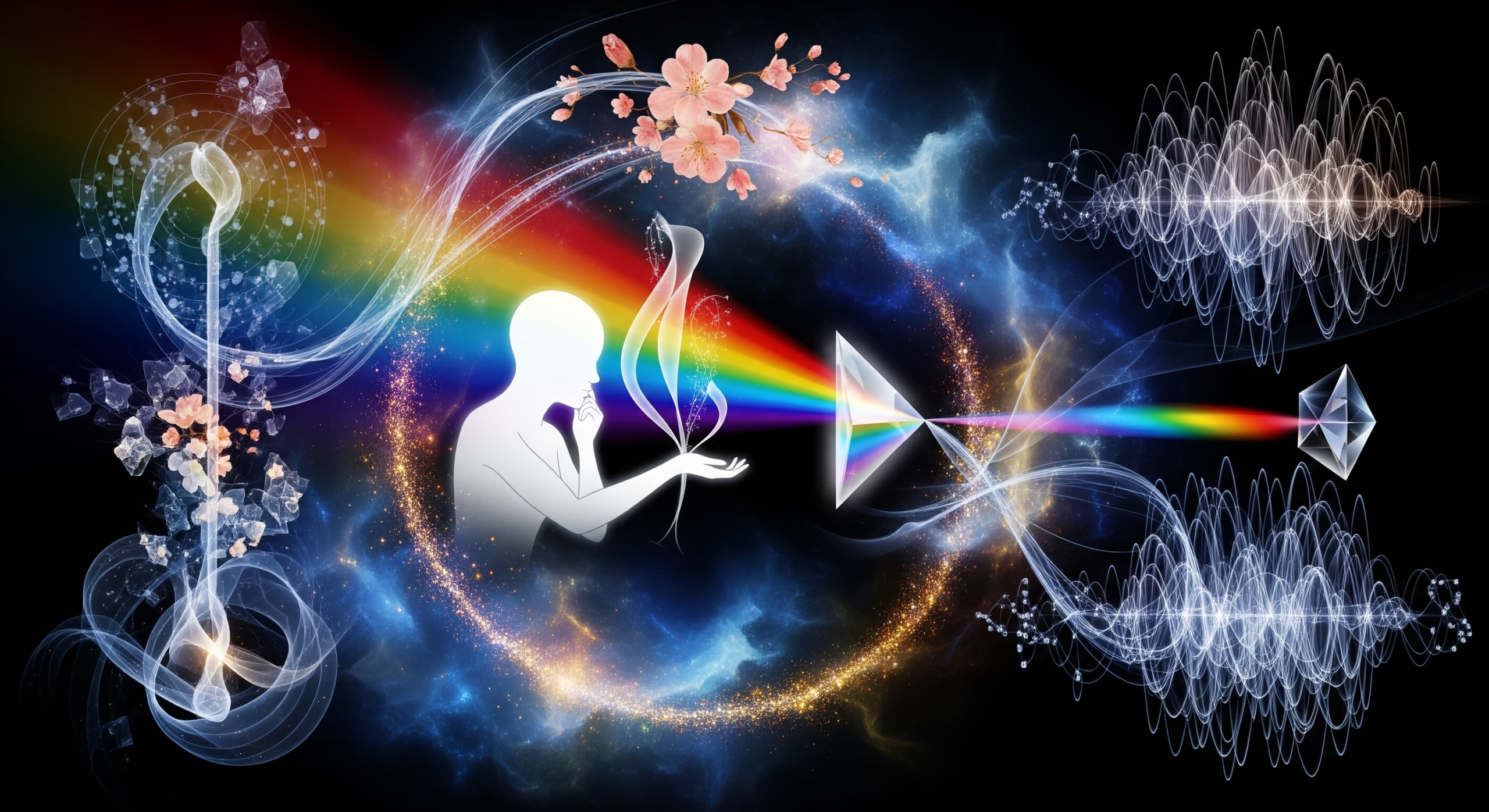
Modern physics has unveiled incredible aspects of our material universe. It has also given us powerful technologies. Yet, its predominantly quantitative and mechanistic worldview often struggles. It struggles to encompass the fullness of life, consciousness, and spirit. Is there a way to understand the physical world that integrates these deeper dimensions? Rudolf Steiner’s spiritual science, Anthroposophy, offers such a path. His series of lectures known as “The Light Course” (GA 320) presents a radical, spiritual-scientific re-evaluation. It re-evaluates phenomena like light, color, sound, electricity, and matter. Understanding “Rudolf Steiner Light Course physics spiritual science” reveals a journey. This journey is into the qualitative, spiritual origins of physical reality. It connects deeply with Goethean scientific principles. This article explores Steiner’s unique insights from The Light Course. It examines his challenge to conventional views. It also shows his vision for a science that embraces both spirit and matter.
Beyond Materialism: The Call for a Spiritualized Understanding of Nature
Rudolf Steiner consistently highlighted the limitations of a purely materialistic science. Such a science, he argued, grasps only the outer shell of reality. It misses the spiritual forces and beings that underlie all physical manifestations. In The Light Course, given to teachers of the first Waldorf school, Steiner aimed to provide impulses. These impulses were for a new kind of physics. This physics would be rooted in spiritual perception. It would also be rooted in qualitative observation. (See GA 320, Geisteswissenschaftliche Impulse zur Entwickelung der Physik).
He did not seek to discard empirical observation. Rather, he sought to deepen it. He wanted to extend it into the supersensible realm. His approach was profoundly influenced by Johann Wolfgang von Goethe. Goethe advocated for a science that engaged with living phenomena. It should do so through active, participatory observation and thinking. Steiner saw Goetheanism as a vital foundation. It was a foundation for a future science. This science could heal the rift between spirit and nature. This is particularly relevant for modern spiritual seekers. Many today search for a worldview that honors both scientific inquiry and spiritual truth.
Light: An Active Spiritual Agency, Not Merely Waves or Particles
Conventional physics in Steiner’s time (and largely still today) grappled with the nature of light. It was seen either as waves or, later, as particles (photons). Rudolf Steiner offered a different perspective. He described light not as a passive substance or entity. Instead, he saw it as a self-radiating, active spiritual force. Light actively pushes back and overcomes darkness.
Darkness, in this view, is not simply the absence of light. It is also an active counter-principle. Light is expansive. It creates space. It fills it with its radiant activity. It is a primary spiritual reality. It is not reducible to purely physical explanations. This understanding resonates with ancient spiritual traditions. Many of these traditions revered light as a divine creative power. The Christ Being, for example, is referred to in St. John’s Gospel as the “Light of the World.” This points to light’s profound spiritual significance. Steiner’s “Light Course” encourages us to experience light phenomenologically. We should see its activity, not just theorize about its supposed composition.
Color: The Living Deeds of Light Interacting with Darkness
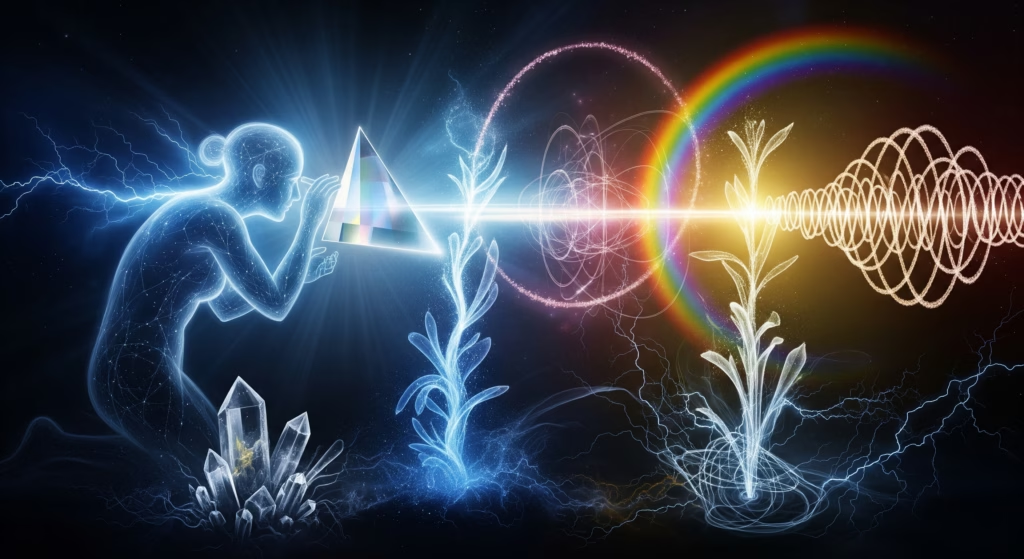
Building upon Goethe’s Theory of Colors (Farbenlehre), Rudolf Steiner explored the qualitative nature of color. Goethe had shown, through meticulous observation, that colors arise from the dynamic interplay of light and darkness. They are not simply components of white light, as Newton proposed. Instead, they are born where light meets resistance, turbidity, or darkness. (This is detailed in GA 1, Goethean Science).
In The Light Course, Steiner elaborates on this. He describes colors as the “deeds of light.” They are active processes, not static properties. He distinguished between:
- Image-colors (Bildfarben): These are colors that arise when light is modified by darkness or a turbid medium. Examples include prismatic colors (the rainbow) or atmospheric colors (blue sky, red sunset). Here, we see light actively struggling with and overcoming darkness, or darkness veiling light.
- Lustre-colors (Glanzfarben): These are surface colors. They appear on opaque objects. They reveal something of the inner nature of the substance itself, as it interacts with light.
Steiner also spoke of the spiritual qualities and inner experiences associated with different colors. For example, blue often relates to the soul’s inwardness. Yellow relates to radiance and intellect. He also pointed to the “peach-blossom color”. This is a subtle, reddish-violet hue. He described it as the characteristic color of the etheric body, or life forces. This perception, however, requires developed spiritual sight. Understanding color qualitatively opens a new dimension. It is a dimension often lost in purely quantitative spectrum analysis.
Sound: More Than Vibration – Echoes of Cosmic Form and Harmony
Conventional physics explains sound primarily as mechanical vibrations. These vibrations propagate through a medium like air. While acknowledging this physical aspect, Rudolf Steiner pointed to a deeper, spiritual nature of sound. He connected sound with inner movement. He also linked it to form-creating forces. (This is also explored in GA 299, The Genius of Language).
He often used the example of Chladni figures. These are patterns formed by sand on a vibrating plate. They make visible the formative power inherent in sound. Steiner suggested that sound, in its essence, is connected to spiritual archetypes of tone. These archetypes resonate within the cosmos. The spiritual nature of music, its power to move the human soul, stems from this connection. Music is not just ordered vibrations. It is an echo of cosmic harmony. It is a language of the soul world.
Electricity and Magnetism: Sub-Natural Forces or Imbalanced Etheric Processes?
Rudolf Steiner’s views on electricity and magnetism are perhaps among his most challenging for conventional scientific thought. He did not see these as fundamental forces of nature in the same way as light or warmth. Instead, he often described them as “sub-natural” forces. He saw them as arising from imbalances or “fallen” processes within higher, etheric forces. (See GA 320).
He was particularly critical of the tendency to explain life or consciousness in terms of electrical phenomena. He saw this as a materialistic reduction. Life, he emphasized, stems from the etheric body. Consciousness stems from the astral body and the ‘I’. These are supersensible realities. They cannot be reduced to physical electricity.
Steiner indicated that electricity and magnetism are, in a sense, “corpses” of higher life processes. They represent forces that have fallen out of the realm of life. They have become rigid and mechanistic. He also spoke of different kinds of electricity. He suggested they have qualitatively different effects. He warned about the dangers of an unchecked, purely Ahrimanic development of electrical technology. This technology, if not guided by spiritual understanding and moral responsibility, could have detrimental effects on human beings and nature. This perspective calls for a much deeper, more conscious engagement with these powerful forces.
Warmth: The Most Spirit-Like Physical Element
In Steiner’s cosmology, warmth (or heat) holds a unique position. It is considered the most spirit-like of the physical “elements.” It was the sole manifest condition of our solar system during its first great embodiment, Old Saturn. (See GA 13, An Outline of Esoteric Science). Warmth is not merely the kinetic energy of molecules, as in conventional physics. It is a primary, active spiritual-physical state. It is the basis from which other physical states differentiate.
Steiner distinguished between outer, measurable heat and inner, soul warmth. The latter is connected to enthusiasm, love, and the activity of the ‘I’. Understanding warmth qualitatively, as a fundamental cosmic principle, is key to Steiner’s spiritual science. It bridges the physical and the spiritual.
Matter and Mass: Condensations of Spiritual Activity
Mainstream physics views matter as fundamental. It sees it as composed of elementary particles. Rudolf Steiner offered a radically different perspective. He described matter and mass not as ultimate building blocks. Instead, he saw them as condensations of spiritual forces and activities. Spirit is primary. Matter arises from the interplay of these spiritual forces.
In The Light Course and other writings, Steiner alluded to concepts like “suctional” and “pressure” forces. These are active in the etheric world. They play a role in shaping and densifying substance into material forms. This view sees matter not as dead stuff. It sees it as spirit in a densified, manifest state. It suggests that behind every physical form lies a history of spiritual activity.
A Goethean Approach to Physics: Phenomenological and Qualitative Knowing
The methodology underlying much of The Light Course is deeply Goethean. It emphasizes:
- Direct Phenomenological Observation: Starting from what can be clearly observed by the senses, without immediately imposing abstract theories.
- Understanding Qualities: Paying close attention to the qualitative aspects of phenomena (e.g., the way colors appear, the nature of shadows, the feeling of warmth).
- Seeking the “Urphänomen” (Archetypal Phenomenon): Striving to find the fundamental, simple phenomenon. From this, more complex phenomena can be understood as arising through lawful metamorphosis and intensification.
- Using “Exact Sensorial Fantasy”: Cultivating a thinking that is pictorial and dynamic. This thinking can inwardly re-create and follow the formative processes of nature.
This approach seeks an understanding that is alive. It connects the observer with the observed in a participatory way. It aims to grasp the “idea” or spiritual archetype living within the phenomenon.
Relevance for Today: Towards a Holistic, Spirit-Integrated Science and Worldview
Rudolf Steiner’s “Light Course” was given nearly a century ago. Yet, its call for a spiritualized understanding of physics and nature is perhaps more relevant than ever.
- Limitations of Materialism: A purely materialistic physics struggles to explain life, consciousness, and the deeper meaning of existence. It can also lead to an alienating and exploitative relationship with nature.
- Path to Holistic Science: Steiner’s approach offers pathways towards a science. This science can recognize and integrate the spiritual dimensions of reality. It can see spirit at work within matter.
- New Relationship with Nature: A qualitative, Goethean approach can foster a deeper reverence. It can also lead to a more responsible interaction with the natural world. This is crucial for addressing ecological crises.
- Implications for Technology and Medicine: A spiritual understanding of forces like electricity or the nature of life could lead to more holistic and human-centered technologies and healing methods.
- Inner Development: Engaging with these ideas requires and cultivates new ways of thinking and perceiving. This is valuable for any modern spiritual seeker.
The “Light Course” challenges us. It asks us to re-imagine what science can be. It encourages us to seek a knowledge that nourishes not only our intellect, but also our soul and spirit.
Conclusion: Physics Re-Enlivened – The Legacy of Steiner’s “Light Course”
Rudolf Steiner’s “Light Course” (GA 320) stands as a pioneering and courageous effort. It aims to lay foundations for a spiritual science of physics. It challenges the dominant materialistic paradigms. It also calls for a new way of knowing nature. This way of knowing is rooted in keen observation, living thinking, and spiritual insight. Understanding “Rudolf Steiner Light Course physics spiritual science” opens the door. It leads to a radically different yet deeply coherent view of the physical world.
His insights into light, color, sound, electricity, and matter reveal these phenomena not as dead mechanisms. He shows them as expressions of underlying spiritual activities and beings. While some of these concepts are challenging to conventional thought, they offer a path. This path leads towards a future physics. This physics can unite scientific rigor with spiritual vision. It can help humanity to rediscover the spirit working actively within the vibrant tapestry of nature. This is a task of immense importance for our time.


