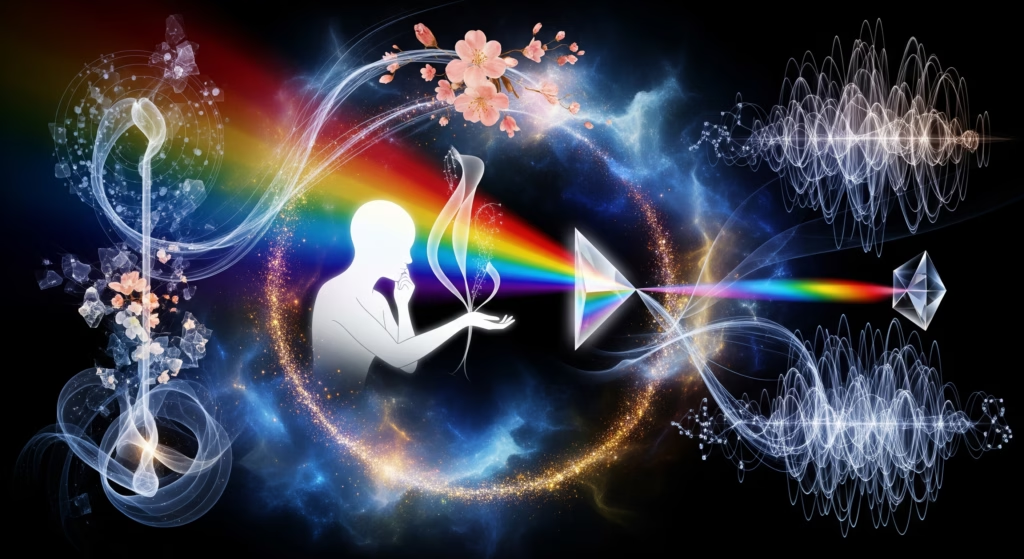
The Tao Te Ching, the “Classic of the Way and its Virtue,” stands as a revered pillar of Eastern thought, traditionally ascribed to the venerable Lao Tzu. In its concise and often paradoxical verses, it points towards the Tao—the indescribable, ultimate Source and principle of all existence—and Te, its inherent power or virtue manifesting within creation. Approaching this text with the methods and insights of spiritual science, the Rudolf Steiner Tao Te Ching perspective allows us to see it not merely as ancient philosophy or mystical poetry, but as a genuine expression of a specific, highly developed form of human consciousness attuned to the supersensible realities woven through the fabric of the world. Understanding its wisdom requires appreciating both its intrinsic depth and its unique position within the unfolding spiritual history of humankind.
The Consciousness of the Ancient East: Sensing the Flow
To truly connect with the Tao Te Ching, one must attempt to enter imaginatively into the consciousness of the ancient Chinese culture from which it arose [The East in the light of the West]. Spiritual science reveals that humanity’s modes of perception have evolved over time. The consciousness prevalent in the East during that epoch, while perhaps lacking the sharply defined individualism and analytical intellect that would later characterise the West, possessed a remarkable intuitive capacity. Moreover, this capacity manifested as a form of natural clairvoyance, a deep feeling-sense for the rhythms of nature, and an inherent understanding of the unity underlying diverse phenomena [Cosmic Memory].
This consciousness experienced less of a separation between self and world, spirit and nature. Consequently, the individual in that epoch felt themselves less as a separate entity confronting the world, and more as a participant within a great cosmic flow—the Tao. The wisdom articulated in the Tao Te Ching, therefore, arises not primarily from logical deduction, but from this profound, holistic perception of the spiritual laws and life currents permeating existence. Indeed, the emphasis is less on defining and dissecting reality, and more on aligning oneself harmoniously with its fundamental nature. The Rudolf Steiner Tao Te Ching interpretation acknowledges the validity and depth of the spiritual truths accessible through this mode of consciousness.
Core Taoist Concepts Through the Lens of Spiritual Science
Let us examine the central jewels of wisdom within the Tao Te Ching, seeking to illuminate them further through the perspective of spiritual science, within the Rudolf Steiner Tao Te Ching framework. Varying our sentence structure and using transitions will be key here.
The Tao (The Way): The Primal Spiritual Ground
The text famously opens by stating that the Tao which can be named or described is not the eternal Tao. It exists beyond form, beyond concept, representing the ultimate, unnamable, eternal source and principle governing all existence. From it, the “ten thousand things” arise, and to it they ultimately return. It is, in essence, the underlying Unity, the unmanifest Divine Ground. From an anthroposophical viewpoint, this resonates strongly with the concept of the Divine Spiritual Ground of all existence, the Godhead in its unmanifest aspect, prior to any creation [Theosophy – An Introduction to the Spiritual Processes in Human Life – reference to spiritual ground]. Furthermore, it bears a relationship to the concept of the Logos, the universal creative Word or cosmic Reason. However, where the Logos is often understood in its active, creative, self-revealing aspect (especially in the Johannine tradition connected to the Christ impulse) [The gospel of St. John], the Tao is apprehended more in its silent, all-encompassing, potential state – the “uncarved block,” the deep stillness from which all movement originates. Thus, the Tao represents the experience of ultimate Unity attainable through profound inner quietude and intuitive perception characteristic of that ancient consciousness.
Te (Virtue / Power / Integrity): The Tao Manifesting
Te represents the inherent quality, power, or virtue that each individual being receives from the Tao. Through Te, the universal Tao manifests uniquely within each particular being or phenomenon. It is the indwelling spiritual essence or archetype working within a being, guiding its authentic expression and function within the cosmic whole [An Outline of Occult Science – discussion of spiritual archetypes]. Therefore, living in accordance with Te means acting spontaneously from this inner spiritual core. This action occurs in harmony with the universal Tao, rather than from artificial constructs or external compulsions. In essence, Te is the expression of the divine potential held within the created form, the unique signature of the Tao in manifestation.
Wu Wei (Non-Action / Effortless Action): Harmonious Will Activity
This crucial concept, often translated simply as “non-action,” carries a much deeper meaning: “effortless action” or “action without striving.” Wu Wei signifies activity that arises effortlessly and effectively because it is perfectly aligned with the flow of the Tao, with Cosmic Will [Intuitive thinking as a spiritual path – contrast with goal-oriented striving]. Importantly, it is action free from personal egotism, excessive force, or artificial intervention against the natural course of things. Wu Wei does not imply passivity; rather, it suggests a highly attentive and receptive state. From this state, actions arise naturally and effectively, guided by an intuitive understanding of the situation’s inherent spiritual dynamics. Spiritual science recognises that true effectiveness often requires transcending purely personal desires and becoming instead a clear vessel for higher spiritual impulses. Consequently, Wu Wei represents this profound capacity to act powerfully yet serenely, guided by spiritual necessity rather than egoistic compulsion. This alignment offers a profound insight when considering the Rudolf Steiner Tao Te Ching relationship.
Yin and Yang: The Universal Dance of Polarity
The dynamic interplay of Yin (representing receptive, feminine, dark, soft, yielding qualities) and Yang (representing active, masculine, light, firm, assertive qualities) forms the fundamental basis of Taoist cosmology. This interplay reflects the profound universal truth that manifestation arises through the creative tension of cosmic polarities. Spiritual science deeply affirms and investigates this principle [Theosophy – An Introduction to the Spiritual Processes in Human Life]. Indeed, all creation unfolds through the dynamic interaction of opposites: spirit and matter, light and darkness, warmth and cold, expansion and contraction. Specifically, Anthroposophy details the roles of the Luciferic (expansive, light-filled but potentially illusory, related somewhat to Yang) and Ahrimanic (contracting, darkening, providing necessary form and resistance, related somewhat to Yin) polarities in human and world evolution [The Influences of Lucifer and Ahriman GA 191]. While the specific characterisations differ—Lucifer and Ahriman being distinct adversarial influences—the ancient Taoist insight into Yin/Yang demonstrates a remarkable perception of the fundamental creative power inherent in cosmic duality and the essential need for achieving dynamic equilibrium for health and right functioning in both the cosmos and the human being.
The Tao Te Ching in the Context of Human Evolution: An Anthroposophical View
How does this stream of wisdom fit within the larger evolutionary narrative described by spiritual science? The Rudolf Steiner Tao Te Ching perspective values it immensely as an authentic expression of spiritual insight from a major cultural stream, while also understanding its specific historical context and character in relation to other developments.
Eastern Intuition versus Western Individuation
The Taoist path, with its profound emphasis on merging with the universal Tao, achieving harmony by attuning to nature’s rhythms, and cultivating wisdom through intuitive quietude and the yielding of the personal ego’s demands (Wu Wei), clearly reflects the strengths of ancient Eastern consciousness [The East in the light of the West]. This consciousness maintained a closer link to primal spiritual unity. Conversely, the developmental trajectory emphasized in the West, particularly from the Greco-Roman epoch onwards, involved the challenging but necessary task of cultivating the individual “I” or Ego. This Ego became the centre of self-awareness, independent thinking, and personal moral responsibility [cite: Rudolf Steiner – The riddles of philosophy]. The primary goal shifted towards the conscious spiritualisation of the individual self, rather than primarily seeking its dissolution into a pre-individual unity.
Wu Wei and the Development of Free Moral Action
The concept of Wu Wei, acting in harmony with the Tao, offers a necessary and profound corrective to the often frantic, ego-driven, and nature-exploiting activity prevalent in modern times. It points towards a wisdom of letting-be and aligning with larger forces. However, from the perspective articulated in The Philosophy of Freedom, the highest potential for human action in the current epoch lies in moral intuition [The Philosophy of Freedom]. This involves the free human spirit consciously grasping the ethical necessity of a situation directly through purified thinking, and then acting out of pure love for the freely chosen deed itself. While Wu Wei represents harmonious participation in cosmic will, the free moral deed represents individual spiritual creativity originating from the autonomous “I”. The Rudolf Steiner Tao Te Ching view acknowledges the validity of Wu Wei for its context but points towards the further development of individual moral freedom as a key task for modern humanity.
The Tao and the Unique Christ Impulse
The Tao Te Ching reveals the universal, immanent Divine Principle, the eternal Way underlying all existence. It offers a profound perception of God in the cosmos, accessible through inner stillness and harmony with nature. The Christ impulse, however, as understood by spiritual science, represents a unique, singular historical event: the descent and incarnation of the Divine Logos, the Cosmic “I AM,” within the stream of human evolution itself [cite: Rudolf Steiner – Christianity as Mystical Fact]. This event, centered on the Mystery of Golgotha, infused Earth evolution with a radically new power. Specifically, it provided the potential for the individual human “I” to find its connection to the Divine within itself, through conscious striving and grace, and to become an active agent in the spiritual transformation of the Earth through deeds of love enacted in freedom [From Jesus to Christ].
Therefore, while Taoist wisdom illuminates the eternal spiritual background (the Tao), the Christ impulse offers the specific evolutionary force needed for the individualized human spirit to consciously reunite with that Ground in freedom and love. This impulse empowers humanity to become active co-workers in cosmic redemption in a new way. The Rudolf Steiner Tao Te Ching view, consequently, honours the profound wisdom of Lao Tzu as a significant spiritual path preparing humanity in one essential stream, while simultaneously emphasizing the unique and central role of the Christ event for humanity’s subsequent and future evolution.
Conclusion: Enduring Wisdom from the Way
Approaching the Tao Te Ching through the Rudolf Steiner Tao Te Ching perspective allows us to appreciate its timeless wisdom without removing it from its vital context within human spiritual history. We recognise Lao Tzu’s purported work as a genuine and profound expression of humanity’s ancient, intuitive connection with the spiritual intelligence and harmony of the cosmos – the Tao. Indeed, its core concepts – the Tao as the ultimate Way, Te as inherent Virtue, Wu Wei as effortless action, and the balance of polarities – offer enduring insights into living harmoniously with nature and spirit.
While spiritual science illuminates a path forward centered on the development of the conscious, free, Christ-permeated “I,” it holds deep reverence for the authentic wisdom streams that guided humanity in earlier epochs. The Tao Te Ching serves as a powerful reminder of the reality of the underlying spiritual unity, the strength found in receptive wisdom, and the importance of aligning our actions with cosmic law. For the modern individual, often caught in the complexities of intellectualism and the demands of a materialistic world, the quiet, profound wisdom of the Tao Te Ching, when contemplated through the clarifying lens of spiritual science, can still offer invaluable orientation. Ultimately, it points towards the eternal spiritual ground from which all true paths, in their diverse ways, arise and find their meaning.