
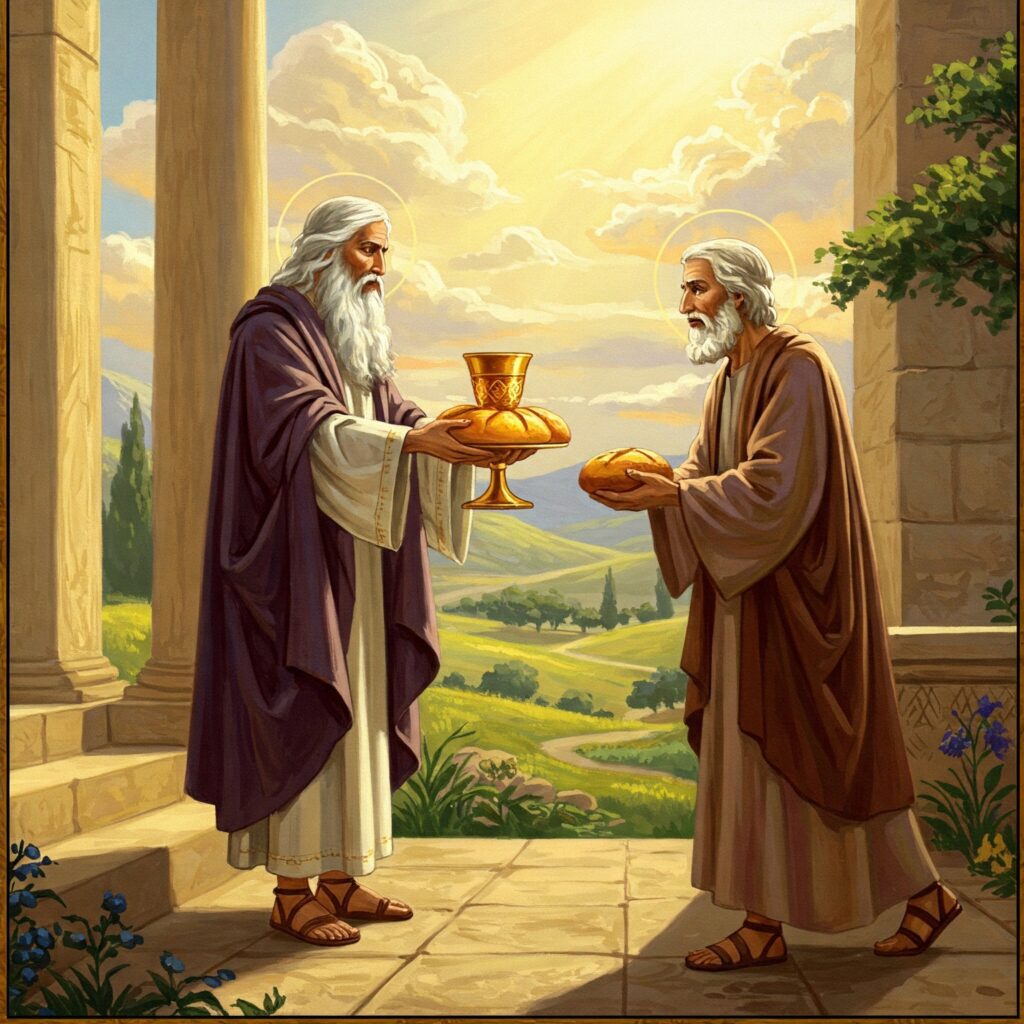
Among the most enigmatic figures mentioned in the Old Testament is Melchizedek, the priest-king of Salem who meets Abraham after a battle. His appearance in Genesis 14 is brief yet profoundly significant: “And Melchisedek king of Salem brought forth bread and wine: and he was the priest of the most high God.” Later, the Epistle to the Hebrews expands on his mysterious nature, describing him as timeless and foreshadowing the priesthood of Christ. For Rudolf Steiner, the founder of Anthroposophy (also known as spiritual science), Melchizedek was far more than a minor historical character; he was a being of immense cosmic importance, an emissary from higher worlds whose actions marked a pivotal moment in human spiritual evolution and the preparation for the Christ impulse. This article delves into the Rudolf Steiner Melchizedek perspective, exploring his identity according to spiritual science, the deep symbolism of the Melchizedek bread wine offering, his connection to the Order of Melchizedek Steiner alluded to, and his relevance within esoteric Christianity Melchizedek studies.
Steiner’s Approach: Spiritual Science and the Bible
Rudolf Steiner approached the Bible, including figures like Melchizedek, not just through historical or theological lenses, but through the methods of spiritual science. This involves viewing scriptures as containing layers of meaning – historical echoes, profound symbolism, reflections of evolving human consciousness, and records of spiritual events or initiation wisdom perceivable through developed inner faculties (Imagination, Inspiration, Intuition) [Based on Knowledge of the Higher Worlds]. He saw figures and events described as often having significance far beyond their literal surface appearance, connecting them to the vast drama of cosmic and human evolution chronicled in the Akasha Record (Cosmic Memory) [Based on Cosmic_Memory]. [Anthroposophy]

Who Is Melchizedek? – Steiner on Melchizedek’s Timeless Nature
The Epistle to the Hebrews (Chapter 7) provides the key scriptural description that Steiner often highlighted when discussing Melchizedek’s unique nature: “Without father, without mother, without genealogy, having neither beginning of days, nor end of life…” [Hebrews 7:3].
- A Being Beyond Ordinary Birth: For Steiner, this description was not merely metaphorical. It indicated that Melchizedek was not an ordinary human being subject to the usual laws of physical heredity and karmic succession. He was a high spiritual being, an initiate of supreme rank, who incarnated or manifested physically at that specific time for a crucial purpose, standing outside the constraints of typical human biography. He wasn’t born into a lineage in the normal way; he appeared.
- Emissary of Higher Worlds: Melchizedek represented the direct intervention of higher spiritual worlds into the course of earthly events. He acted as a “priest of the most high God” (El Elyon), signifying his connection to spiritual powers preceding and transcending the specific guidance of Yahweh for the Hebrew people. He embodied the purity and wisdom of these higher realms.
- Connection to Shem’s Etheric Body: Steiner provided a specific esoteric insight into the conditions surrounding Melchizedek’s appearance, linking it to the lineage prepared for Abraham. Based on his spiritual research (referenced in your provided text as GA 107, Lecture 15, though the specific lecture isn’t among the PDFs supplied, the context aligns with Disease, Karma and Healing which was provided), Steiner explained that the etheric body (life-body) of Shem, the righteous son of Noah, was spiritually preserved after the Atlantean catastrophe. This pure etheric substance, untainted by later declines, was then spiritually multiplied and became the subtle foundation, the archetypal life-body quality, for the Semitic peoples destined to carry the Abrahamic impulse. Melchizedek appeared within this stream, bearing a high spiritual substance capable of meeting and consecrating the prepared vessel of Abraham. He carried “a high etheric substance untouched by the corruptions of the Atlantean epoch,” necessary to guide the transition towards the future Christ impulse [User-provided text].
Thus, the Rudolf Steiner Melchizedek perspective reveals him as a unique, timeless spiritual individuality, a cosmic priest appearing physically to impart a crucial impulse at a turning point in human spiritual history, connected to the preparation of humanity’s very life-forces for future divine incarnation. [Genesis 14 and Hebrews 7]
The Offering of Bread and Wine – A New Form of Initiation
Perhaps the most striking element of Melchizedek’s appearance is his offering: “And Melchisedek king of Salem brought forth bread and wine…” (Genesis 14:18).
Steiner saw profound significance in this simple act, viewing it as marking a major shift in the nature of initiation and spiritual practice:
- Departure from Blood Sacrifice: In many ancient cultures and Mystery traditions, spiritual connection and sacrifice often involved blood – either animal sacrifice or ecstatic states altering the human blood processes (trance, ancient forms of clairvoyance often tied to blood mysteries). Melchizedek offers no blood.
- Consecration of Earthly Substances: Instead, he brings bread and wine – fundamental products of agriculture and human culture, representing the transformation of earthly substances through human effort. Bread, derived from grain nurtured by earth and sun, symbolizes the physical body and earthly nourishment. Wine, derived from the transformed fruit of the vine, symbolizes the life forces and the spirit or blood that courses through life.
- Shift Towards Consciousness: This offering signifies a transition away from older initiation methods relying on altered states or external rituals towards a future path grounded in conscious human awareness and the spiritualization of everyday life. The elements are simple, common, yet capable of bearing the highest spiritual meaning when consciously received.
- Prophecy of the Eucharist: Steiner emphasized that Melchizedek’s offering was a direct prophetic foreshadowing of the Last Supper, where Christ Jesus offered the same elements – bread and wine – imbuing them with His own Being (“This is my body… This is my blood…”). Melchizedek performs the gesture; Christ fulfills its ultimate meaning by uniting His cosmic spiritual essence with these earthly substances. This Melchizedek bread wine offering therefore stands as the archetype for the central Christian sacrament, linking the Old Testament preparation to the New Testament fulfillment.
Melchizedek’s act inaugurates a new form of spiritual connection, one centered on the conscious human being transforming the fruits of the earth and receiving spiritual nourishment through them, anticipating the deepest mystery of esoteric Christianity.
The Melchizedek Impulse in Spiritual History: The Inner Priesthood
According to the Steiner view, Melchizedek’s brief encounter with Abraham implanted a powerful spiritual impulse that resonated through subsequent history, particularly within the stream leading towards Christianity. This is often referred to as the Order of Melchizedek Steiner described – not an external organization, but an inner spiritual current or lineage.
- Consecrating the Abrahamic Stream: Melchizedek’s blessing consecrated Abraham and the lineage descending from him, preparing them spiritually (not just physically) to become the eventual bearers of the vessel for the Christ Incarnation. The “inner temple” was founded [User-provided text].
- The Inner Priesthood: Hebrews 7 emphasizes Melchizedek’s priesthood is not based on Levitical lineage (earthly heredity) but is eternal, foreshadowing Christ’s own eternal priesthood. Steiner interpreted this as the priesthood Melchizedek represents being an inner priesthood Steiner termed it – a spiritual capacity arising directly from the individual’s connection to the divine, independent of external office, tradition, or bloodline. It is priesthood by being, not by inheritance.
- Resonance in Later Figures: Steiner saw this Melchizedek impulse resurfacing in key figures who embodied direct spiritual inspiration and served the Christ principle:
- John the Baptist: The immediate forerunner, preparing the way from outside the established religious structure.
- John the Evangelist: The disciple “whom Jesus loved,” author of the most esoteric Gospel, representing direct spiritual vision.
- Christian Rosenkreutz: The legendary founder of Rosicrucianism, viewed by Steiner as a high initiate guarding the esoteric stream of Christianity through the ages.
- True Christian Initiation: All genuine Christian initiation, Steiner suggested, stands spiritually “after the Order of Melchizedek,” emphasizing inner transformation and direct experience over external authority [User-provided text].
This Melchizedek Anthroposophy perspective reveals an ongoing spiritual stream, the inner priesthood, flowing through history, carried by individuals who connect directly to the spiritual world and serve the Christ impulse in freedom.
Melchizedek’s Relevance Today (“Melchizedek and You”)
Steiner emphasized that figures like Melchizedek are not merely subjects for historical or theological study; they represent living spiritual impulses relevant to contemporary inner life and the spiritual science Melchizedek illuminates.
- Awakening the Inner Priest/Priestess: The Melchizedek impulse can awaken within each individual soul today. It represents the potential for every human being to develop an inner connection to the divine and act out of spiritual insight, regardless of external roles.
- Service and Moral Harmony: We step into this “inner priesthood” whenever we act out of selfless service, offering our deeds (our “bread”) consciously. We become a “living chalice” for this force when we strive to harmonize our thinking, feeling, and willing through moral development – creating an inner balance capable of receiving spiritual impulses.
- Recognizing the Inner Christ: Walking in Melchizedek’s footsteps today means learning to recognize the divine spark, the Christ potential, within every other human being, moving beyond judgments based on external laws, traditions, or appearances.
- Building the Inner Temple: Melchizedek, the timeless priest-king, serves the “inner temple” – the sacred space within the human soul built not with stone, but through the cultivation of clear spiritual thought, moral strength developed through self-knowledge, and selfless love .
Engaging with the meaning Mary Magdalene Steiner revealed, or understanding the Rudolf Steiner Melchizedek perspective, ultimately points towards this path of inner transformation and service.
Conclusion: Summary of Steiner’s Perspective
In the spiritual science of Anthroposophy, Melchizedek emerges from the brief scriptural mentions as a figure of immense esoteric significance. Rudolf Steiner presented him not as an ordinary historical figure, but as a timeless spiritual being, a high initiate acting as a direct emissary from the spiritual world. Appearing outside the normal bounds of karma and heredity (as highlighted in Hebrews 7 Melchizedek descriptions), his encounter with Abraham marked a crucial turning point. His offering of bread and wine symbolized a shift towards a new form of initiation based on conscious engagement with transformed earthly elements, profoundly foreshadowing the Christ’s Last Supper. The Order of Melchizedek Steiner alluded to represents an inner priesthood, a spiritual capacity attainable through inner transformation rather than external lineage, an impulse carried through figures dedicated to the esoteric Christianity Melchizedek helped prepare. Ultimately, the Melchizedek Anthroposophy reveals is a living impulse accessible today, calling individuals to build the inner temple through self-knowledge, moral development, and selfless service, recognizing the divine within the human. Understanding this profound figure requires further study of Rudolf Steiner’s work, particularly his lectures on Genesis and Christology. [Spiritual-Scientific Anthropology GA 107]
The figure of Melchizedek opens doors to deep spiritual mysteries. What are your thoughts on Rudolf Steiner’s interpretation? Share your questions or insights below.