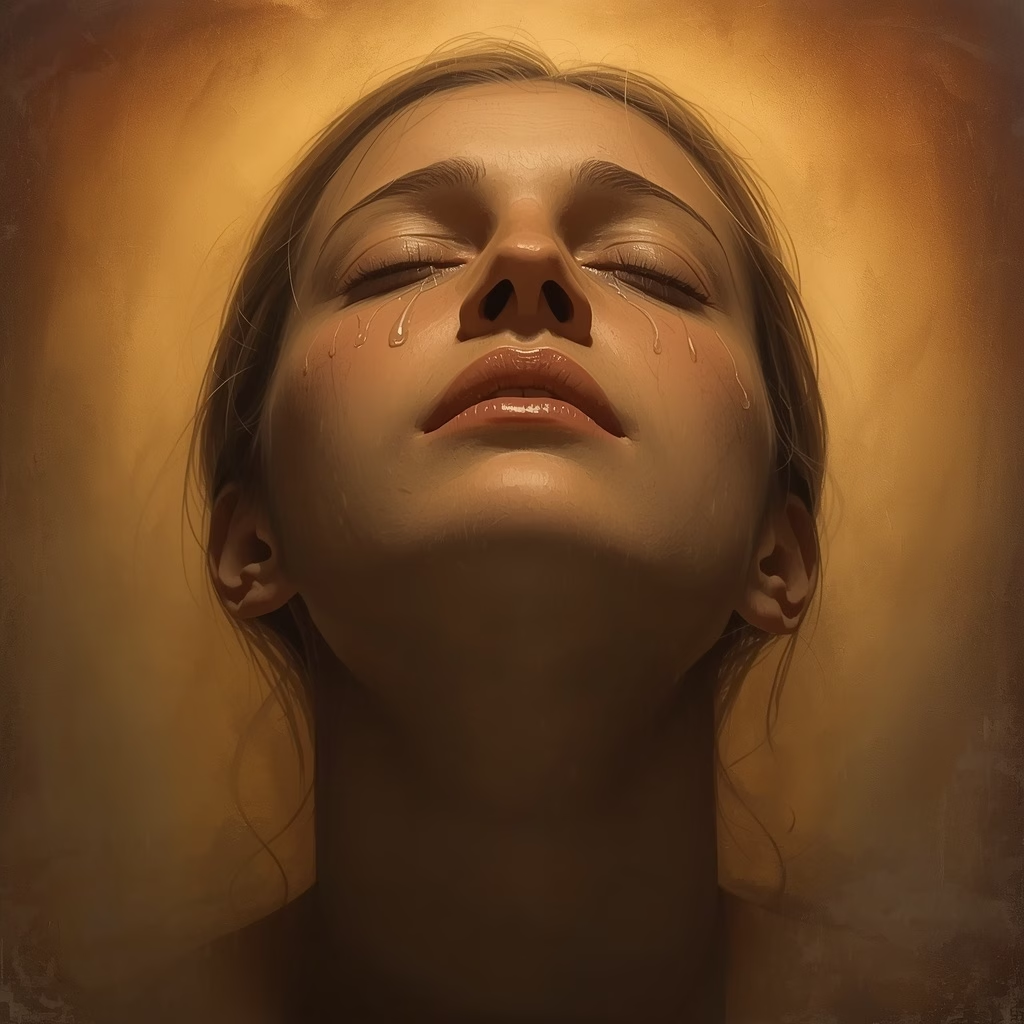
Tears are one of the most distinctly human phenomena in existence. No other creature weeps in the way that human beings weep. Every culture in every era has understood instinctively that tears carry meaning — that they express something real about the inner life that words cannot reach and that ordinary composure cannot contain.
Rudolf Steiner’s spiritual science approaches tears with honesty and precision. He reveals weeping as a genuine spiritual phenomenon — one whose physiological reality is inseparable from its soul dimension. He addresses this in GA 293 (“Study of Man”), GA 212 (“The Human Heart”), and GA 312 (“Spiritual Science and Medicine”).
What Tears Actually Are
Tears arise when the soul’s content exceeds what ordinary consciousness can process and contain. Steiner addresses this in GA 293. The ordinary waking consciousness manages the soul’s content through thinking, categorising, and articulating. However, there are moments when the soul’s experience — its grief, its joy, its sudden recognition of beauty or truth — is too large or too profound for this ordinary processing to handle. It overflows the boundaries of ordinary consciousness. And that overflow expresses itself physically through tears.
This is why weeping so consistently accompanies experiences at the extremes of the soul’s range — not the moderate feelings of daily life, but the overwhelming ones. Tears arise at genuine grief, at genuine joy, at moments of profound beauty, at moments of sudden deep recognition of something true.
Furthermore, Steiner indicates in GA 312 that the tear process is governed by forces of the etheric body working through the rhythmic system. When the soul is overwhelmed, the etheric forces respond — and the specific glandular activity that produces tears is the physical expression of this etheric response. This explains the specific quality of relief that genuine weeping produces: it is the restoration of physical and etheric equilibrium temporarily disturbed by the overwhelming soul experience.
The Three Kinds of Tears
Tears of grief arise from the experience of a sudden, unwilled, and irreversible change in the soul’s inner landscape. Something genuinely loved is now absent. The soul contracts — and the physical organism responds with tears. Steiner indicates that tears of genuine grief carry specific spiritual significance: they are the physical expression of genuine attachment, which is always an expression of genuine love. The soul that cannot weep for what it has lost has, in some sense, not genuinely loved it.
Tears of joy and beauty arise from a different — and in a specific sense higher — soul experience. Where tears of grief arise from the soul’s contraction in the face of loss, tears of joy and beauty arise from the soul’s expansion in the face of something that exceeds its ordinary capacity for experience. The beautiful piece of music, the overwhelming landscape, the genuine act of human goodness — all produce in the soul a momentary opening beyond its ordinary boundaries, a sudden direct contact with a dimension of reality that ordinary consciousness cannot usually reach. That expansion must express itself physically. It expresses itself through tears.
Tears of recognition are among the most spiritually significant of all. They arise when a truth is spoken that cuts through all the defences of ordinary consciousness and lands with the force of something always known but never before articulated. These tears confirm something important: the soul knows more than ordinary consciousness can articulate, and genuine truth can reach it in ways that bypass the ordinary cognitive faculties and register directly at the level of the body. Tears of recognition are the body’s acknowledgment that something genuinely real has been genuinely perceived.
The Suppression of Tears
Steiner makes a sobering observation about the consistent suppression of tears. At the soul level, habitual armour against weeping produces a gradual insensitivity to the experiences that most directly touch the soul’s genuine life. The person who has trained himself never to weep has also trained himself not to feel what would produce weeping.
Furthermore, Steiner indicates in GA 312 that the physical suppression of tears — the specific tension produced when the tear process is consciously interrupted — introduces a genuine disturbance into the rhythmic system and the etheric organisation of the head and neck region. The consistent, habitual suppression of the tear process represents a consistent interference with a natural etheric-physical regulatory process with real long-term consequences.
Tears and Genuine Art
Steiner indicates that genuine art regularly produces in its audience exactly the kind of soul overflow that tears express — not accidentally, but because genuine art works by temporarily widening the soul’s capacity to perceive. That widening, when it succeeds, produces tears because the soul is encountering something larger than it normally holds.
Furthermore, the tears produced by genuine artistic experience carry spiritual educational value. They are the organism’s genuine contact with a spiritual reality mediated through art — and that contact leaves a real trace in the soul’s constitution, developing a specific sensitivity and capacity for openness to spiritual reality that is itself a genuine form of inner development.
Tears are the soul’s most honest signature. They cannot be faked. They arise from a level of the soul’s life that the ordinary will cannot control. Understanding what Steiner reveals about them transforms the relationship to weeping — from something to be managed or suppressed into something to be received honestly, as the soul’s most direct and most genuine physical expression of genuine encounter with the realities that matter most.
The full article on Substack covers the complete etheric-body account of the tear process, the specific spiritual cost of emotional armour and tears suppression, the relationship between tears and genuine art, and Steiner’s complete account of what makes tears of recognition spiritually distinctive. Free to read on Substack.
Read the full article free on Substack →