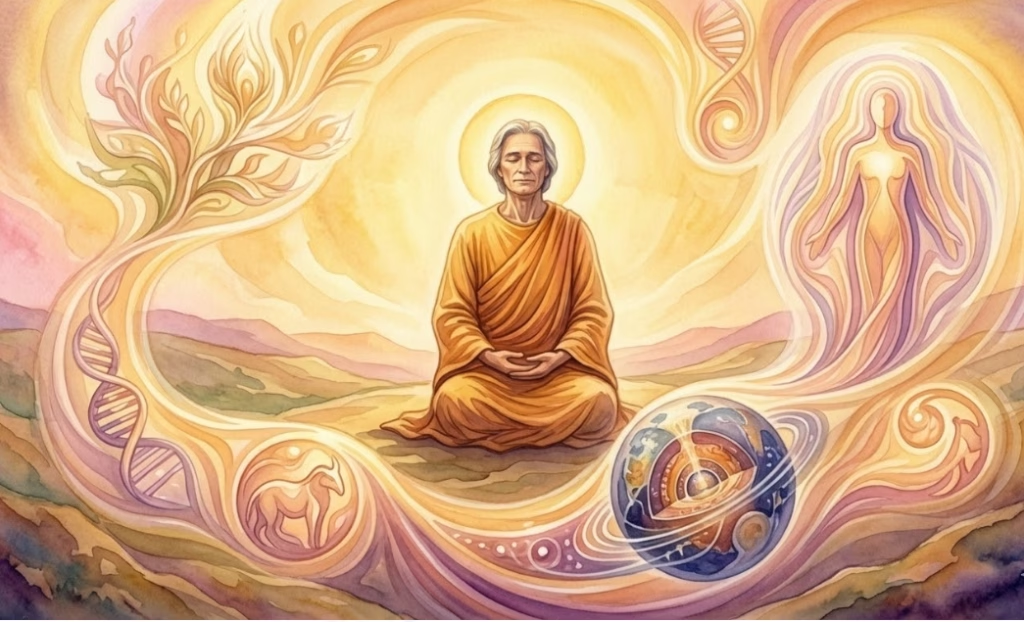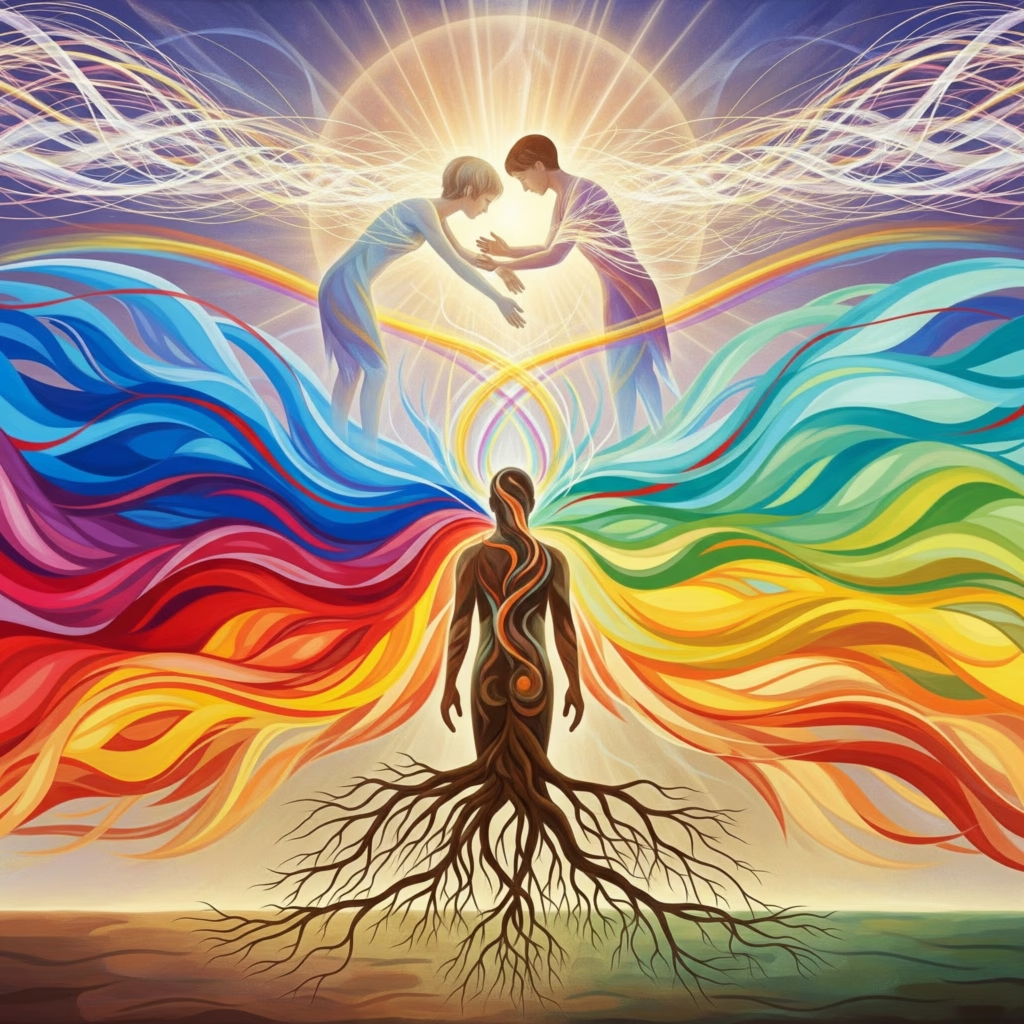
In our modern world, sexuality is often viewed through one of two lenses. It is seen either as a purely biological function for procreation and pleasure, or as a complex psychological drive shaping our identity and relationships. While both views hold truths, they remain incomplete. A spiritual-scientific perspective, such as that developed by Rudolf Steiner, offers a far deeper context. This article delves into the views of Rudolf Steiner on sexuality, framing it not as a standalone issue, but as an integral part of the human journey. This journey spans from our cosmic origins to our ultimate spiritual destiny. From this viewpoint, sexuality is a powerful earthly force. It is a temporary but necessary stage in our evolution. Its highest purpose is to be transformed into selfless, creative love through the conscious power of the human spirit.
Beyond Biology: The Fourfold Human Being and Sexuality
To grasp the perspective of Rudolf Steiner on sexuality, we must first understand the whole human being. Spiritual science shows that a person is more than just a physical body. We are composed of four interacting members:
- The Physical Body: This is the dense, material instrument we perceive with our senses. It is the vessel for earthly life and the carrier of our genetic and hereditary stream. Physical sexuality is anchored here.
- The Etheric or Life Body: This is a supersensible body of formative forces. It maintains the life, growth, and repetitive processes of the physical body. It is the bearer of our life habits, temperament, and memory.
- The Astral Body or Soul Body: This is the carrier of our inner life of feelings, passions, desires, and instincts. Pleasure and pain, sympathy and antipathy, all live in the astral body. The powerful drives and emotional currents of sexuality are intensely active in this part of our nature.
- The “I” or Ego: This is our unique core of self-awareness and spirit. The “I” is that part of us which can say “I” to itself. It is the seed of human freedom, self-consciousness, and spiritual love. The “I” is eternal and passes from one incarnation to the next.
Sexuality, therefore, is not just a physical act. It is a dynamic interplay. It involves the physical body’s procreative possibility, the etheric body’s life forces, and the astral body’s powerful passions and desires. The central task of human life is for the “I” to gradually gain mastery over these other members. It must learn to guide and transform them, rather than be ruled by them. A complete understanding of Rudolf Steiner on sexuality begins with this holistic picture of the human being.
A Cosmic Perspective: Why Did the Sexes Divide?
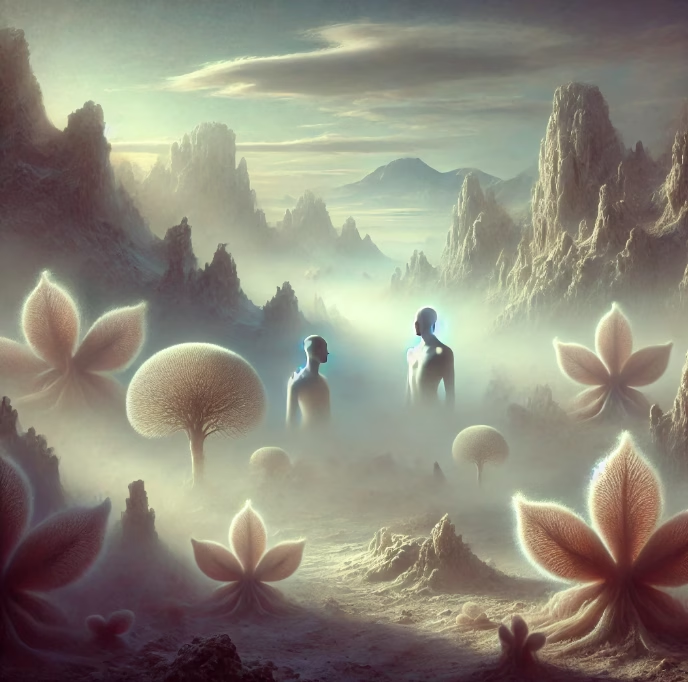
A core insight of spiritual science is that humanity was not always divided into male and female. This division occurred at a specific point in our deep past. This period is known as the Lemurian epoch. Before this time, the human form was different, more malleable, and each individual being contained both polarities within itself.
Why, then, did this separation occur? It was not an accident or a “fall” in the purely negative sense. It was a necessary and wise measure of cosmic guidance for a specific evolutionary purpose.
-
The Birth of Objective Love: As long as humanity was androgynous, love could only be a form of self-love. By dividing humanity into two sexes, a separate “other” was created. This created the possibility for love to flow from one being to another. It established the powerful longing for reunification that underlies all romantic love (Eros). This longing for the “other” is the earthly foundation upon which a higher, selfless love could later be built.
-
The Development of Objective Consciousness: The separation into sexes played a crucial role in developing our objective, intellectual consciousness. Confronting an external world and an external “other” helped to forge the human intellect. It forced the human being to look outward, to compare, to judge, and to think. The powerful forces that were once used for self-sufficient creation were redirected. They helped to build the inner architecture of the human mind and brain. So, the division was a sacrifice of one kind of creative power for the sake of gaining another: the power of objective thought and freedom. The discussion of Rudolf Steiner on sexuality is incomplete without this immense cosmic backstory.
Sexuality’s Earthly Purpose and Its Mastery by the “I”
In its earthly form, sexuality serves several functions. The most obvious is procreation. It provides the physical vehicle through which new human souls, with their unique “I,” can enter into earthly incarnation. It is the gate through which the stream of heredity flows, providing the physical substance for the next generation.
However, from a spiritual viewpoint, sexuality is also a mighty force of nature that must be consciously integrated. It is like having a wild fire burning within the soul. This fire provides warmth and immense energy. But if it is left untended, it can lead to chaos and destruction. The “I” has the task of becoming the master of this fire. This means neither extinguishing it through ascetic denial nor letting it run wild through hedonism. It means learning to understand its nature and to direct its forces into constructive channels.
This is also where adversarial forces can find an entrance. As spiritual science describes, the Luciferic influence can work through sexuality by inflaming the astral body with unbridled passion, fantasy, and a desire to escape reality in a whirlwind of sensation. Conversely, the Ahrimanic influence works to harden sexuality. It reduces it to a purely mechanical, biological act, devoid of love, soul, and spirit. It promotes a view of the human being as a mere animal driven by instinct. The view of Rudolf Steiner on sexuality is one of finding the true human path, holding the balance between these two extremes.

The Spiritual Path: From Eros to Agape, Transforming Love
The ultimate spiritual purpose of sexuality is its own transformation. The journey of human development is to elevate love from the sphere of instinct and attraction to the sphere of conscious, free, spiritual giving. Spiritual science distinguishes between two kinds of love:
-
Eros: This is love based on attraction, on a “chemistry” between two people. It is rooted in the sympathies and antipathies of the astral body and the longing for completion. It is a powerful and beautiful force, the foundation of romantic love, but it is still essentially a “taking” love, a love that seeks to fulfill a need.
-
Agape: This is selfless, spiritual love. It is a love that flows out from the “I” as a free and conscious act of giving. It loves the other being for their own sake, for their true spiritual essence, independent of personal need or attraction. It is the love spoken of by St. Paul and embodied in the Christ Impulse.
The earthly relationship between two people, grounded in Eros, can become the greatest school for the development of Agape. Through the challenges and joys of a committed partnership, the “I” learns to see beyond its own needs. It learns to understand and serve the “I” of the other. The sexual act itself can be raised from a purely instinctual or passionate level to an expression of this deeper soul and spirit communion. Thus, within the framework of Rudolf Steiner on sexuality, the physical relationship becomes a potential vessel for the highest moral and spiritual development.
The Future of Humanity and the Overcoming of Polarity
Spiritual science reveals that our current state is not final. The division of the sexes is a condition specific to our current phase of Earth evolution. In the distant future, in later stages of our planet’s development (known esoterically as Future Jupiter, Future Venus, and Future Vulcan), this polarity will be overcome.
Humanity will evolve to a state where it is once again whole. We will become spiritually creative beings in a new way. Procreation will no longer happen through the physical sexual act. It will occur through powers of the spirit, through a kind of creative “word” or spiritual utterance. The immense creative power that is now channeled into physical sexuality will be transformed and placed at the disposal of the free human spirit for the creation of new spiritual realities.
Knowing this places our current experience of sexuality in its true perspective. It is a powerful, necessary, and meaningful stage of our development, but it is a stage we are meant to pass through and spiritualize. It is not our final destination. This long-term view is essential to the thinking of Rudolf Steiner on sexuality.
Conclusion: Consciousness, Freedom, and the Spiritualization of Love
The perspective of Rudolf Steiner on sexuality is therefore panoramic. It sees this powerful human force as originating in a cosmic act of separation for the sake of developing love and freedom. It sees its earthly purpose as both the creation of physical bodies for incarnating souls and as a powerful energy that the human “I” must learn to master.
Its ultimate goal is its own transformation. The path leads from the instinctual drive of the astral body to the free, conscious, and selfless love of the “I,” from Eros to Agape. This is not a path of repression, but of conscious transformation. It is the work of imbuing our most powerful earthly instincts with our highest spiritual ideals. By understanding the cosmic dignity and evolutionary purpose of sexuality, we can approach this intimate sphere of life not with shame or indulgence, but with reverence, responsibility, and the conscious striving to make it an expression of our true and free humanity.