Among the foundational insights offered by Rudolf Steiner (1861-1925) through the spiritual science known as Anthroposophy, the concept of the Threefold Human Being stands as a foundational pillar. This perspective offers a dynamic and nuanced understanding of human nature, moving beyond simple dualities like mind versus body or spirit versus matter. Exploring the Rudolf Steiner Threefold Human Being model reveals a picture of interconnected systems within our physical organism, our soul life, and our spiritual core, providing practical keys for self-knowledge, child development, health, and even social organization. This article delves into the Threefold nature of human being according to Steiner, explaining the distinct yet interwoven aspects of Body Soul and Spirit Steiner described, the soul forces of Thinking Feeling Willing, their connection to the functional organization of Head heart limbs, and the concept’s relevance for areas like Waldorf education and the Threefold Social Order.
What is the Threefold Human Being? (Steiner’s Core Idea)
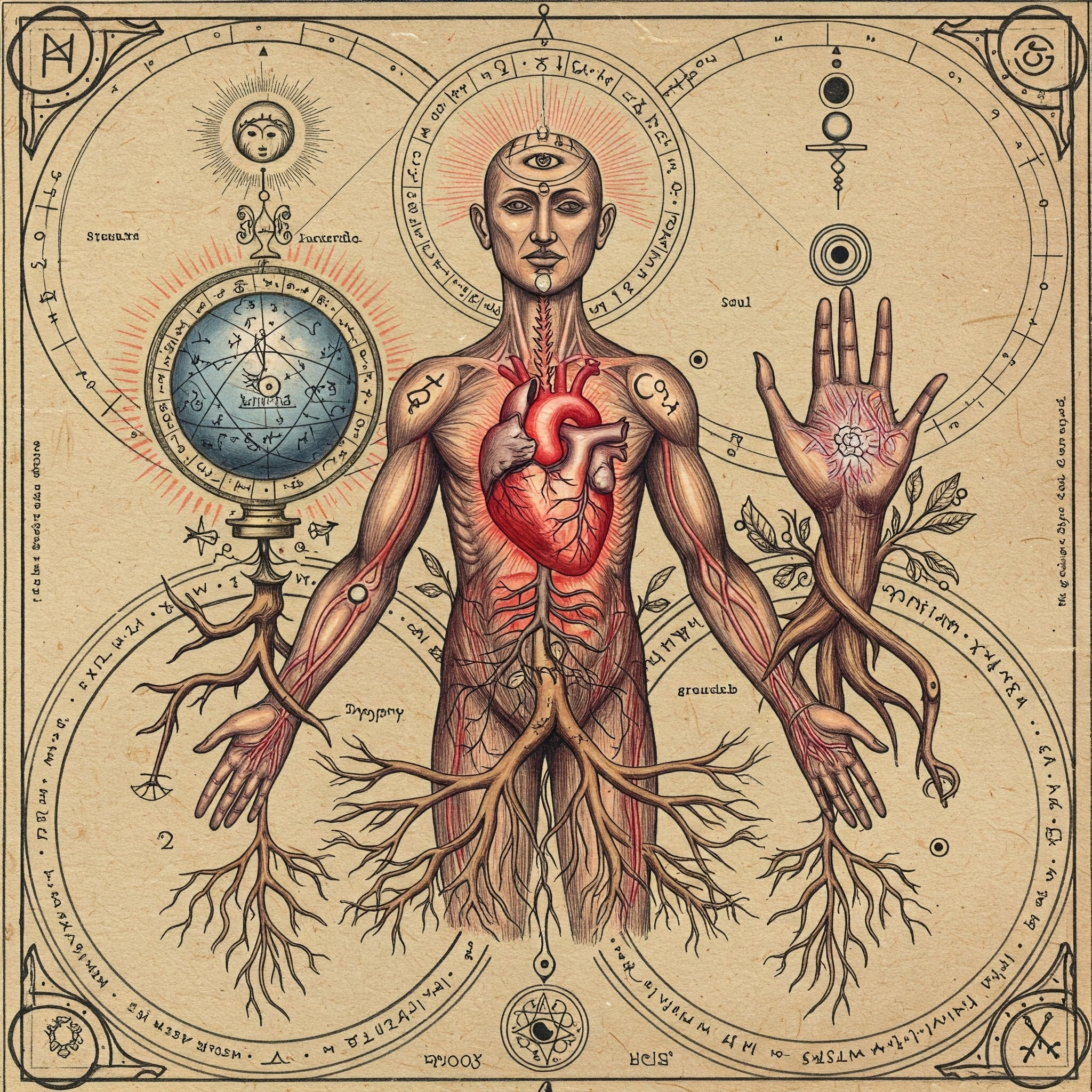
The concept of the Threefold Human Being Steiner presented is not primarily a static anatomical division, but a description based on spiritual-scientific observation of functional relationships active within us. Steiner identified three primary functional systems or poles of activity that interpenetrate and influence each other throughout our entire organism, encompassing our physical, soul, and spiritual dimensions. Recognizing this threefoldness allows us to see the human being not as a collection of separate parts, but as a holistic organism characterized by polarities and mediation. This view forms a cornerstone of Anthroposophy and provides essential keys for understanding human development and well-being.
These three functional systems are:
- The Nerve-Sense System (primarily associated with the head and thinking).
- The Rhythmic System (primarily associated with the chest region – heart and lungs – and feeling).
- The Metabolic-Limb System (primarily associated with the abdomen, metabolism, and limbs, and willing).
Understanding the characteristics and interplay of these systems provides a key to deciphering the Threefold Man Steiner described.
Body, Soul, and Spirit: The Three Members Explained
While Anthroposophy acknowledges the traditional division into body, soul, and spirit, it illuminates this through the lens of the dynamic threefold functional organization. Steiner showed how these seemingly separate aspects are deeply interwoven through the three primary systems.
A Functional Threefoldness: Nerve-Sense, Rhythmic, Metabolic-Limb Systems
Steiner’s practical insights into education, medicine, and social life rely heavily on understanding these three functional systems within the physical organism:
- The Nerve-Sense System (Head): This system encompasses the brain, spinal cord, and the entire network of nerves extending throughout the body, intimately connected with our sense organs. It is the primary physical instrument for perception, thinking, observation, memory, and conscious awareness. Physiologically, it is characterized by relative coolness, stillness, and highly differentiated, formed structures (especially the brain). Steiner described it as the ‘cool pole’ or ‘form pole’ of the organism, primarily oriented towards receiving impressions from the world and reflecting past experiences. It connects the human being cognitively to the surrounding world, mirroring cosmic structures in its form. Steiner pointed out that the head develops relatively quickly in childhood and tends towards hardening or ossification, representing the forces of the past within us.
- The Rhythmic System (Heart/Chest): This system is centered in the chest region and includes the heart, blood circulation, and the breathing process. It functions as the great mediator and balancer between the conscious, form-oriented head system and the active, transformative metabolic system. Its primary soul expression is our feeling life – our experiences of joy, sorrow, sympathy, antipathy, rhythm, and aesthetic experience are intimately connected with breathing and heart activity. The rhythmic system represents balance, harmony, the living present, and the vital connection between our inner world and outer expression. It maintains a dynamic equilibrium throughout life.
- The Metabolic-Limb System (Limbs): This system includes the organs of digestion and metabolism, along with the muscles and bones of the limbs that enable movement and action in the world. It is the primary physical ground for the faculty of willing. Impulses, desires, instincts, and the driving force for action find their physiological ground here. This system is characterized by warmth, intense biochemical activity, processes of breakdown (catabolism) and building up (anabolism), and movements that are often initiated consciously but carried out largely unconsciously. It is the ‘warm pole’ or ‘activity pole,’ connecting us dynamically and physically to the Earth, grounding our intentions in deeds, and carrying the forces oriented towards the future.
Understanding the specific characteristics and interplay of these Head heart limbs systems is fundamental to grasping the functional threefoldness.
The Interplay with Soul: Thinking, Feeling, Willing
The three fundamental soul activities identified by Steiner – Thinking Feeling Willing – find their primary expression and physiological support through these threefold bodily systems:
- Thinking: Our capacity for observation, forming concepts, making judgments, remembering, and engaging in inner reflection is predominantly linked to the nerve-sense system. Through thinking, we create an inner world of ideas that mirrors or interprets outer reality. Steiner emphasized that thinking, when consciously directed and observed, can become a pathway to direct spiritual perception, moving beyond mere abstraction to grasp living concepts. As explored in his Philosophy of Freedom, thinking is the one soul activity where we can experience ourselves actively creating spiritual content within our consciousness.
- Feeling: Our rich inner life of emotions, sympathies, antipathies, aesthetic responses, and moods finds its primary vehicle in the rhythmic system. Feeling acts as the mediator between the often cool objectivity of thought and the driving force of the will. It colors our experience, provides value judgments, and connects us soul-to-soul with others and the world. Our feelings arise from the interplay between our inner state and the outer world, constantly seeking balance within the rhythmic processes of heart and breath.
- Willing: Our impulses to act, our desires, intentions, and the execution of movements are primarily grounded in the metabolic-limb system. While often initiated by thoughts or feelings, the core process of willing itself operates largely unconsciously, like the processes of metabolism. It is deeply connected to our life forces and drives our engagement with the world, carrying our innermost intentions into physical manifestation.
These three soul activities are rarely completely separate; they constantly flow into and influence one another, ideally guided and harmonized by the spiritual core of the human being.
The Connection to Spirit: The “I” and Higher Development
How does this functional threefoldness relate to the overarching division of Body soul spirit Steiner described?
- The Body is the physical instrument organized into these three interacting systems, providing the stage for earthly life.
- The Soul lives and expresses itself through these systems via the activities of thinking, feeling, and willing. These three activities constitute the realm of our inner experience.
- The Spirit, the central core of our being, the unique human “I” or Ego, is the conductor of this orchestra. The “I” experiences itself and the world through thinking, feeling, and willing, using the soul activities and the bodily instrument. The task of the “I” during earthly evolution is to gradually permeate, harmonize, and spiritualize these soul forces and, through them, the bodily systems.
Furthermore, the path of inner development outlined in Anthroposophy, leading towards the higher cognitive faculties of imagination inspiration intuition, involves a conscious transformation and enhancement of thinking, feeling, and willing by the “I”. Living, mobile thinking becomes the foundation for Imagination; purified and perceptive feeling opens the door to Inspiration; and consciously directed, morally imbued willing leads towards Intuition, a direct union with spiritual reality.
Thinking, Feeling, and Willing: The Three Soul Forces in Detail
Steiner provided rich characterizations of these soul forces, highlighting their unique qualities and potential polarities, often linked to the influences of Lucifer and Ahriman:
- Thinking: At its best, thinking brings clarity, objectivity, understanding, and the light of consciousness. It connects us with universal truths and laws. However, detached from feeling and life, it can become cold, abstract, lifeless, overly critical, and susceptible to the hardening, materialistic influence of Ahriman. Living, flexible, intuitive thinking represents thinking connected to its spiritual source.
- Feeling: Feeling connects us intimately with the world through sympathy and antipathy, providing warmth, value, meaning, and the basis for artistic experience and empathy. It is the mediator, bringing harmony. Left undisciplined, however, feeling can become purely subjective, swayed by fleeting emotions, prejudices, or illusions – tendencies Steiner linked with the Luciferic influence. Cultivated feeling develops into balanced judgment, empathy, and a perceptive organ for soul realities.
- Willing: Willing is the power to act, to create, to transform the world, grounded in the life forces of the metabolism. It carries our intentions into reality. Because it operates largely unconsciously, however, untransformed willing often manifests as blind instinct, selfish desire, or impulsive action. Through conscious direction by the “I” and moral development, the will can become the vehicle for ethical deeds and spiritual purpose.
Health, both psychological and physical, depends on the dynamic, harmonious interplay of these three soul forces and their corresponding bodily systems. Steiner spoke of “Soul Economy” as the art of understanding and working consciously with these forces within oneself and in others (especially in education) to foster integration and prevent one-sidedness.
The Threefold Human Being and Waldorf Education
Nowhere is the practical application of the threefold human being concept more evident than in Waldorf education. The entire pedagogy, initiated by Steiner, is structured around understanding the child’s development through the lens of Waldorf education and threefold human being principles. Steiner gave detailed indications for structuring pedagogy based on which system/soul force is naturally dominant during specific developmental phases:
- Early Childhood (Approx. 0-7 years): This phase is seen as dominated by the metabolic-limb system and the forces of willing. The child learns primarily through imitation and physical activity. Education focuses on rhythm, imaginative play, practical work, and providing a morally sound environment worthy of imitation, nurturing the child’s life forces and grounding them in the physical world. The emphasis is on doing and physical experience.
- Elementary Grades (Approx. 7-14 years): The rhythmic system and feeling life awaken more strongly around the change of teeth. The child now learns best through imagination, art, music, storytelling, and connecting with the world through feeling and beauty. Authority and love from the teacher provide guidance. Academic subjects are presented artistically – writing evolves from drawing, arithmetic from whole-life situations, history through vivid narratives. The aim is to educate the feeling life, fostering wonder, reverence, and a heart-connection to the world.
- Adolescence (Approx. 14+ years): The capacity for abstract thinking, judgment, and independent understanding, supported by the maturing nerve-sense system, fully awakens. Education now addresses the intellect directly, encouraging critical thinking skills, scientific understanding, causality, and the search for ideals. The goal is to help the young person develop free, independent judgment and find their individual path in the world.
By consciously working with the unfolding Threefold nature of human being stage by stage, Waldorf education strives to cultivate integrated individuals with balanced capacities of head, heart, and hands.
The Threefold Human Being and Social Threefolding
Rudolf Steiner extended this threefold principle beyond the individual human being (Threefold Man Steiner) to the social realm, proposing the idea of a Threefold Social Order. He suggested that a healthy society requires the relative autonomy and distinct guiding principles for three spheres of social life, mirroring the human threefoldness:
- The Cultural/Spiritual Sphere (education, arts, sciences, religion): Grounded in the capacities of the individual spirit and thinking. This sphere requires Freedom to flourish. (Corresponds to the Head/Thinking pole).
- The Rights/Political Sphere (law, government, human rights): Dealing with the relationships between all people equally, this sphere should be grounded in the principle of Equality or Democracy. (Corresponds to the Rhythmic/Feeling pole).
- The Economic Sphere (production, distribution, consumption): Based on meeting mutual needs, this sphere should be guided by the principle of Fraternity or associative cooperation, focused on meeting needs through mutual support. (Corresponds to the Metabolic-Limb/Willing pole).
Steiner believed many social problems arise from these spheres becoming confused or one dominating the others (e.g., economic interests controlling culture, or the state dictating spiritual life).
The Threefold Human Being and Karma
The lens of threefoldness also illuminates the workings of karma. The specific balance and development of our thinking, feeling, and willing capacities, along with the health and tendencies of our nerve-sense, rhythmic, and metabolic-limb systems, are deeply interwoven with our individual karma carried from previous lives. The connection between karma and threefold man provides insight into individual destiny.
- Karmic Predispositions: Experiences and actions from previous lives can create tendencies towards imbalance in the current life – perhaps an over-developed intellect compensating for a past lack, or a weak will needing strengthening. Our temperament (choleric, sanguine, melancholic, phlegmatic), which Steiner linked to the interplay of the bodily sheaths, also carries karmic weight.
- Life Tasks: Our karma brings us specific life tasks often related to harmonizing our threefold nature – learning to bring warmth to our thinking, clarity to our feelings, or consciousness to our will. Life challenges often serve this purpose.
- Illness as Karmic Imbalance: From an anthroposophical medical perspective, illness can sometimes be understood as a manifestation of a deep-seated disharmony between the three functional systems (nerve-sense, rhythmic, metabolic-limb), often related to unresolved karmic patterns seeking expression or resolution. Recognizing these connections can be part of a holistic approach to healing.
Practical Applications and Self-Development
Beyond its role in education, medicine, and social thought, understanding the Threefold nature of human being offers invaluable tools for self-awareness and conscious personal growth:
- Self-Observation: It provides a framework for observing ourselves: Am I primarily driven by thoughts, analysis, and observation (head)? Am I ruled mainly by my feelings, sympathies, antipathies, and emotional responses (heart/rhythm)? Or am I driven largely by impulses, actions, and engagement with the physical world, perhaps less consciously (limbs/will)? Where do my strengths and weaknesses lie within this dynamic?
- Cultivating Balance: Recognizing one-sidedness allows for conscious effort to cultivate the underdeveloped aspects. Anthroposophical practices often include exercises specifically designed to strengthen and harmonize thinking (e.g., concentration exercises, clear concept formation), feeling (e.g., reviewing the day with balanced feeling, cultivating equanimity), and willing (e.g., specific meditative sequences focusing will, carrying out self-chosen resolutions). Engaging in artistic work nourishes the feeling life; practical crafts engage the will; disciplined study trains thinking.
- Path to Higher Knowledge: The conscious integration and transformation of thinking, feeling, and willing through the power of the “I” forms the foundation for developing higher, spiritual perception: imagination inspiration intuition. It is through working on these fundamental soul capacities that we build the organs for perceiving spiritual reality.
Conclusion: The Importance of the Threefold Perspective
The concept of the Threefold Human Being Steiner presented is a cornerstone of Anthroposophy, offering a rich, dynamic, and holistic understanding of human existence. It moves beyond simplistic divisions to reveal the intricate interplay of Body, Soul and Spirit Steiner described, manifesting functionally through the systems associated with Head, Heart and Limbs and expressing itself inwardly through the soul forces of Thinking, Feeling and Willing. Far from being merely a theoretical model, the Threefold nature of human being provides indispensable keys for comprehending child development (informing Waldorf education threefold human being), health, individual destiny (karma and threefold man), and the potential for a healthier Threefold Social Order. For the individual seeking self-knowledge, embracing the perspective of the Threefold Man Steiner illuminated offers a path towards balance, integration, and the unfolding of their full human and spiritual potential.