The four Gospels are not merely historical chronicles; they are profound initiation documents, composed by authors with direct insight into spiritual realities. In such texts, every detail is imbued with significance, and nothing is left to chance. It is with this understanding that we must approach a curious and recurring phenomenon: the appearance of the same name in connection with different, often starkly contrasting, figures. We encounter not one, but two significant figures named Lazarus, several pivotal women named Mary, two disciples named James, two named Simon, two figures named Salome, and two towering prophets named John. This article will explore the spiritual meaning of repeated names in the New Testament from a perspective informed by the insights of spiritual science.
We will move beyond the literal interpretation and discover that these repetitions are not coincidences, but are a sacred and intentional teaching method. They are spiritual hieroglyphs that reveal a process of transformation, of metamorphosis, of initiation. Often, the two figures with the same name represent the “before” and “after” of a soul’s journey, or the exoteric and esoteric aspects of a single spiritual principle. By exploring these divine doubles—Lazarus, Mary, John, Salome, Simon, and James—we can unveil a deeper story woven into the Gospels: the story of how the human “I,” the human soul, and the human will are called to be reborn and transfigured through the power of the Christ Impulse.
The Name as a Spiritual Reality
The Word That Reveals the Being
Before we can explore the specific examples, we must re-awaken our sense for the sacred power of a name. In our modern, materialistic age, a name is an arbitrary label. In all ancient wisdom, however, a name was understood to be an audible expression of a being’s inner essence and mission. To “name” a thing was to know its spiritual reality. This is why the divine name was held in such reverence, and why Adam was given the task of “naming” the creatures in the Garden—it was an act of soul-perception, of recognizing their spiritual nature.
When the initiated authors of the Gospels used a name, they did so with a full awareness of its spiritual weight. Therefore, when they use the same name for two different figures, they are consciously creating a spiritual resonance. They are inviting the reader to look beyond the outer personalities and to perceive an inner process of transformation or a profound spiritual polarity. The repeated name is a key that unlocks a deeper, hidden layer of meaning.
Lazarus and John: The Initiation of the “I” and the New Wisdom
From Beggar to Beloved Disciple
The most dramatic example remains that of Lazarus, whose journey is so profound that it is intertwined with that of the great apostle John.
First, we meet Lazarus the Beggar in Christ’s parable. He is the image of the spiritually impoverished soul of pre-Christian humanity, lying at the gates of the old mysteries, longing for even the “crumbs” of spiritual truth. His destiny after death is “Abraham’s bosom”—a peaceful but unconscious rest.
Then we meet Lazarus of Bethany, the friend of Jesus. His sickness and four days in the tomb are not a normal death, but a profound initiation rite performed by the Christ Himself. The call, “Lazarus, come forth!” is the call of the Hierophant to the initiate, raising him from the “death” of ordinary consciousness into a new, higher life of direct spiritual perception.
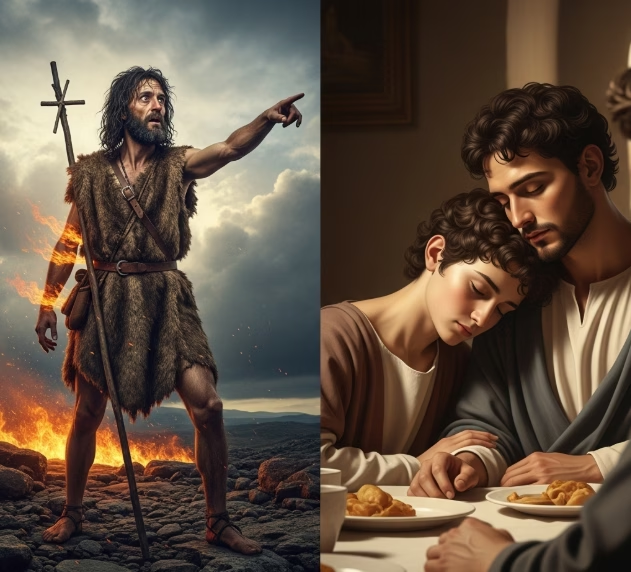
Spiritual science reveals that these two are pictures of the same individuality before and after initiation. But the story goes even further. Esoteric tradition holds that this initiated Lazarus is none other than the author of the Gospel of John, the one who calls himself “the disciple whom Jesus loved.” This brings us to the two Johns. John the Baptist is the last and greatest prophet of the Old Covenant, the reincarnation of Elijah. His wisdom is preparatory; it comes to him as a voice from without. He must decrease. John the Evangelist, the initiated Lazarus-John, is the first and greatest initiate of the New Covenant. His wisdom, the deep wisdom of the Logos, now lives within him. He does not need to point to another; he bears the living Word in his own heart, a heart that has leaned upon the breast of the Lord. The two Johns represent the monumental shift from the old initiation of law and prophecy to the new initiation of freedom and love. The journey of Lazarus-John is the journey of the human “I,” from a state of spiritual poverty to becoming a conscious, loving vessel for the highest divine wisdom.
The Two Marys and Two Salomes: The Journey of the Human Soul
The Choice Between Illusion and Devotion
The path of the human soul, the astral body, with all its potentials for both degradation and sanctification, is revealed in the polarity of the women who attend to the great events.
The three Marys—the pure Mother, the passionate Magdalene, and the contemplative Mary of Bethany—show the complete picture of the soul’s potential. As we have explored, Mary Magdalene (the sinner) and Mary of Bethany (the seer) are two stages of the same soul. The Magdalene is the astral body in its fallen, passionate state, possessed by the “seven devils” of worldly desire. Through her encounter with the Christ, she is purified and becomes the contemplative, devoted soul who sits at His feet. It is this healed and purified soul that is the first to perceive the Resurrection, for only the purified soul can see the new spiritual reality.
This theme is presented with even starker clarity in the two figures of Salome.
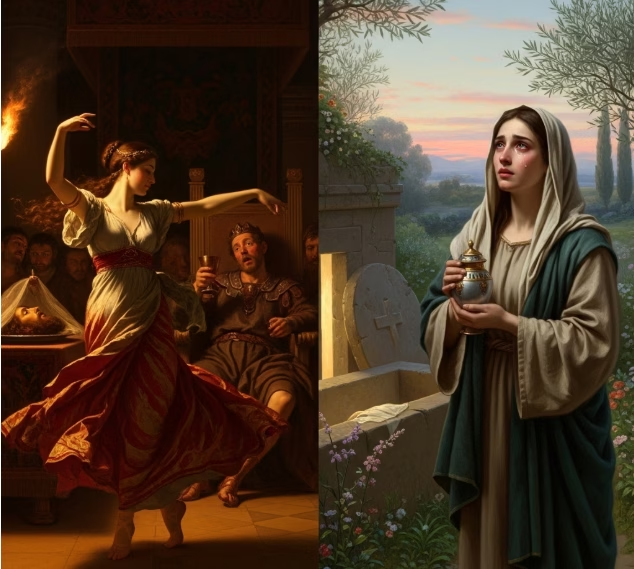
- The first Salome is the daughter of Herodias, the young dancer. She is the instrument of a decadent, worldly court. Her dance, an appeal to the lower senses, mesmerizes King Herod and becomes the direct cause of the beheading of John the Baptist. She represents the human soul when it gives itself over entirely to the alluring illusions of the sense-world. In this state, the soul becomes an agent for the destruction of the spirit; its seductive art leads directly to the silencing of the prophetic Word. She embodies the false, deathly “peace” (shalom) of a soul asleep in materialism.
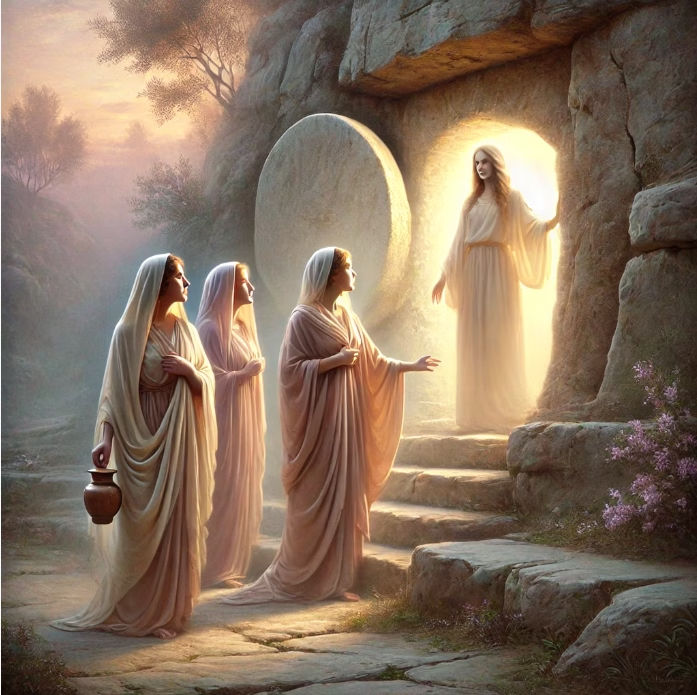
- The second Salome is one of the holy women, one of the Myrrhbearers who follows Christ to the Cross and comes to the tomb on Easter morning to anoint His body. She is a figure of unwavering devotion and selfless love. She seeks to serve the spirit even in its apparent death. She represents the human soul that turns away from the illusions of the senses and directs its forces of love and devotion towards the divine. It is this soul, along with the healed Mary Magdalene, that is granted the first vision of the empty tomb and the angelic message of the Resurrection.
The two Salomes are a stark picture of the choice that stands before every human soul. The name is the same, representing the potential of the soul. But one path leads to the beheading of the spirit through a dance of sensory illusion. The other path leads to the revelation of the resurrected spirit through an act of selfless devotion.
The Two Simons: The Transformation of the Human Will
From Failing Striver to Faithful Bearer
The human will, in its relationship to the Christ event, is powerfully illustrated in the two figures named Simon.
- Simon Peter is the most prominent of the apostles. He is given the name “Rock.” He is filled with a fiery, striving will. He makes the great confession of faith, and he declares that he will die for his master. Yet, when the great trial comes, his personal will fails him. He denies Christ three times. Simon Peter represents the conscious, striving human “I” in its early stages. It has the best of intentions, it makes great promises, but its own personal forces are not yet strong enough to overcome the fear and doubt instilled by the material world. He wants to carry the cross, but he cannot.
- Simon of Cyrene appears suddenly during the carrying of the cross. He is a stranger from the crowd, a man simply coming in from the country. He is “compelled” by the Roman soldiers to carry the cross for Jesus. He is not a disciple making a conscious choice; he is an ordinary man drawn by destiny into the central event of world history. He represents the unconscious, humble, and good will that lives in humanity. While the conscious will of the great apostle fails in that moment, the simple, un-self-conscious will of this stranger performs the necessary deed.
The Spiritual Connection: The two Simons are a picture of the two aspects of the human will. Simon Peter is the personal, self-conscious will that must be humbled and transformed. Simon of Cyrene is the deeper, more instinctual will that can be guided by destiny to serve the good. The entire later life of Peter, his own martyrdom by crucifixion, is the story of the transformation of his will. Through the power of Pentecost, his striving but failing “Simon” nature is finally transformed into the steadfast “Peter” nature, capable of consciously and freely carrying the cross to the very end. The two Simons show the path the human will must take, from being an unconscious bearer of fate to becoming a conscious bearer of the Christ Impulse.
The Two Jameses: The Transformation of a Spiritual Stream
This principle of transformation also applies to entire spiritual traditions, as seen in the two apostles named James.
- James, the son of Zebedee, one of the “Sons of Thunder,” represents the old, fiery, and exclusive form of the Hebrew tradition. This form, for all its power, had to die. His early martyrdom symbolizes the necessary sacrifice of the old vessel.
- James, the “brother of the Lord,” emerges after the Resurrection as the wise, pious, and just leader of the new community in Jerusalem. He represents the purified moral essence of the old tradition, which has been reborn and placed in the service of the new, universal Christ Impulse. The death of the one allows for the sanctified rebirth of the other.
Conclusion
The mystery of the repeated name, when seen with the eyes of the spirit, ceases to be a puzzle and becomes a profound revelation. It is a key, intentionally placed within the Gospels, that unlocks a deeper narrative of spiritual transformation. It shows that the mission of the Christ was not a single, external event, but the inauguration of a continuous process of inner metamorphosis that is available to all of humanity.
In the journey of Lazarus-John, we see the path of the human “I,” from spiritual poverty to initiated wisdom. In the journey of the Marys and Salomes, we see the path of the human soul, from worldly passion and illusion to purified devotion and spiritual sight. In the journey of the Simons, we see the path of the human will, from personal fallibility to steadfast service. And in the journey of the Jameses, we see the path of an entire spiritual tradition, from sacrificial death to resurrected purpose.
The Gospels, through this sacred device, show us not just what happened once in Palestine, but what can happen within our own souls. They show us that we all carry within us the potential of the beggar and the initiate, the sinner and the saint, the denier and the rock. The encounter with the Christ Impulse is the power that can lead us from the first state to the second. The repeated name is the signpost on this most sacred of journeys.