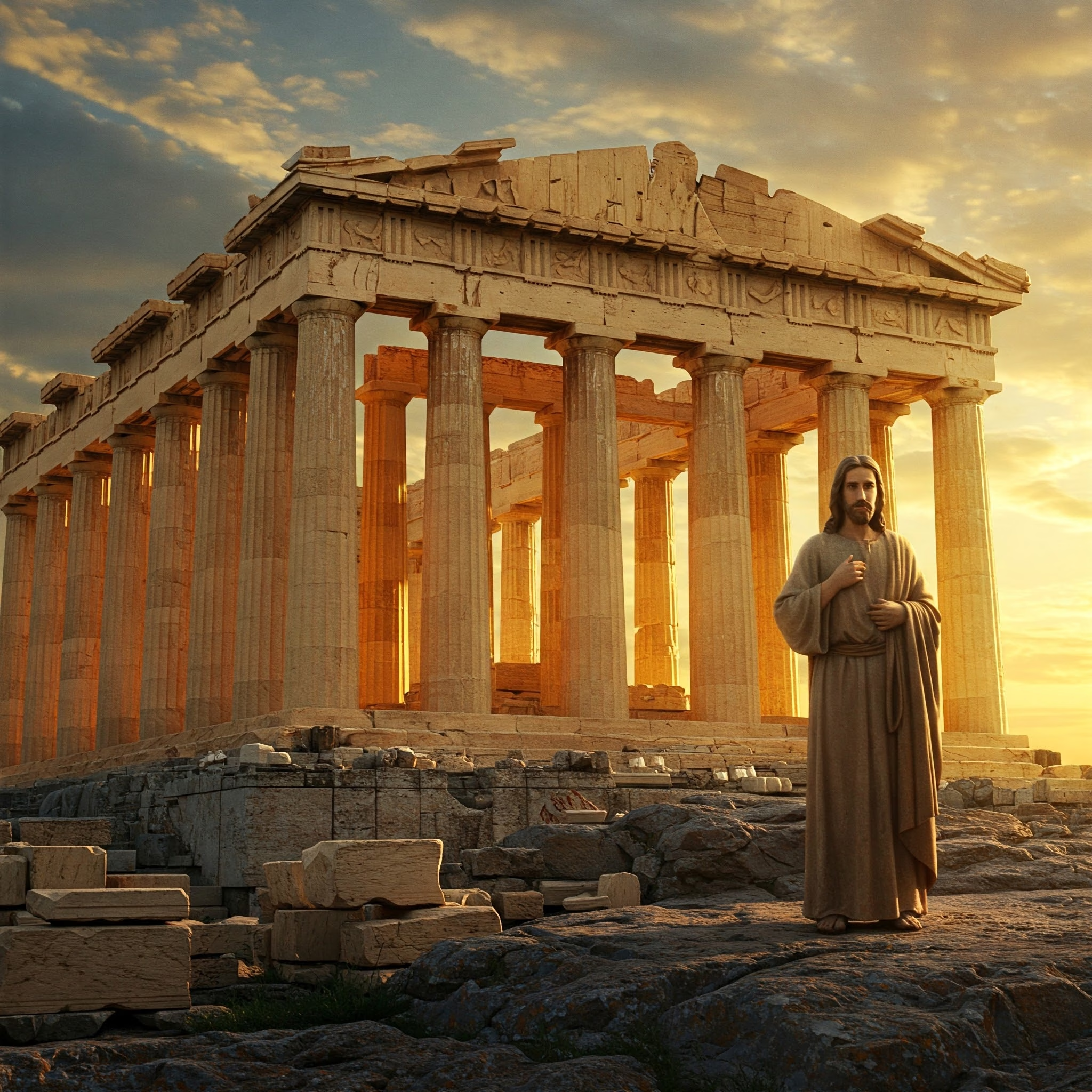
Ancient Greece stands as a luminous peak in human history, the cradle of democracy, philosophy, epic poetry, drama, and art forms that continue to inspire awe. Its influence on Western civilization is undeniable. But is there a deeper, spiritual connection between the culture of Ancient Greece and the pivotal event that occurred in Palestine – the life, death, and Resurrection of Christ Jesus? From the perspective of spiritual science, or Anthroposophy, as developed by the Austrian philosopher and spiritual researcher Rudolf Steiner, the answer is a profound yes. The Steiner view of ancient Greece’ connection with Christ reveals a fascinating interplay, suggesting that Greek culture played an indispensable role in preparing human consciousness for the arrival and eventual understanding of the Christ impulse. This article explores the Greece/Christ connection Steiner described, delving into the unique development of the Greek soul, the insights of Greek philosophy Steiner saw as preparatory, the profound meaning of the Logos Steiner discussed, the mission of Paul in Athens Steiner interpreted, and the connection between Greek mysteries Anthroposophy investigates within this spiritual-historical panorama, all based on the insights of Anthroposophy and studies about Christ and spiritual science about ancient Greece.
Ancient Greece: Preparing the Vessel for Christ (Steiner’s View)
While Rudolf Steiner indicated that the actual incarnation of the Christ Being required the specially prepared physical and soul vessel developed within the Hebrew lineage in Palestine, he saw Ancient Greece as fulfilling an equally vital, complementary task: forging the intellectual and cultural vessel needed for humanity to eventually understand and consciously integrate the universal significance of the Christ impulse. This preparation was intricately woven into the unique evolution of human consciousness during the Greek cultural epoch.
The Development of the Intellectual Soul
In Anthroposophy’s view of history, human consciousness evolves through successive Post-Atlantean cultural epochs, each with a specific task. The Fourth Post-Atlantean epoch, spanning roughly from the 8th century BCE to the 15th century CE, encompasses the Greco-Roman period. According to Steiner, its central mission was the cultivation of what he termed the ‘Intellectual Soul’ or ‘Mind Soul’ (German: Verstandes- oder Gemütsseele). This was a critical phase in the journey towards the Consciousness Soul, which characterizes our current Fifth Post-Atlantean epoch Greece is a precursor to.
The development of the Intellectual Soul marked a significant departure from earlier modes of consciousness, which were often more dreamlike, pictorial, or based on sentient feeling and atavistic clairvoyance. The Greek spirit pioneered:
- The capacity for clear, logical, objective thinking, differentiating the self from the surrounding world.
- The ability to form abstract concepts and engage in rational discourse.
- A heightened sense of human individuality and self-awareness, moving away from the dominance of group-soul consciousness of the past.
This forging of the intellect was a necessary step in human evolution towards freedom and self-determination. It created the capacity for human beings to begin understanding the world through their own rational powers, rather than relying solely on inherited wisdom or divine revelation channeled through priests or oracles. It was precisely this newly developed faculty of clear thinking that would later be needed to grapple with the profound spiritual truths brought by Christ. Greece, in essence, sharpened the tool of human thinking itself.

Greek Philosophy (Plato, Aristotle) and the Path to the Logos
The zenith of the Intellectual Soul’s development is found in Greek philosophy. Rudolf Steiner held figures like Plato and Aristotle in high esteem, viewing their work not just as intellectual achievements but as vital preparatory steps on humanity’s path towards consciously grasping spiritual realities, including the reality of the Logos, the Cosmic Word. The Greek philosophy and Christ connection lies in this forging of conceptual clarity.
- The Socratic Quest: The famous injunction at Delphi, “Know Thyself,” adopted by Socrates, signaled the turn inward, the quest for truth through self-examination and reasoned dialogue – a foundation for individual spiritual striving.
- Plato’s World of Ideas: Steiner interpreted Plato’s eternal Ideas or Forms not as mere mental constructs but as reflections of objective spiritual archetypes, the formative realities behind the changing physical world. Plato trained the human mind to look beyond sense appearances towards supersensible realities, preparing it to conceive of universal spiritual principles.
- Aristotle’s Logical Foundation: Aristotle, Steiner explained, brought thinking firmly into connection with earthly reality, developing the foundational principles of logic and scientific observation. By meticulously categorizing the world and analyzing the structure of thought itself, Aristotle provided humanity with the disciplined intellectual tools necessary for clear, objective knowledge – tools that could later be applied to understanding both natural and spiritual phenomena.
Through this intense philosophical activity, Greece created a conceptual framework capable of thinking about universal principles, divine reason, and the relationship between the spiritual and material worlds, paving the way for the concept of the Logos.
The Logos: A Bridge Between Greek Wisdom and Christ
One of the most compelling aspects of the Greece Christ connection Steiner described is the concept of the Logos (Λόγος). This term, central to Greek thought, provided an intellectual bridge to the understanding of the Christ Being.
- The Greek Logos: From Heraclitus, who spoke of an underlying cosmic Reason (Logos) and Fire ordering all things, through Plato’s concept of the supreme Good as the source of all reality, to the Stoics who conceived of a universal divine Logos permeating the cosmos, Greek philosophy wrestled with the idea of a universal, rational, creative principle. This philosophical Logos represented the highest point human reason could reach in contemplating the divine ordering of the world before the historical Christ event.
- The Johannine Logos: Rudolf Steiner placed immense importance on the Prologue of the Gospel of St. John, which begins, “In the beginning was the Logos, and the Logos was with God, and the Logos was God… And the Logos became flesh and dwelt among us.” Steiner saw this not merely as borrowing a Greek philosophical term, but as revealing the identity of the Being whom Greek philosophy had sought conceptually. The Logos Steiner Greece understood was the intellectual striving; the Gospel of John Steiner interpreted revealed the Being Himself, the Cosmic Word who created and sustains the world, now incarnated in Jesus of Nazareth.
- Language as Vehicle: Steiner also pointed to the unique capacity of the Greek language, shaped by this philosophical development, to articulate the subtle spiritual truths concerning the Logos and the Christ event with unparalleled precision and depth. The New Testament being written in Greek was, for Steiner, no accident but part of this spiritual-historical preparation.
Greece, therefore, built the intellectual highway towards the Logos; Christianity revealed the divine traveler who embodied it.

St. Paul in Greece: Connecting Worlds
The historical and spiritual confluence of the Greek intellectual stream and the new Christ impulse is powerfully represented, in Steiner’s view, by the mission of the Apostle Paul, particularly his engagement with philosophers in Athens. The significance of Paul in Athens Steiner highlighted lies in this direct encounter.
- Paul’s Unique Position: Paul, a Roman citizen deeply versed in both Jewish scripture and Hellenistic culture, and transformed by his direct supersensible encounter with the Risen Christ at Damascus, was uniquely equipped to bridge these worlds.
- The Areopagus Speech (Acts 17): Steiner interpreted Paul’s address to the Athenian philosophers on the Areopagus not as a rejection of their wisdom, but as a conscious connection to it. By referencing their altar “To the Unknown God,” Paul acknowledged their genuine spiritual seeking. He then proclaimed that the God they sought unknowingly was the very God who created the world, who had now fully revealed Himself in the man Jesus, and whose reality was confirmed by the Resurrection.
- Reason Meets Revelation: Paul employed reasoned argument familiar to his Greek audience but pointed towards a reality – the Resurrection – that transcends philosophical speculation and requires a leap towards spiritual experience or faith. The mixed reaction he received (some mocking, some wanting to hear more) symbolizes the ongoing challenge and potential of bringing the direct Christ revelation into dialogue with human intellectual striving. Paul’s mission in Greece represents the crucial effort to pour the new wine of the Christ impulse into the prepared vessel of Greek thought.
Greek Mysteries and Christian Initiation
Beyond its exoteric philosophy and art, Ancient Greece spirituality was deeply nourished by its esoteric traditions known as the Mysteries. Anthroposophy’s Greek mythology and Mystery interpretation, as presented by Steiner, sees these not as mere pagan cults but as vital precursors containing genuine spiritual wisdom and initiatory experiences that prepared the way for Christianity.
- Centers of Initiation: Steiner viewed the ancient Mysteries (such as the Eleusinian mysteries Steiner often referenced, as well as Samothracian, Orphic, and Dionysian streams) as places where chosen individuals underwent carefully guided processes designed to awaken dormant spiritual faculties. Through symbolic rituals, dramatic performances, and inner disciplines, initiates could achieve direct perception of the spiritual world, the nature of the soul’s journey, death, rebirth, and the workings of cosmic beings.
- Pre-Christian Knowledge of Christ?: Steiner indicated that within the deeper strata of some Mysteries, particularly those influenced by streams flowing from the East or preserving ancient Atlantean wisdom, there existed a prophetic knowledge, a fore-feeling or even a spiritual perception, of the great Sun Spirit, the Logos, who was destined to descend to Earth. Figures like Dionysus, in some interpretations, were seen as foreshadowing aspects of the Christ Being.
- Fulfillment in Christ: While respecting the validity of the ancient Mysteries for their time, Steiner presented the Christ event not as negating the ancient Mysteries, but as fulfilling their deepest truths and making the path of initiation, previously accessible only to a select few within hidden centers, potentially available to all humanity through historical revelation and inner connection with the Christ impulse. Christ became the universal Mystery accessible in the light of day.
The Greek mysteries Anthroposophy explores were thus seen as crucial preparatory stages, fostering spiritual experiences and concepts that helped pave the way for humanity’s reception of the Mystery of Golgotha.
Conclusion: Greece’s Pivotal Role in Spiritual History
From the perspective of Rudolf Steiner and Anthroposophy, the Christ’s connection with Greece Steiner described is not one of direct physical interaction during Jesus’s life, but a profound spiritual-historical necessity. While Palestine provided the prepared human vessel and soul environment for the Incarnation itself, Ancient Greece forged the indispensable intellectual and cultural vessel for the Christ impulse to be understood and integrated into human consciousness.
Through the development of the Intellectual Soul, the rigorous striving of Greek philosophy towards the Logos, the precision of the Greek language, and the deep spiritual experiences cultivated within the Greek Mysteries, Hellenic culture created the cognitive framework and sharpened the human faculties required to eventually grasp the universal significance of the Being who appeared in Jesus of Nazareth. The mission of St. Paul represents the historical moment when these two streams—the direct spiritual revelation flowing from Palestine and the intellectual preparation of Greece—consciously met.
Therefore, the Steiner view about ancient Greece reveals Greek civilization not merely as a precursor in a secular sense, but as an essential, divinely guided stage in preparing humanity for the central event of its evolution. The Anthroposophy’s perspective about Greece and Christ illuminates how the “glory that was Greece” served a pivotal role in making possible the understanding and articulation (in Greek!) of the universal Christ impulse revealed in Palestine, enabling the influence of Greece on Christianity to be recognized on a truly spiritual level.