Few myths carry the specific weight of moral ambiguity that the story of Prometheus does. He is a rebel and a benefactor simultaneously — a Titan who defies the highest god to bring humanity a gift that transforms its condition, and who suffers eternal torment as the direct consequence. Chained to a rock, his liver devoured daily by an eagle and regenerated each night, Prometheus has stood for millennia as one of the most potent images of the price that genuine knowledge exacts from those who bring it into the world before its time.
Rudolf Steiner’s spiritual science approaches this myth with precision, addressing it in various lecture cycles connected with Greek mythology, including material in GA 92 (“The Founding of the Christian Community”) and GA 180 (“Mystery Truths and Christmas Impulses”). For Steiner, the myth encodes a genuine spiritual memory of one of the most significant transitions in human evolution — from a humanity governed by inherited divine guidance to a humanity capable of independent, self-directed thought.
Who Prometheus Represents
Steiner describes the Titans generally as mythological representations of an earlier, more instinctive stage of consciousness — superseded by the Olympian gods, who represent a later, more individuated stage. Prometheus, surviving into the Olympian age, occupies an unusual position: his very name, meaning “forethought,” encodes the specific capacity for independent reasoning beginning to emerge within humanity even while the gods remained the primary custodians of cosmic knowledge.
His theft of fire is not simply the acquisition of a useful technology. It is the mythological encoding of humanity’s first acquisition of a spark of the very faculty — independent, self-directed cognitive fire — that the developed human “I” would eventually come to possess in full.
Fire as Independent Thinking
Fire, throughout ancient mystery tradition, represents the transformative, illuminating quality of genuine spiritual cognition. Steiner indicates that the development of independent human thinking was not simply granted by the guiding spiritual hierarchies as a freely bestowed gift. It was, in an important sense, seized — developed through humanity’s own struggle, necessarily involving a degree of separation from the direct, protective guidance the hierarchies had previously provided.
This is why the myth insists on Zeus’s anger and Prometheus’s punishment. The acquisition of independent thinking involved a genuine cosmic cost — a real separation from the protective unity with divine guidance that the pre-Promethean condition of humanity had enjoyed.
The Precise Meaning of the Punishment
The specific form of Prometheus’s punishment carries precision worth attention. Steiner connects the liver with the astral body’s activity and the soul forces of desire, courage, and vital will. The eagle — a symbol of cognitive clarity elsewhere in Steiner’s work — devouring the liver, the organ of vital astral force, encodes a specific dynamic: the price of developing clear, independent thought is a continuous demand placed upon the vital, instinctive dimension of the soul.
The nightly regeneration of the liver indicates this is not a one-time cost. It is an ongoing condition of the developed human constitution — the continuous tension between vital instinct and developing conscious thought that every human being who has taken up the Promethean fire must continue to carry.
Furthermore, Prometheus’s chains at the remote, rocky edge of the world represent the specific condition of consciousness bound to physical, mineral, earthly reality — the condition that independent human thinking, working through the physical brain, inevitably involves.
Liberation Through Heracles
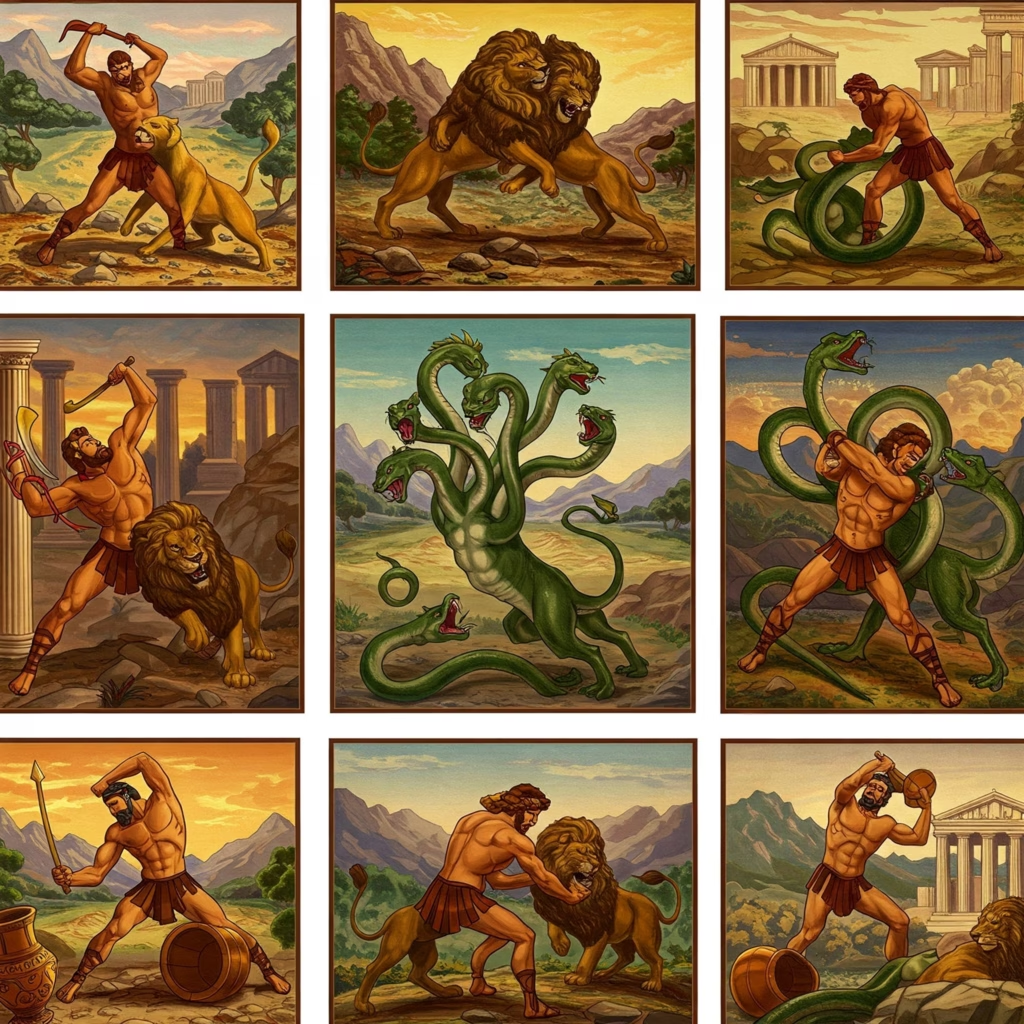
The myth does not end in eternal torment. Heracles eventually kills the eagle and frees Prometheus — a resolution Steiner illuminates with specific significance. Heracles represents the developed human will — decisive, courageous, physically effective action that complements the cognitive capacity Prometheus’s fire represents.
The full arc of the myth therefore encodes a complete developmental sequence: the theft of independent cognitive fire, the genuine cost this exacts upon the vital soul, and eventual liberation through a complementary capacity for decisive, will-directed action. The human being who has developed only independent thought, without the courage to act decisively upon what that thought reveals, remains, in a specific spiritual sense, still chained to the rock.
A Double-Edged Gift
Steiner’s broader teaching on Lucifer illuminates the myth further. The theft of fire carries structural similarities to the Luciferic gift of independent selfhood entering human evolution during the Lemurian epoch. Both gifts make possible genuine independent thought, genuine freedom, and genuine moral responsibility — and both come at genuine cost: separation from direct divine guidance and the specific vulnerability to error that independent selfhood makes possible.
This is precisely why the appropriate response, in Steiner’s account, is neither simple gratitude nor simple rejection but genuine, ongoing moral work — tending the stolen fire wisely rather than using it without moral seriousness.
The full article on Substack covers the complete cosmological placement of Prometheus among the Titans and Olympians, the specific connection to the Luciferic influence explored in earlier articles, and Steiner’s complete account of why the theft, though genuinely costly, was ultimately necessary for human development. Free to read on Substack.
Read the full article free on Substack →