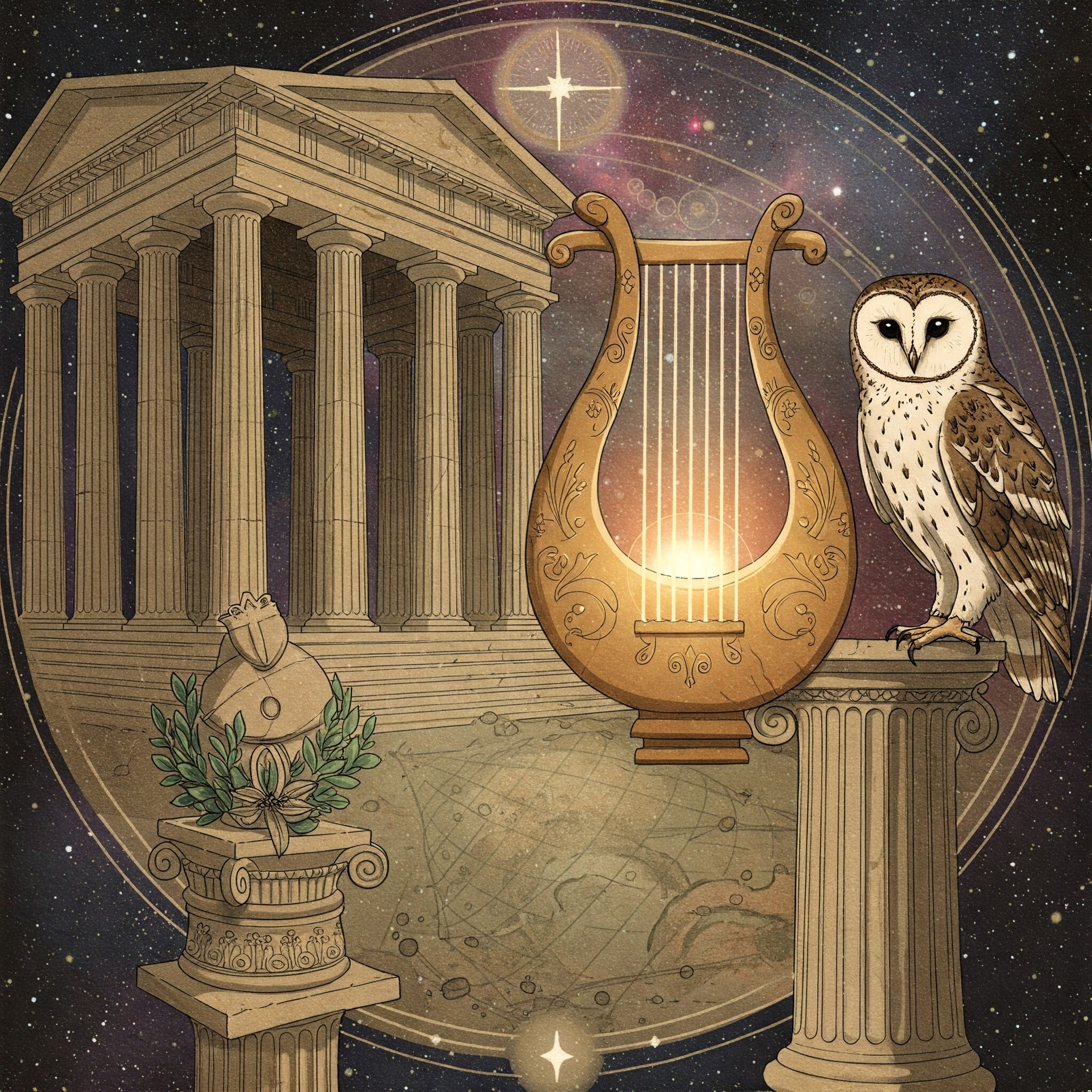
The myths of ancient Greece—tales of Zeus’s thunderbolts, Apollo’s lyre, Athena’s wisdom, and the intricate dramas played out on Mount Olympus and Earth—form a cornerstone of Western culture. While often appreciated for their literary beauty or studied as historical artifacts, their deepest significance is revealed when viewed through the lens of anthroposophical spiritual science. The Rudolf Steiner Greek Mythology perspective invites us to see these narratives not as mere fictions or primitive explanations, but as inspired imaginations reflecting a unique stage of human consciousness, the activity of guiding Spiritual Hierarchies, the nature of cosmic forces, and a crucial preparation for the central event of Earth evolution.
The Consciousness of Ancient Greece: Dawn of the Intellectual Soul
Understanding Greek mythology requires understanding the consciousness from which it sprang [The Riddles of Philosophy]. Spiritual science describes human evolution unfolding through distinct cultural epochs. The ancient Greek period (the fourth post-Atlantean epoch) marked a pivotal transition. Humanity was developing what anthroposophy terms the Intellectual or Mind Soul. This meant a shift away from the more instinctive, dreamlike clairvoyance of earlier cultures (like the Indian or Persian) towards clearer conceptual thinking, a more objective perception of the outer world, and a strengthening sense of individual selfhood [The Spiritual Guidance of the Individual and Humanity GA 15].
However, this emerging intellect was not yet the purely abstract, sense-bound thinking often dominant today. It remained interwoven with feeling and imagination, and still possessed a receptivity to spiritual inspiration. The Greeks perceived the world with growing intellectual clarity, yet still experienced it as permeated by divine forces and beings. Their myths represent the translation of supersensible perceptions and spiritual truths into the language of this awakening intellectual soul, often through powerful, archetypal images. The Rudolf Steiner Greek Mythology approach emphasizes understanding the myths through the lens of this specific consciousness.

The Olympian Pantheon: Hierarchies, Forces, and Soul Capacities
The gods and goddesses of Olympus, as depicted in Greek myth, can be understood from the Rudolf Steiner Greek Mythology perspective as multifaceted imaginations reflecting several layers of reality:
- Spiritual Hierarchies: The figures often represent the activity of specific ranks of the Spiritual Hierarchies guiding humanity during that epoch [cite: the-celestial-hierarchy-of-rudolf-steiner.pdf].
- Zeus (Jupiter): As the supreme ruler establishing order, he reflects the form-giving, regulating activity of the Exusiai (Spirits of Form), working particularly through the etheric realm and shaping the consciousness of the age.
- Apollo: The god of light, harmony, prophecy, and healing, clearly reflects the influence of high beings from the Third Hierarchy, likely an Archangel or even the guiding Archai (Time Spirit) of the Greek epoch, mediating solar wisdom and preparing for the Christ impulse.
- Athena: Born from Zeus’s head, she embodies wisdom manifesting as clear thought, representing the guiding influence of the Archai fostering the development of the Intellectual Soul.
- Hermes (Mercury): As the swift messenger, he reflects the mediating activity of Angels and Archangels bridging the spiritual and earthly realms.
- Cosmic Forces and Principles: The gods also embody fundamental cosmic forces and principles. Zeus represents cosmic order and overarching intelligence. Poseidon embodies the dynamic, fluidic forces of the watery/etheric element. Apollo represents the ordering, harmonizing power of the Sun’s spiritual light. Hephaestus represents the transformative power of fire applied through will and craft.
- Human Soul Capacities: The Olympians mirror the forces awakening within the human soul itself during the development of the Intellectual Soul. Athena represents emerging rational thought. Apollo represents artistic inspiration and clarity of vision. Ares embodies impulsive will. Aphrodite represents the power of earthly love and desire within the astral body. The complex relationships and conflicts among the gods often depict the inner struggles and dynamics within the developing human soul as it navigated these emerging capacities [The occult truths of myths and legends]
It is the genius of Greek mythology, as understood through the Rudolf Steiner Greek Mythology framework, that these different layers—hierarchical influence, cosmic forces, and human soul development—are woven together into unified, living imaginations.

The Greek Mysteries: Esoteric Heart of the Culture
Behind the exoteric myths accessible to the populace lay the esoteric core of Greek spiritual life: the Mysteries, such as those celebrated at Eleusis, Samothrace, or Ephesus [The Mysteries of the East and of Christianity GA 144]. These were centers of initiation where prepared individuals could, through specific disciplines and sacred rites, achieve direct, conscious experience of the spiritual worlds and the truths veiled within the popular myths.
- Pathways to Supersensible Knowledge: The Mysteries provided structured paths for transcending ordinary sense perception and entering into communion with spiritual realities. They involved purification, inner trials, and the awakening of higher faculties of perception [Initiation and Its Results].
- Connection to Myth: The myths often served as preparatory teachings or symbolic representations of the processes undergone within the Mysteries. The stories of gods, goddesses, and heroes provided imaginative frameworks for understanding the spiritual journey.
- Drama’s Origin: Greek drama, particularly tragedy as exemplified by Aeschylus and Sophocles, arose directly from the spirit, if not the exact rituals, of the Mysteries [cite: Waldorf Education and Anthroposophy 1 – Lecture 7]. It presented audiences with powerful images of human destiny grappling with divine law and spiritual forces, aiming to evoke feelings of fear and compassion (Aristotle’s catharsis) that echoed the transformative experiences of initiation [Christianity as Mystical Fact]. Understanding the Mysteries provides essential context for the Rudolf Steiner Greek Mythology interpretation.
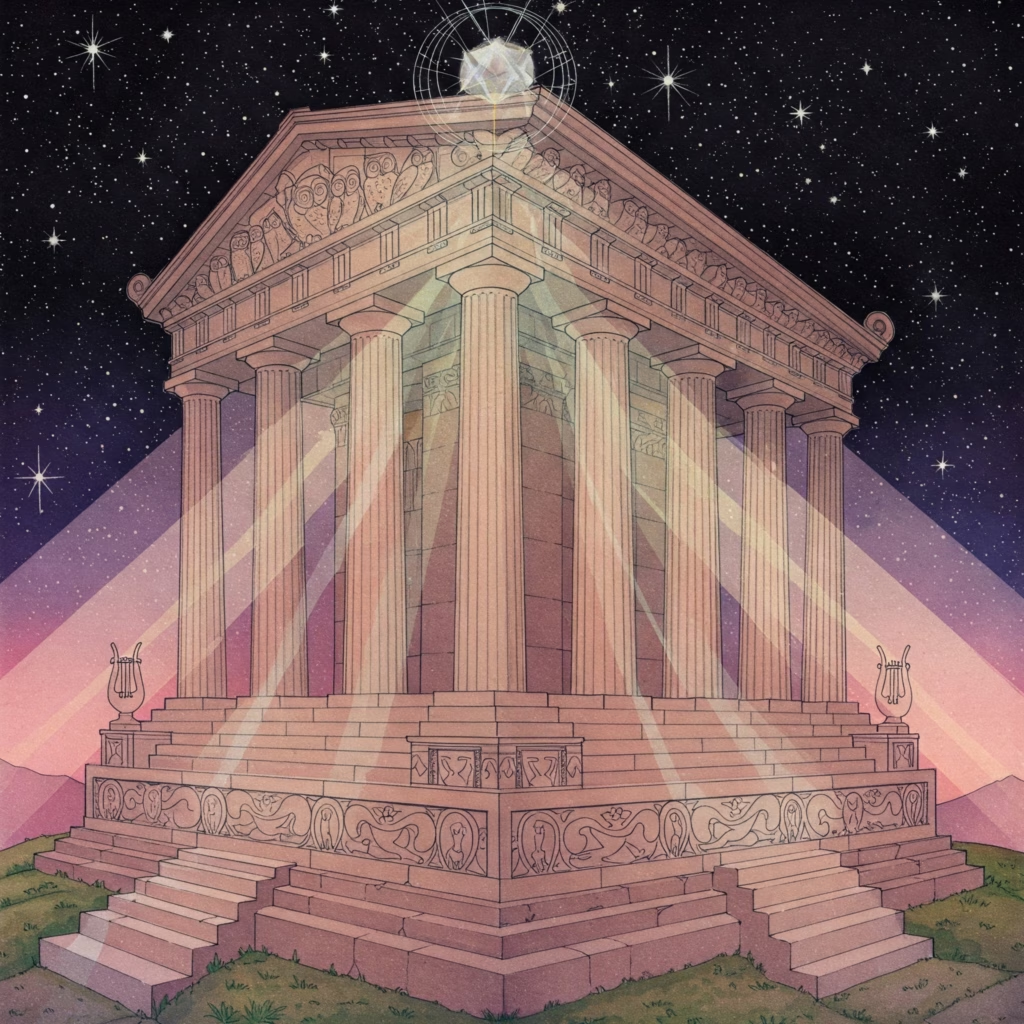
Preparing the Way: Greece and the Mystery of Golgotha
From the perspective of spiritual history illuminated by anthroposophy, the entire trajectory of Greek culture served as a crucial preparation for the central event of Earth evolution: the incarnation, death, and resurrection of the Christ Being [Christianity as Mystical Fact].
- Development of Thinking: The unique achievement of Greek philosophy was the development of clear, logical thinking, the capacity to grasp universal concepts independent of direct sensory perception [The riddles of philosophy]. This forging of the instrument of thought, particularly the understanding of the Logos (as Cosmic Reason or Word), was essential preparation for humanity to eventually be able to comprehend the profound spiritual significance of the Logos becoming flesh in Christ Jesus [The gospel of St. John].
- Refinement of the Soul: Greek art, poetry, and drama cultivated a refined soul life, exploring the heights and depths of human feeling and experience. This differentiation of the soul, particularly the Intellectual Soul, prepared humanity to inwardly receive and resonate with the subtle, transformative power of the Christ’s impulse of love.
- Pointing Towards the Sun Spirit: Figures like Apollo, the God of Light associated with the Sun, served as powerful imaginative precursors, pointing towards the true Sun Spirit Who would descend from cosmic heights [From Jesus to Christ]. The Mysteries, with their themes of initiation, death, and rebirth, also prepared human souls to understand the possibility of overcoming death through spiritual power, foreshadowing Christ’s resurrection. The Rudolf Steiner Greek Mythology view sees this entire culture, guided by its specific hierarchical influences, as fulfilling a necessary role in the divine plan leading towards the Mystery of Golgotha.
Conclusion: The Living Legacy of Greek Myth
To engage with Greek mythology through the Rudolf Steiner Greek Mythology perspective is to engage with a living stream of spiritual wisdom. These narratives are far more than ancient stories; they are windows into the soul of a people awakening to intellectual self-awareness while still perceiving the spiritual forces and guiding beings of the cosmos. They reflect the activity of the Spiritual Hierarchies – particularly the Exusiai, Archai, and Archangels – shaping human consciousness and culture during a pivotal epoch.
Understanding Zeus as the Spirit of Form, Apollo as the Archangelic Sun-Guide, Athena as Archai-inspired Wisdom, and the other Olympians as reflections of hierarchical beings wielding cosmic and soul forces, allows us to appreciate the spiritual depth behind the myths. Recognizing the Greek Mysteries as the esoteric heart of the culture provides context for the myths’ profound themes. Seeing the entire epoch as a preparation for the Christ impulse integrates Greek wisdom into the larger spiritual history of humanity.
For us today, these myths offer enduring value. They provide archetypal images of soul forces and spiritual principles. They illuminate a crucial stage in the evolution of consciousness. They remind us of the reality of the spiritual world and its guiding beings. By studying them with the insights of spiritual science, we can enrich our understanding of ourselves, our history, and the spiritual foundations upon which our modern world, with its unique challenges and potentials, is built. The Rudolf Steiner Greek Mythology approach helps us hear the eternal truths still echoing from ancient Olympus.