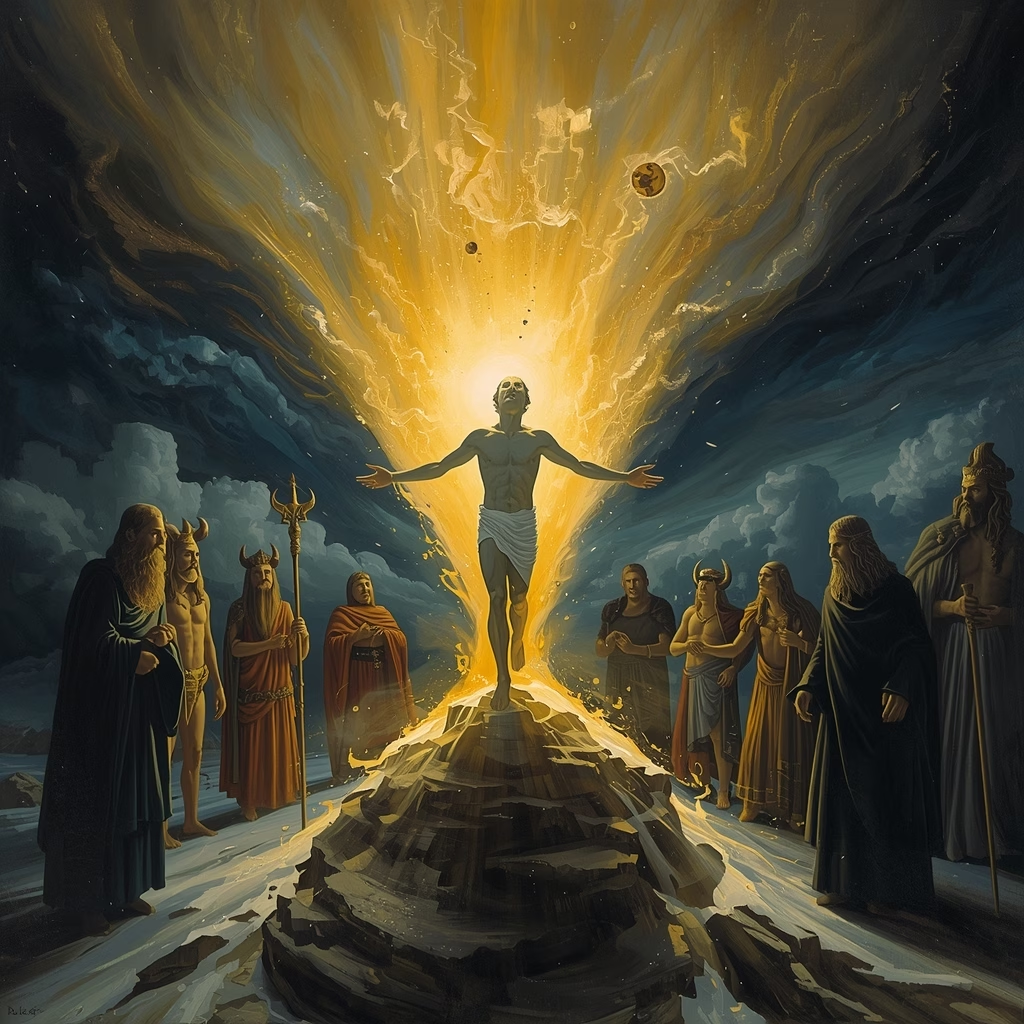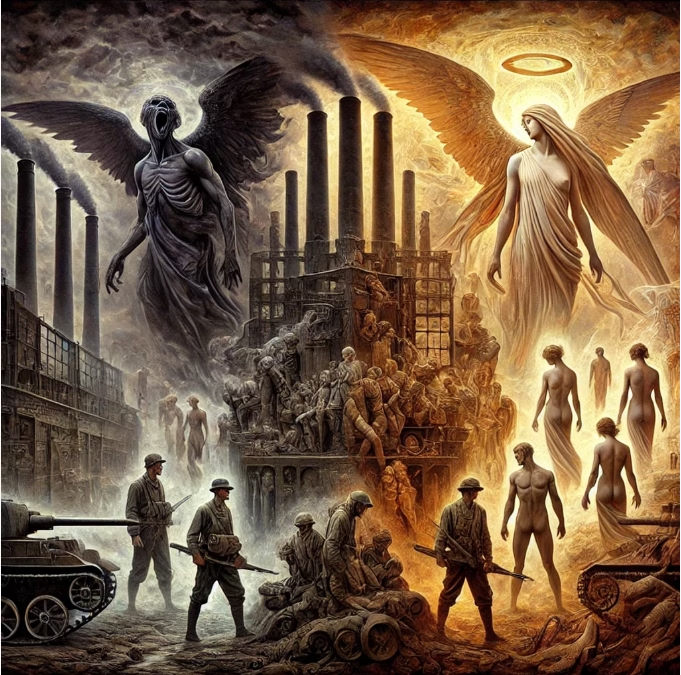
Rudolf Steiner repeatedly stated during the years 1914–1918 that the First World War would remain incomprehensible as long as it was explained only through political, economic, or national causes. Diplomatic conflicts, military alliances, and territorial ambitions were, in his view, merely the outer symptoms of far deeper processes. The true causes of the war lay in the spiritual world and in the evolution of human consciousness. Humanity, Steiner argued, had entered a phase in which spiritual forces that once worked invisibly were now intervening directly in earthly affairs. The tragedy of the war was that human beings no longer possessed the inner faculties required to recognize or consciously engage with these forces.
Steiner emphasized that modern humanity had become accustomed to explaining destiny through surface events while ignoring supersensible realities. This blindness was not neutral. It created the conditions under which destructive spiritual beings could operate freely through human thinking, feeling, and willing. The First World War was therefore not an accident of history, but a lawful consequence of humanity’s spiritual condition at the beginning of the twentieth century.
The Long Preparation of the Catastrophe
According to Steiner, the war did not arise suddenly in 1914. Its spiritual causes had been preparing themselves for centuries. Since the fifteenth century, humanity had been undergoing a progressive narrowing of consciousness. This development was necessary for the emergence of individual freedom, but it also involved the gradual loss of direct spiritual perception. Human beings increasingly confined their awareness to the sensory world and to intellectual abstractions derived from it. The spiritual realities once experienced instinctively were pushed into the background.
Steiner explained that this narrowing of consciousness created a growing imbalance. Human beings developed powerful intellectual capacities without developing corresponding moral and spiritual insight. Thinking became sharper but colder. Feeling became more subjective and less connected to truth. Will became increasingly externalized into social systems, institutions, and technologies. By the nineteenth century, this imbalance had reached a critical stage. Humanity possessed immense power over nature and society, but little awareness of the spiritual consequences of its actions.
The First World War erupted at the moment when this imbalance could no longer be contained.
The Transformation of Thinking and Its Spiritual Consequences
One of Steiner’s central themes in his wartime lectures is the transformation of human thinking itself. He repeatedly stressed that modern thinking had lost its living connection to the spiritual world. Thoughts were no longer experienced as realities, but as mental images produced by the brain. This change, while necessary for freedom, became dangerous when thinking was no longer guided by moral imagination.
Steiner warned that thinking detached from spiritual reality does not become neutral. It becomes susceptible to influence by supersensible beings that work precisely through dead, abstract intellect. When thoughts are no longer inwardly experienced as moral acts, they can be used as instruments. According to Steiner, modern political and social thinking before the war functioned in exactly this way. Concepts such as nation, state, security, and progress were handled intellectually without inner responsibility for their truth.
The war, Steiner said, was planned, organized, and sustained through this deadened thinking. Decisions affecting millions of lives were made through calculations that excluded moral and spiritual considerations. Human beings no longer felt inwardly responsible for what they thought. This loss of responsibility in thinking was one of the deepest spiritual causes of the catastrophe.
Ahrimanic Forces and the Mechanisation of War
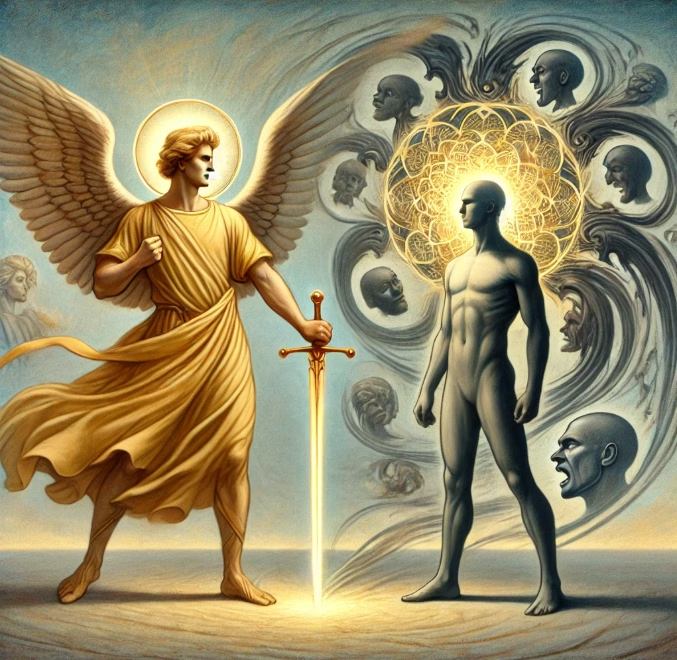
Steiner spoke explicitly during the war about the increasing activity of Ahrimanic beings. Ahriman, in Steiner’s spiritual science, is a real spiritual intelligence whose aim is to bind human consciousness entirely to the material world. His influence manifests through mechanization, rigid logic, quantitative thinking, and the domination of living processes by dead systems.
According to Steiner, the First World War was the first conflict fully shaped by Ahrimanic intelligence. Warfare became industrial, bureaucratic, and abstract. Human beings were treated as units of production and combat power. The battlefield was organized according to logistical efficiency, mathematical planning, and technological capacity. Moral judgment was replaced by technical necessity.
Steiner emphasized that this was not merely a social or ethical problem, but a spiritual one. When human beings surrender their thinking to Ahrimanic forces, they cease to act as free moral agents. They become extensions of systems that function independently of conscience. The war revealed how deeply modern humanity had already allowed its thinking and willing to be absorbed into mechanized processes.
Luciferic Forces and Emotional Intoxication
Alongside Ahrimanic influences, Steiner described the strong activity of Luciferic beings in the years leading up to the war. Luciferic forces work through exaltation, illusion, enthusiasm, and false spirituality. Where Ahriman hardens and deadens, Lucifer inflames and intoxicates.
Steiner observed that European peoples had fallen under Luciferic illusion through exaggerated nationalism and romantic idealism. Nations experienced themselves emotionally as bearers of a special destiny. Concepts such as honor, sacrifice, and historical mission were felt intensely rather than consciously examined. This emotional certainty replaced moral insight.
Many intellectuals and cultural figures welcomed the war as a necessary purification. Steiner warned that this enthusiasm was profoundly dangerous. It detached feeling from truth and created a willingness to sacrifice human lives without understanding the spiritual consequences. Luciferic forces thus prepared the human soul to accept destruction while believing it to be meaningful or inevitable.
Untruthfulness in Public Life as a Spiritual Force
A central element of Steiner’s wartime teaching concerns untruthfulness in public life. In his lecture cycle The Karma of Untruthfulness, Steiner explained that modern civilization had become structurally dishonest. This dishonesty did not consist merely in individual lies, but in the way language itself was used in politics, journalism, and diplomacy.
Words no longer expressed reality. They concealed it. Treaties, alliances, and public narratives were constructed on half-truths and deliberate ambiguities. According to Steiner, this condition had karmic consequences. When truth is systematically distorted, spiritual beings that thrive on deception gain access to human affairs.
Steiner stated clearly that such beings were actively involved in the First World War. They fed on confusion, fear, and hatred generated by collective untruthfulness. The war was therefore not only fought with weapons, but with words detached from reality. Humanity had created a false picture of itself and the world, and the collapse of this picture could only occur through catastrophe.
The Misuse of Folk Souls and Collective Identity
Steiner also explained the war through the misuse of Folk Souls, the Archangelic beings guiding different peoples. In earlier epochs, humanity was rightly guided through collective spiritual beings. In the modern age, however, individuals were meant to emancipate themselves from unconscious dependence on national impulses and develop personal moral responsibility.
According to Steiner, the tragedy of the First World War was that humanity regressed instead of progressing. Individuals surrendered their conscience to collective identity. National allegiance replaced ethical judgment. The rightful task of the Folk Souls was distorted, and their influence became destructive rather than guiding.
This regression allowed collective forces to override individual responsibility. Steiner warned that when human beings abandon their inner freedom in this way, they open themselves to spiritual possession. The war expressed this possession on a massive scale.
The Michaelic Battle and the Failure of Moral Thinking
Rudolf Steiner repeatedly placed the First World War within the context of the Michaelic age. According to his spiritual science, the Archangel Michael assumed a new leadership role for humanity beginning in the late nineteenth century. Michael’s task was to guide human thinking toward consciousness, truthfulness, and moral responsibility. This guidance did not take place through emotional enthusiasm or blind faith, but through the transformation of thinking itself into a spiritual and ethical activity.
Steiner emphasized that the decisive battle of the modern age is not fought on the battlefield, but within human thought. Michael seeks to inspire a form of thinking that remains clear and exact while becoming inwardly alive and morally accountable. Humanity, however, largely failed to meet this task. Instead of transforming thinking into a consciously spiritual activity, it allowed intellect to become autonomous, abstract, and morally neutral. This failure created the conditions under which Ahrimanic and Luciferic forces could seize human consciousness.
The First World War, Steiner explained, was the outer manifestation of this inner defeat. Thinking had lost its connection to spiritual truth and thus became available as an instrument of power, calculation, and deception. Humanity entered the age of freedom without having learned how to think responsibly. The war revealed what happens when intellectual capacity outpaces moral development.
The Spirits of Darkness and Their Release Into Human Affairs
In his 1917–1918 lecture cycle The Fall of the Spirits of Darkness, Steiner spoke about a decisive event in the supersensible world that directly affected earthly history. He described how certain spiritual beings, whose activity had previously been restricted to the supersensible realms, were cast down into the sphere of human consciousness. These beings, which Steiner identified as particularly hostile to human freedom, now worked directly through human thinking and social life.
Steiner made it clear that this release did not cause the war mechanically. Rather, it intensified forces that were already present due to humanity’s materialistic orientation. Human beings who had lost conscious spiritual perception became especially vulnerable to these beings. Where thinking was abstract and untruthful, where feeling was driven by hatred or illusion, and where will was surrendered to systems and authorities, these spirits could operate freely.
The First World War coincided precisely with this spiritual event. According to Steiner, the chaos, confusion, and moral blindness of the war years were inseparable from the activity of these beings. Humanity was confronted with forces it could no longer perceive or control because it had abandoned spiritual knowledge. The war thus revealed not only a human failure, but a new stage in the spiritual battle surrounding Earth evolution.
Fear, Suggestion, and the Manipulation of Consciousness
Steiner also addressed the role of fear and mass suggestion during the war. He explained that fear weakens the human “I” and makes consciousness permeable to external influence. Modern society, he warned, had already become highly susceptible to suggestion due to its dependence on authority, media, and abstract systems of thought.
During the war, fear was deliberately cultivated. Populations were subjected to continuous emotional pressure through propaganda, sensationalized reporting, and simplified narratives of good and evil. According to Steiner, this was not merely a psychological phenomenon. Fear creates specific spiritual conditions that allow destructive beings to work through human souls.
Steiner emphasized that suggestion replaces thinking. When people no longer examine reality inwardly, they become receptive to implanted ideas. The war demonstrated how entire populations could be guided into hatred, obedience, and sacrifice without conscious understanding. This condition, Steiner warned, represented a profound spiritual danger for the future of humanity.

Death on a Mass Scale and Its Spiritual Consequences
Steiner spoke with particular gravity about the unprecedented scale of death during the First World War. Millions of human beings passed suddenly from physical life into the spiritual world, often without preparation, reflection, or completion of their earthly tasks. This created extraordinary conditions in the supersensible realms surrounding the Earth.
He explained that such mass death alters the relationship between the living and the dead. Souls who die suddenly carry intense questions, unresolved intentions, and powerful emotional forces into the spiritual world. These forces do not disappear. They remain active within the spiritual environment of humanity and influence the living.
Steiner stressed that the living bear responsibility for these souls. If humanity fails to transform the conditions that led to such deaths, the karmic impulses released by them will return. He repeatedly warned that unresolved war karma does not dissolve on its own. It demands conscious response through truthfulness, moral courage, and spiritual understanding.
The War as a Karmic Threshold for Humanity
From Steiner’s perspective, the First World War constituted a karmic threshold. Humanity was confronted with the consequences of its spiritual development and forced to choose between transformation and repetition. The war revealed what modern consciousness had become when severed from spiritual reality. It exposed the results of thinking without truth, feeling without responsibility, and willing without freedom.
Steiner insisted that karma does not punish. It educates. The suffering of the war was not imposed from outside, but arose from humanity’s own spiritual condition. The catastrophe was therefore also an opportunity. If humanity learned to recognize the spiritual causes of the war, it could begin to transform them consciously.
However, Steiner warned that this opportunity could be missed. Without spiritual insight, humanity would attempt to rebuild the world using the same modes of thinking that led to destruction. In that case, the karmic forces of the war would reappear in new and more dangerous forms.
The Failure to Learn and the Return of Unresolved Forces
In his final years, Steiner spoke openly about his concern that humanity was failing to learn from the war. He observed that materialistic thinking continued to dominate education, politics, and science. Untruthfulness in public life persisted. Collective identity and ideology remained powerful. The deeper spiritual causes of the catastrophe were largely ignored.
Steiner stated explicitly that when karmic lessons are not consciously integrated, they return. The forces released by the First World War would not vanish simply because the fighting had ended. If humanity did not take spiritual reality seriously, these forces would reorganize themselves in new historical forms.
These statements were not predictions in a journalistic sense. Steiner presented them as expressions of spiritual law. Human freedom remained intact, but freedom without consciousness leads to repetition rather than progress.
Steiner’s Call for a Spiritual Renewal of Thinking
Throughout his wartime and post-war lectures, Steiner emphasized that the only genuine response to the catastrophe lay in the renewal of human thinking. Thinking must become inwardly alive again. It must reconnect with spiritual reality and moral responsibility. Only such thinking can resist the influence of destructive spiritual forces.
Steiner did not advocate a return to old belief systems or instinctive spirituality. He insisted that modern humanity must consciously develop spiritual knowledge appropriate to its stage of evolution. This includes recognizing the reality of spiritual beings, understanding karma, and accepting responsibility for the consequences of thought and action.
The war demonstrated that humanity could no longer afford spiritual ignorance. The price of such ignorance had been revealed in blood and devastation.
Conclusion: The War as a Spiritual Warning
According to Rudolf Steiner, the First World War was the result of spiritual forces acting through a humanity that had lost conscious connection to the spiritual world. It arose from materialistic thinking, Ahrimanic mechanization, Luciferic illusion, untruthfulness in public life, mass suggestion, and the failure to meet the Michaelic task of moral thinking. The catastrophe was not meaningless. It was a warning written into history itself.
Steiner did not present this understanding to condemn humanity, but to awaken responsibility. The war marked a threshold in human evolution. Whether humanity would cross that threshold consciously or repeat its suffering depended on its willingness to take spiritual reality seriously. The task Steiner set before humanity was clear: to transform thinking into a morally guided spiritual activity, capable of withstanding the forces that seek to dominate human consciousness.
Only through such transformation could the karmic forces released by the war be redeemed rather than repeated.