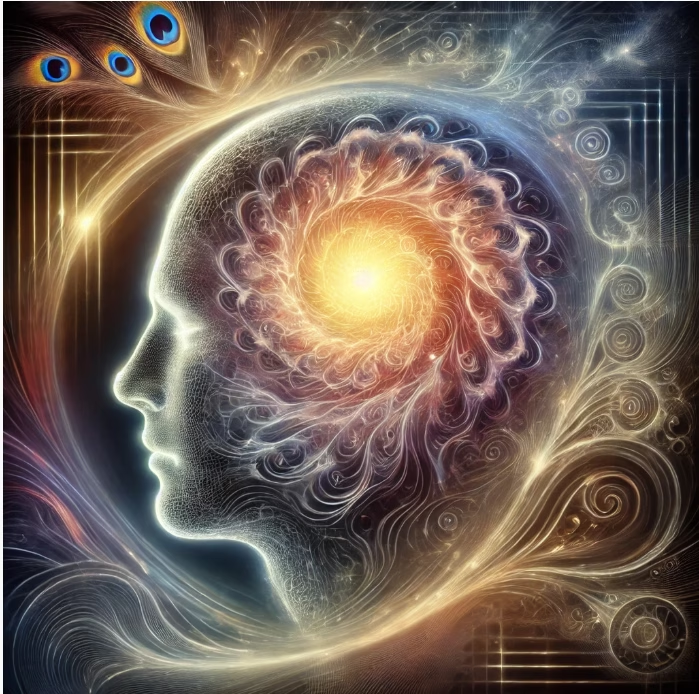
Almost everyone has experienced it. You enter a room you have never visited and feel, with sudden and inexplicable certainty, that you have been here before. You meet a person for the first time and feel a quality of deep recognition — as though this person has been known to you for a very long time.
Modern psychology calls this déjà vu and explains it as a neurological processing error. This describes a mechanism. It does not explain the experience itself — the specific quality of soul recognition déjà vu carries, or why it attaches consistently to specific places and specific people rather than arising randomly.
Rudolf Steiner’s spiritual science offers a different explanation — one that takes the experience seriously. He addresses the memory of past lives in GA 9 (“Theosophy”), GA 135 (“Reincarnation and Karma”), and GA 120 (“Manifestations of Karma”). For Steiner, déjà vu is not a neurological glitch. It is a genuine, if dim and partial, breakthrough of real memory — the moment when a soul’s deep karmic history briefly surfaces into ordinary waking consciousness.
What the Soul Carries Across Death
Everything the soul has genuinely experienced leaves a trace — not in the physical brain, which dissolves at death, but in the soul’s own constitution. These traces do not appear in the next incarnation as explicit memories. However, the essential character of those experiences — their soul quality, their emotional tone, the specific quality of recognition they carry — does persist. It lives in the soul as deep familiarity, as specific sensitivities and resonances, as the soul’s genuine memory of what it has been through.
Déjà vu is the moment this deep soul memory breaks through the surface of waking consciousness — when a specific impression from the present life strikes a chord in the soul’s deep history with sufficient force to produce a genuine, if fleeting, sense of recognition.
Furthermore, Steiner indicates in GA 120 that the specific emotional tone of déjà vu reflects something of the karmic relationship involved. A déjà vu carrying warmth and belonging reflects a connection characterised by genuine love and collaborative development. One carrying unease reflects a connection with unresolved content — something between these two souls not fully worked through in the previous encounter.
Children and the Memory of Past Lives
The young child — particularly in the first three years of life — carries a much more direct connection to previous incarnations than the adult. This connection appears not as explicit memory but in the specific quality of the child’s reactions: inexplicable warmth toward a specific person encountered for the first time, inexplicable fear of specific situations, specific capacities that appear from the earliest months with a completeness the present incarnation alone cannot explain.
Steiner notes that children sometimes make spontaneous observations about previous lives with a matter-of-fact certainty entirely distinct from fantasy or imagination. These observations typically cease as the incarnation process deepens through the first seven years and the connection to the spiritual world progressively dims. While they are present, they deserve genuine seriousness rather than dismissive amusement.
Talents, Passions, and the Memory of Ability
Déjà vu in the strict sense is only the most dramatic form of a broader phenomenon. The deeper and more pervasive form of past-life memory Steiner describes is the memory of capacity — the specific talents and passions that certain souls bring into incarnation with an authority the present lifetime alone cannot explain.
Steiner describes in GA 135 how genuine mastery achieved in a previous life deposits something real in the soul’s constitution that appears in the next incarnation as innate aptitude. Not as an explicit memory of having practiced, but as the specific ease and genuine internal authority with which the soul approaches a domain it has genuinely inhabited before. The child who plays a musical instrument with inexplicable instinctive ease, the person whose vocational calling carries a quality of inner necessity — these are the soul’s recognition of what it has already built, breaking through as a compass rather than a mere preference.
Places That Remember Us
Steiner indicates in various karma lectures that souls develop genuine karmic relationships not only with other human beings but with specific places — specific landscapes and regions whose forces have shaped previous incarnations in significant ways. The person who visits a country for the first time and feels with immediate certainty that this is where he belongs is responding to the echo of a real karmic relationship with that place — the specific spiritual forces of that landscape his soul has previously known and been shaped by.
The Ethics of Knowing
Steiner cautions against two errors. The first is fatalism — assuming that because the present life reflects karmic history, nothing genuinely new can be created. Karma is not a closed circuit but an ongoing creative process in which genuine present choices always add something new. The second is romanticisation — assuming that recognising a past-life connection automatically determines how to relate to it. Past-life recognition is a beginning, an indication of significance, not a blueprint for how to proceed.
The most productive response to déjà vu — in any of its forms — is genuine attentiveness: the willingness to hold the recognition honestly and ask what it is trying to tell us about who we are, where we have been, and what we are here to do.
The full article on Substack covers Steiner’s complete account of what specifically persists across the threshold of death, the geographical karma of specific places and landscapes, and the precise ethical framework for working with past-life recognitions without falling into fatalism or romanticisation. Free to read on Substack.
Read the full article free on Substack →