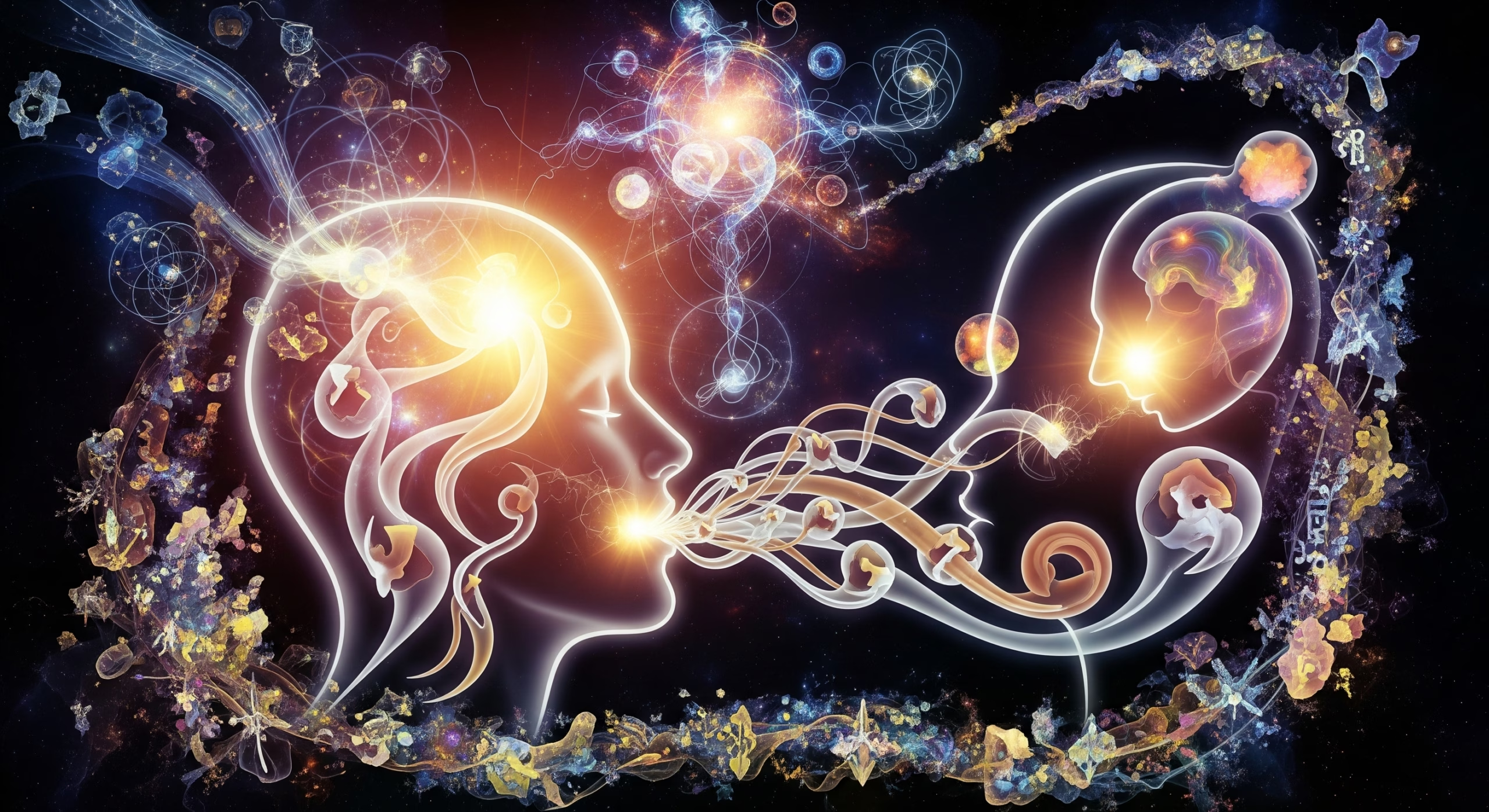
Language is fundamental to our human experience. We use it daily to communicate, express, and understand our world. However, is there more to language than mere utility? Rudolf Steiner’s spiritual science, Anthroposophy, reveals a profound spiritual dimension to the Word. It shows human speech as an echo of cosmic creative forces. It also highlights its potential for deep spiritual expression and transformation. Steiner explored the origins of language. He delved into the inner life of speech sounds. He also showed the connection between language, thinking, and the divine Logos. Understanding Rudolf Steiner language Logos creative speech spiritual power perspective offers a new reverence for our words. It also shows paths to re-enliven their inherent spiritual force. This article explores these profound insights. We will see how language can become a bridge to deeper realities.
The Cosmic Word: Language as an Echo of Divine Creation
At the heart of Rudolf Steiner’s understanding of language is the concept of the Logos, or the Cosmic Word. This is most famously expressed in the opening of St. John’s Gospel: “In the beginning was the Word, and the Word was with God, and the Word was God… All things were made through Him [the Word].” (See Steiner’s lectures on St. John, e.g., related to GA 94 and GA 112).
Steiner illuminated this Logos not as an abstract principle. He showed it as a living, creative Divine Being. This Being is the Cosmic Christ Spirit. Through His activity, the spiritual archetypes of all creation were brought forth. The universe itself, in this view, is a divine utterance. It is a vast, meaningful expression of spiritual thoughts and intentions. Human language, therefore, in its deepest origin, is a “fallen” reflection. It is an earthly echo of this original, world-creating Word. Our capacity to speak and to form concepts mirrors, on a human scale, the creative power of the Logos. This imbues language with an inherent sacredness. It also gives it a profound potential.
The Inner Life of Speech Sounds: Vowels and Consonants as Spiritual Gestures
Rudolf Steiner went beyond conventional linguistics. He explored the inner, spiritual nature of speech sounds themselves. He revealed that vowels and consonants are not arbitrary noises. Instead, they carry distinct spiritual qualities and formative forces. (This is a key theme in GA 299, The Genius of Language).
Vowels: Expressing the Soul’s Interiority
Vowels, Steiner explained, are primarily an expression of our inner soul life. They carry our feelings, our emotions, our devotion, and our connection to the spiritual world within us. When we utter a vowel, we are, in a sense, revealing something of our innermost being. Vowels have a more universal, musical quality. They are like streams of soul-light flowing outwards. For example:
- A (as in “father”): Often expresses wonder, openness.
- E (as in “they”): Can express self-assertion, a boundary.
- I (as in “machine”): Points to the self, the ‘I’-feeling.
- O (as in “go”): Can express embrace, encompassing.
- U (as in “flute”): Often relates to fear, or going into the depths. These are not rigid definitions. They are indications of the soul gestures vowels carry.
Consonants: Sculpting the Forms of the World
Consonants, in contrast, are more connected to the outer world. They picture, imitate, or sculpt the forms and processes we perceive around us. They create boundaries. They give definition. They are more related to specific cultures and the particularities of earthly forms. For example:
- B, P, M: Often relate to enveloping, protecting, or motherly qualities.
- L: Can convey a flowing, light-filled quality.
- R: Often expresses movement, rolling, or dynamic force.
- S, F: Can suggest hissing, flowing, or more airy phenomena. The dynamic interplay between the soul’s inner expression (vowels) and its picturing of the outer world (consonants) creates the richness and meaning of human language. This understanding forms a basis for artistic speech.
The Evolution of Language and Consciousness: From Living Pictures to Abstract Concepts
Rudolf Steiner described how language itself has evolved alongside human consciousness.
- Ancient Languages: In very ancient times (e.g., during the later Atlantean and early post-Atlantean epochs), language was much more pictorial and musical. It was more directly connected to the clairvoyant perception of spiritual realities. Words were like living images. They carried an inherent magical power. Ancient sacred languages, like Sanskrit or ancient Hebrew, retained much of this original character. Their sounds and structures were seen as direct reflections of cosmic laws.
- Development of Abstract Thought: As human consciousness evolved, especially with the rise of the intellectual soul in the Greco-Roman epoch, language became more abstract. It became more a tool for intellectual concepts and less a direct revelation of spirit. This was a necessary development. It allowed for the growth of individual thinking and freedom.
- Modern Challenges: In our current materialistic age, there is a danger. Language can become increasingly hollow. It can become disconnected from living meaning and spiritual truth. Words can be used superficially. They can also be used to manipulate or obscure reality.
However, Steiner also showed that this is not an irreversible decline. Humanity now has the task of re-spiritualizing language. We can do this consciously. We can do it by imbuing our words with truth, feeling, and a renewed connection to their spiritual origins.
Language, Thinking, and the Human ‘I’: Weaving Meaning
There is an intimate and inseparable relationship between language, thinking, and the human ‘I’ (Ego).
- Language as a Vehicle for Thought: Our ‘I’ uses language as its primary instrument to form and express thoughts. Through language, we articulate our inner world. We also grasp the world around us conceptually.
- Language Shaping Thought: Conversely, the structure and vocabulary of the language we speak also shape our way of thinking. Different languages can subtly guide consciousness towards different nuances of experience.
- The ‘I’ as the Conscious Speaker: Ultimately, it is the human ‘I’ that is the true speaker. It is the spiritual center that strives to use language consciously and truthfully. Developing clarity in our thinking is therefore closely linked to developing clarity and responsibility in our use of language. (This relates to themes in GA 4, The Philosophy of Freedom).
Awakening the Creative Power of the Word: Artistic Speech and Eurythmy
Rudolf Steiner did not only offer theoretical insights into language. He also initiated practical artistic disciplines. These aim to revitalize our relationship with the Word. They seek to awaken its inherent creative and healing powers.
Creative Speech (Sprachgestaltung)
Creative Speech, or formative speech, is an art of speaking developed by Steiner and Marie Steiner-von Sivers. It works consciously with the spiritual formative forces living in the sounds of speech (vowels and consonants). It also works with rhythm, meter, and various speech gestures. Through specific exercises and artistic recitation, the speaker learns to imbue words with their true inner life and power. This makes speech a more potent vehicle for conveying meaning, feeling, and spiritual truth. It is not just about beautiful speaking. It is about making the Word a living, creative force. This art is a cornerstone of Waldorf education. It is also used therapeutically. (GA 299, The Genius of Language, provides foundational insights for teachers).
Eurythmy: Visible Speech and Visible Song
Eurythmy is another art form initiated by Rudolf Steiner. It is often described as “visible speech” and “visible song.” In eurythmy, the spiritual laws and gestures inherent in speech sounds and musical tones are made visible through human movement. Each vowel and consonant, each musical note and interval, has its corresponding eurythmic gesture. Eurythmy thus reveals the inner, creative life of language and music. It can be a powerful path for experiencing and understanding the formative forces of the Logos. While specific Eurythmy texts (like GA 279) are not on the provided list, the principle is deeply connected to GA 299’s exploration of the “genius” of language.
The Logos and the Christ Impulse in Language: Re-ensouling Our Words
The concept of the Logos, the Cosmic Word, finds its ultimate human expression and accessibility through the Christ Being. Rudolf Steiner showed how the Christ, as the incarnate Logos, entered Earth evolution to bring new spiritual life to humanity. This includes a new potential for our relationship with language. (This is a central theme in his lectures on St. John’s Gospel). The “I AM” sayings of Christ Jesus in John’s Gospel are supreme examples. They show the Word revealing divine identity and creative power. (“I AM the Way, the Truth, and the Life.”) Through the Christ impulse, human language can be gradually re-sanctified. It can be lifted from a purely utilitarian or materialistic function. It can become again a vessel for truth, love, healing, and genuine human connection. Standard English capitalization (He, Him, His) for pronouns referring to the Christ honors His unique divine nature as the Logos.
The Sacred Responsibility of Language: Truthfulness and Conscious Speech
Given the spiritual power inherent in language, Rudolf Steiner placed great emphasis on our moral responsibility in its use.
- Truthfulness: Words have creative power. Therefore, speaking truthfully aligns us with the creative forces of the Logos. Falsehood, gossip, or empty chatter, conversely, have a destructive, darkening effect on the soul and the world.
- Conscious Articulation: Striving for clarity, precision, and beauty in our speech is not a mere aesthetic concern. It is a way of honoring the spiritual nature of the Word.
- Listening with Heart: True communication involves not just speaking, but also listening deeply. This means listening with empathy and an openness to the other’s meaning. This is related to the higher senses like the sense of Word and the sense of ‘I’.
Cultivating a reverent and responsible relationship to language is an essential part of any spiritual path. It helps to purify our own soul. It also contributes to a healthier social and cultural life.
Relevance for Modern Life: Reclaiming the Spiritual Essence of Our Words
In our modern age, language often seems devalued. We are bombarded with superficial soundbites. We see manipulative rhetoric. We also experience the erosion of meaningful communication. Rudolf Steiner’s insights into the spiritual power of the Word are therefore more relevant than ever.
- Countering Superficiality: A deeper understanding of language encourages us to use words more consciously and meaningfully.
- Enriching Communication: It can transform our everyday conversations. It makes them opportunities for genuine human encounter rather than mere exchanges of information.
- Revitalizing Arts and Education: Principles of artistic speech and a spiritual understanding of language can enrich poetry, drama, storytelling, and education (as in Waldorf schools).
- Spiritual Practice: Becoming aware of the spiritual forces in language can itself be a meditative practice. It attunes us to deeper realities.
By reclaiming the spiritual essence of our words, we can contribute to a more truthful, beautiful, and soulful human culture.
Conclusion: Language as a Bridge to the Spirit
Rudolf Steiner’s spiritual science offers a profound and inspiring vision. It sees language not as a mere human convention. It is a divine gift. It is an echo of the creative Logos that brought forth the cosmos. “Rudolf Steiner language Logos creative speech spiritual power” is a key to unlocking this deeper understanding. From the inner life of vowels and consonants to the world-creating power of the Cosmic Word, language is revealed as a bridge. It connects our human soul with the deepest spiritual realities.
The evolution of language mirrors the evolution of human consciousness. Our modern task is to re-infuse our words with living meaning. We must use them with truthfulness. We must also use them with artistic sensitivity and moral responsibility. By doing so, language can once again become a powerful instrument for spiritual development. It can foster genuine human connection. It can also become a means of experiencing the creative and redemptive power of the Word in our lives. This is a path open to all who seek to understand the true genius of language.