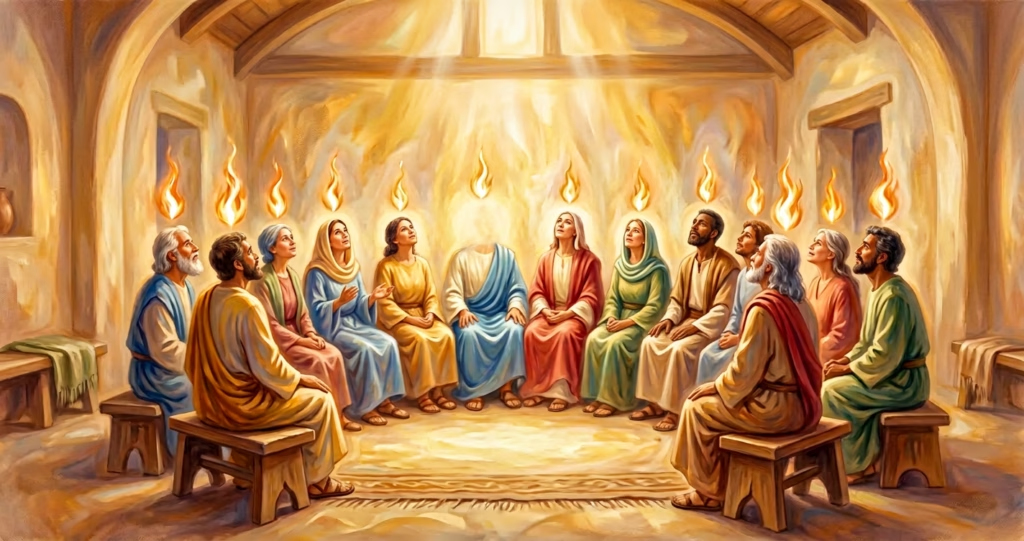
In the history of Western consciousness, the epistles of the Apostle Paul are a monumental landmark. More than just letters of encouragement and admonition to the first Christian communities, they represent the first great intellectual and spiritual grappling with the meaning of the Mystery of Golgotha. Paul, the thirteenth apostle, the one “untimely born,” was uniquely positioned for this task. As one who had not followed the historical Jesus through the hills of Galilee, his entire mission was founded upon a single, shattering spiritual event: his encounter with the Risen Christ on the road to Damascus. His letters are therefore the expression of a new kind of Gospel—not a Gospel of memory, but a Gospel of direct spiritual experience.
This article will explore the deep spiritual meaning of Paul’s epistles from a perspective informed by the insights of spiritual science. We will discover that Paul was the great apostle to the Consciousness Soul, the thinking intellect of modern humanity. His mission was to translate the living reality of the Christ event into a conceptual framework that could be grasped by the conscious, thinking mind. We will explore his central themes—the distinction between Jesus and the Christ, the mystery of the two Adams, the Church as the living Body of Christ, and the path of selfless love—and see them not as abstract theology, but as precise descriptions of a new path of initiation, a path that remains open to every human soul to this day.
The Damascus Road: The Initiation of the Consciousness Soul
A New Form of Revelation
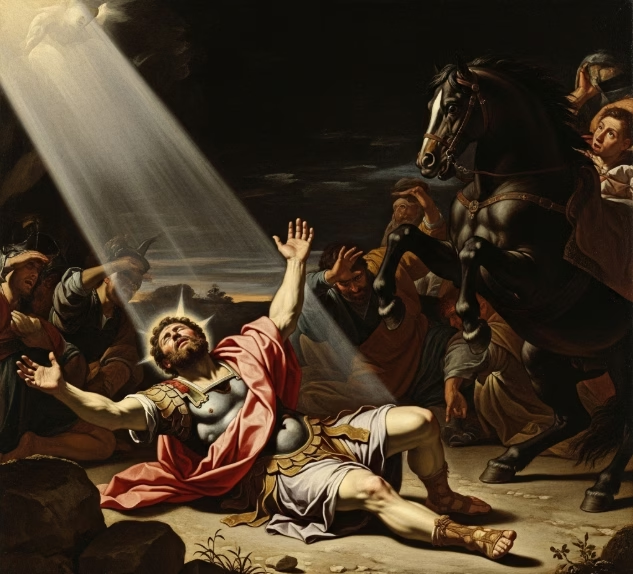
The key that unlocks the entirety of Paul’s mission is the event that transformed him from Saul the persecutor into Paul the apostle. This was not a vision, a dream, or a psychological conversion in the modern sense. It was a genuine, objective, clairvoyant perception of a supersensible reality. As he approached Damascus, a great light from heaven shone around him, and he heard a voice say, “Saul, Saul, why do you persecute me?” When Saul asked who was speaking, the voice replied, “I am Jesus, whom you are persecuting.”
Spiritual science reveals that what Paul experienced in that moment was an encounter with the resurrected Christ in His etheric body. After the Mystery of Golgotha, the Christ Being did not simply ascend to a distant heaven. His spiritual body, the life-body, remained united with the etheric sphere of the Earth. He became the new guiding spirit of earthly evolution. While the original twelve apostles knew Him in the flesh, it was Paul’s destiny to be the first to know Him in this new, supersensible, but no less real, form.
Paul was uniquely prepared for this initiation. As a zealous Pharisee, he had trained his intellect to a point of razor-sharpness through intense study of the Mosaic Law. This highly developed faculty of thinking, when suddenly struck by the overwhelming spiritual light of the Christ, was shattered. His physical sight was taken away for three days, a classic element of an initiation process, signifying a death of the old way of seeing the world. When his sight was restored, it was a new kind of sight. He could now perceive the spiritual reality that stood behind the physical. The event on the Damascus Road was the prototype for the modern spiritual path. We, like Paul, cannot meet the physical Jesus. But we can, through the training and transformation of our own conscious thinking, prepare ourselves to one day have our own “Damascus experience”—an inner encounter with the living, etheric Christ.
From Jesus to the Christ: The Central Pauline Mystery
The Indwelling of the Cosmic Spirit
Because his entire Christianity was founded upon this supersensible encounter, Paul’s teaching is centered on a crucial distinction: the distinction between the historical man, Jesus of Nazareth, and the cosmic, divine Being, the Christ, who had dwelt within that man for three years. While the other apostles spoke primarily of what they had seen and heard the man Jesus do and say, Paul spoke of the universal, spiritual reality of the Christ, who could now be experienced by every human soul, regardless of whether they had ever known Jesus in the flesh.
This leads to the very heart of the Pauline mystery, encapsulated in his statement to the Galatians: “It is no longer I who live, but Christ lives in me.” This is one of the most profound statements of initiation ever uttered. It is not a beautiful metaphor for belief. It is a precise description of a real, inner transformation. It describes the process whereby the individual human “I,” or Ego, through devotion and inner work, consciously steps back and makes of itself a vessel, a holy grail, for the indwelling of the Christ Impulse. The goal of the Pauline path is not to imitate the outer life of Jesus, but to allow the inner power of the Christ to be born within one’s own soul. Paul’s mission was to teach humanity how to find the path from the historical Jesus to the ever-present, indwelling Christ.
The Two Adams: The Law of Karma and Grace
A New Progenitor for Humanity
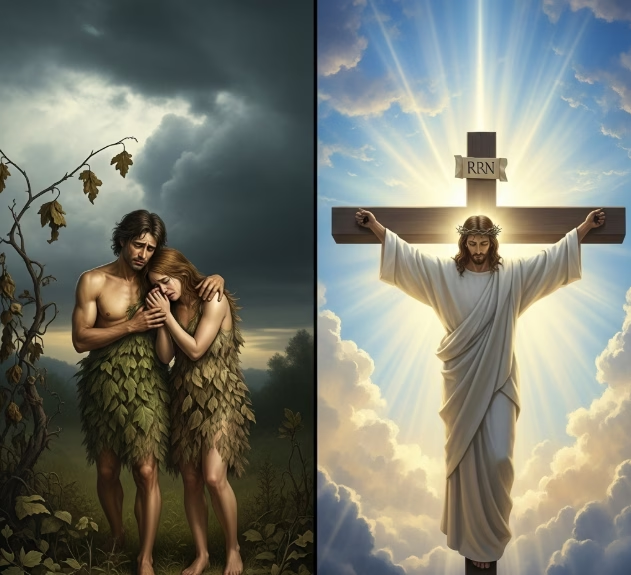
In his masterful Epistle to the Romans, Paul lays out a magnificent, sweeping picture of human evolution in order to explain the significance of the Christ event. He does this through the powerful imagery of the “first Adam” and the “second Adam.”
- The “first Adam” is the progenitor of all physical humanity. He represents the entire stream of earthly evolution as it descended into the material world. Through this Adam, the Bible tells us, “sin” and “death” entered the world. From a spiritual-scientific perspective, “sin” is separation from the spiritual world, and “death” is the inevitable consequence of being bound to a purely physical body. The stream of the first Adam is the stream of physical heredity, of what we might call karma, the web of cause and effect that governs our earthly lives. The great Law of the Old Covenant, given through Moses, could illuminate this karma, it could make us conscious of our “sin,” but it could not, by itself, give us the power to overcome it.
- The “second Adam” is the Christ. He does not enter humanity through the stream of ordinary physical heredity. He is a new spiritual beginning, a new progenitor for a future, spiritualized humanity. Through His deed, the Mystery of Golgotha, a new force entered into earthly evolution. This force is Grace. Grace is not a cancellation of karma. It is a new spiritual power that is made available to the human “I.” It is the power to take hold of one’s own karma, to work with it, and to transform it from within.
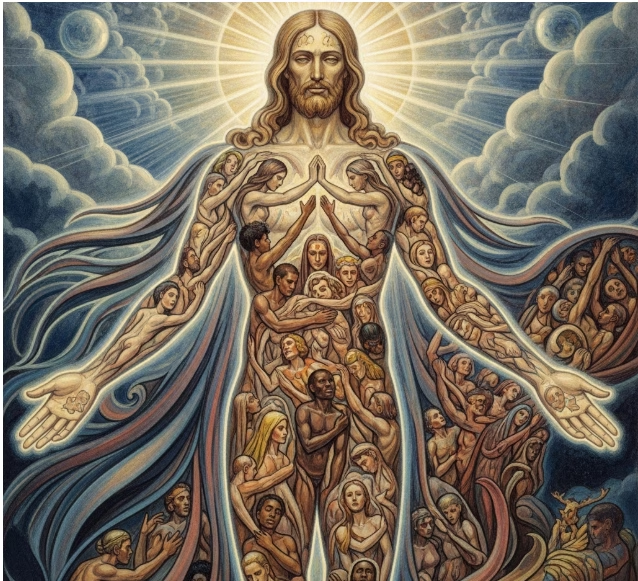
The Body of Christ: The New Spiritual Community
A Living Organism of Souls
One of Paul’s most powerful and enduring teachings is his description of the Christian community as the “Body of Christ.” We find this in his letters to the Corinthians and the Ephesians. This, again, is not a mere organizational metaphor. It is a description of a supersensible, spiritual reality.
Paul explains that the community of those who have been filled with the Christ Impulse forms a new kind of collective being, a new type of “group soul.” In this spiritual organism, the Christ Himself is the “head,” the guiding, all-encompassing consciousness. The individual human beings are the various “members”—the eyes, the hands, the feet. Each member is unique, each has a different function, but all are animated by the one spirit and work together for the good of the whole.
This teaching was, and is, profoundly revolutionary. It is a direct overcoming of the old divisions that had defined humanity for millennia. As Paul says, in this new spiritual body, there is “neither Jew nor Greek, there is neither slave nor free, there is no male and female, for you are all one in Christ Jesus.” The old group-souls of race, tribe, and nation, which worked through the forces of common blood, are to be superseded by a new spiritual community, which is to be formed out of the free choice of individual “I”s. The Body of Christ is a living organism of free individuals, united not by blood from the past, but by a shared spirit oriented towards the future.
The Great Hymn to Love: The Path of the Heart (1 Corinthians 13)
The More Excellent Way
In the midst of his practical advice to the Corinthian community, Paul suddenly breaks into a sublime passage that has become known as the “Hymn to Love.” This is not a piece of sentimental poetry. It is a precise and profound description of the new Christian path of initiation, the path of the future.
Paul contrasts the old spiritual gifts—”speaking in tongues,” “prophecy,” “knowledge”—with what he calls a “more excellent way,” the way of love (agape). The old gifts were often remnants of an older, dream-like, involuntary clairvoyance. The new path, the path that is open to the fully awake Consciousness Soul of modern humanity, is to consciously transform one’s own soul through the cultivation of a selfless, objective, and spiritualized love.
This agape is not a mere human feeling. It is the very force of the Christ working within the human heart. It is the power that overcomes egoism. It is the spiritual substance that binds together the various members of the “Body of Christ.” Paul describes its qualities: it is patient, it is kind, it does not envy, it is not proud, it seeks not its own. This is a description of the human soul after it has been completely permeated and transfigured by the Christ Impulse. This is the ultimate goal of the Pauline path.
Conclusion
The epistles of the Apostle Paul are a testament to a spiritual event of world-historical importance: the birth of a new form of cognition, a new way of knowing the divine. They are the founding documents of a spirituality that does not depend on being in a particular place or belonging to a particular people, but on an inner, conscious, and free act of the individual human soul.
Paul’s great and enduring mission was to take the Mystery of Golgotha, which had occurred once in time as a historical event in Palestine, and to reveal it as an eternal, living, and internal potential that could be realized within every human being. He translated the Gospel of historical memory into a universal Gospel of spiritual experience. To read his epistles with a spiritual-scientific understanding is to discover a profound roadmap for the modern spiritual journey—a journey that leads from the Damascus-like shattering of our old, materialistic certainties to the quiet, world-changing, and deeply creative realization: “It is no longer I who live, but Christ lives in me.”