He is a voice crying in the wilderness, a figure clothed in camel’s hair, subsisting on locusts and wild honey. His message is stark and uncompromising: “Repent, for the kingdom of heaven is at hand.” In the grand drama of the Gospels, John the Baptist appears on the stage with fiery intensity, preparing the way for the central event of all human history. But who was this great and solitary soul? To see him as merely a devout preacher is to miss the immense cosmic significance of his being. This article will explore the spiritual mission of John the Baptist from a perspective informed by the methods of spiritual science as articulated by a researcher like Rudolf Steiner.
We will journey beyond the historical narrative to understand John’s true identity as a reincarnated spirit, the return of the great prophet Elijah. We will delve into the esoteric meaning of his preaching, his water baptism, and his relationship to the one who would come after him to baptize with “fire and the Holy Spirit.” We will discover that his life and his seemingly tragic death were not accidents of fate, but sublime and necessary acts in the spiritual evolution of humanity. The spiritual mission of John the Baptist, we will find, was to be the perfect and final closing chord of the Old Covenant, creating the profound silence into which the new music of the Christ Impulse could be born.
The Reincarnated Prophet: Elijah’s Fiery Spirit Reborn
A Karmic Necessity
The first and most crucial key to understanding the spiritual mission of John the Baptist is the reality of reincarnation, and specifically, the fact that his soul was a reincarnation of the great Old Testament prophet, Elijah. This is not a later esoteric invention; it is a truth stated directly, if enigmatically, in the Gospels themselves. When the disciples ask Jesus about the prophecy that Elijah must come first, Jesus replies, “Elijah has already come, and they did not recognize him, but have done to him whatever they wished.” He was speaking of John the Baptist.
To grasp the necessity of this, we must ask: What was Elijah’s original mission? Elijah lived in the 9th century BC, a time when the people of Israel were in danger of falling into the decadent nature-worship of the Phoenician god Baal. The worship of Baal was connected to an old form of clairvoyance, a dreamy consciousness that saw spiritual beings in the lightning, the storm, and the fertility of the earth, but in a way that pulled the human soul away from its own developing individuality, its “I.” Elijah was the fierce and powerful champion of the God Yahweh, the great Moon-regent whose mission was to guide humanity towards selfhood by giving them the Law and concentrating their consciousness through a single, transcendent God. Elijah’s entire life was a struggle against the Luciferic temptation of a dreamy, nature-bound spirituality that would prevent the human “I” from being properly born.
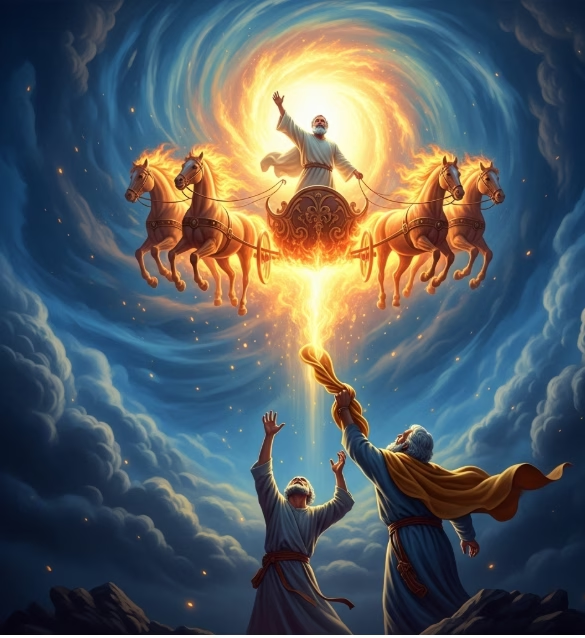
His departure from the Earth is also profoundly significant. He did not die a normal death but was taken up into the heavens in a “chariot of fire.” From a spiritual-scientific viewpoint, this indicates that his powerful, fiery “I” or Ego was preserved intact in the spiritual worlds, held in reserve for a future, even greater task. It was an ego forged in the fire of devotion to the one God, an ego that had mastered the elemental forces of nature.
Why was this specific soul needed to prepare the way for Christ? Because the mission was a higher octave of the same theme. In Elijah’s time, the danger was a decadent clairvoyance pulling humanity away from a proper incarnation. In John’s time, the danger was a hardened, legalistic materialism that would prevent humanity from recognizing the spirit that had now come into incarnation. Elijah fought the old gods of nature to make way for the one God of the Law. John the Baptist had to fight the hardened letter of the Law to make way for the one God-Man of Love. The same fiery, uncompromising zeal was needed for both tasks. The soul of Elijah was the only one with the specific karmic preparation and spiritual power to be the great “turner-around” of consciousness that was required.
“A Voice Crying in the Wilderness”: The Meaning of John’s Preaching
The Call to a Turning of Consciousness
The setting for John’s ministry is deeply symbolic. He does not preach in the temples of Jerusalem or the synagogues of Galilee. He is “a voice crying in the wilderness.” The wilderness is a place outside the established, and often corrupt, structures of civilization and religion. It is a return to the elemental, to the direct encounter with God and with oneself, stripped bare of all social and cultural conventions. To come out to John in the wilderness was already an act of leaving the old world behind.
His message, “Repent, for the kingdom ofheaven is at hand,” is often misunderstood today as a call to feel guilty for past sins. The Greek word used in the Gospels, however, is metanoia, which literally means “a change of mind” or “a turning around of consciousness.” John was not primarily demanding emotional remorse; he was demanding a complete re-orientation of the human soul. He was telling the people of his time that the way they had been thinking and perceiving reality was no longer sufficient. The old way of knowing God through the inherited bloodline and the external Law was coming to an end. A new faculty of perception was needed to recognize the new reality that was about to dawn. His preaching was a powerful, shattering call to wake up from the slumber of tradition and prepare the inner eye to see something unprecedented.
Even his famous diet of “locusts and wild honey” can be read from a spiritual perspective. Locusts, which swarm in from the air, represent the forces of the elemental world, forces that can be destructive but which he has mastered and internalized. Wild honey represents the pure, uncultivated wisdom of nature, sweetness that has not been processed by human artifice. He nourished himself on the most primal spiritual and natural forces, standing as a man completely independent of the sophisticated but decadent culture of his time.
The Baptism of Water: A Preparation for the Baptism of Fire
Washing the Soul for a New Perception
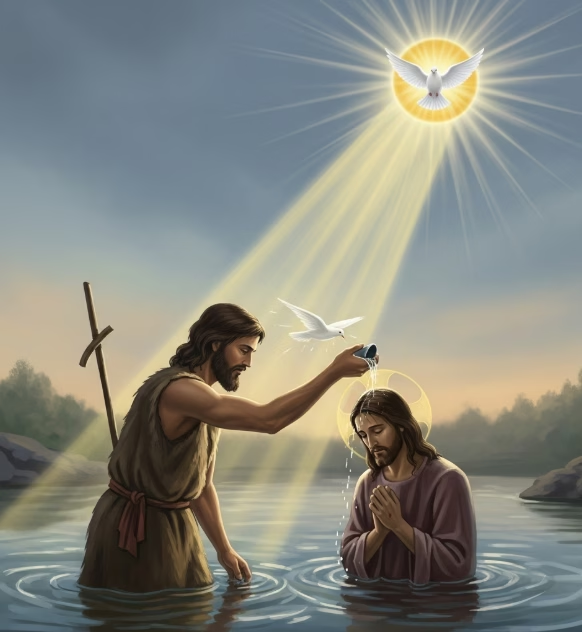
The central ritual of John’s ministry was his baptism in the River Jordan. To understand the spiritual meaning of this act, we must understand that for the ancients, water was not just a physical substance. It was connected to the etheric world, the realm of life-forces and memory. The baptism performed by John was an esoteric rite designed to produce a specific effect on the soul of the person being baptized.
By immersing the person in water, John worked powerfully upon their etheric body. This had the effect of temporarily loosening the etheric body’s connection to the physical body. In this slightly loosened state, the individual was able to experience a vivid, panoramic memory of their own life, a perception of the “sins” or karmic entanglements that burdened their soul. It was an induced state of self-knowledge. It allowed the person to see themselves with a new clarity, to recognize their deviation from the divine path, and thus to feel the profound need for the “turning around of consciousness” that John was preaching. John’s baptism was a “washing away” of the karmic dust that clouded the soul’s inner vision, making it clean and ready to perceive the coming Messiah.
However, John himself was fully aware that his water baptism was only a preparation. He famously said, “I baptize you with water for repentance. But after me comes one who is more powerful than I… He will baptize you with the Holy Spirit and fire.” This is one of the most important esoteric statements in the New Testament.
- Water is connected to the etheric realm, the realm of life and memory. It cleanses and prepares. It works from the outside in.
- Fire is the ancient symbol for the spirit itself, for the “I.” The baptism of fire is the direct infusion of the human “I” with the divine “I” of the Christ. It is an inner kindling, a spiritual awakening that happens from the inside out.
John could prepare the vessel by washing it with water. Only Christ could fill that vessel with the new fire of the spirit. The spiritual mission of John the Baptist was to lead humanity to the very threshold, to make them ready for an inner transformation that he himself could not provide. His entire mission points away from himself and towards the greater being who was to come.
This is powerfully illustrated in the scene at the Jordan when Jesus comes to be baptized. John’s initial hesitation, “I need to be baptized by you, and do you come to me?” is the profound recognition of the old consciousness bowing before the new. He sees that his preparatory mission has reached its fulfillment. The being for whom he has been preparing the way now stands before him.
“He Must Increase, But I Must Decrease”: The Tragic Destiny of the Forerunner
The Necessary Sacrifice of the Old Consciousness
After the baptism of Jesus, John utters the famous words that encapsulate the tragic grandeur of his destiny: “He must increase, but I must decrease.” This is not merely a statement of personal humility. It is the statement of a profound law of spiritual evolution. The old way of knowing must fade for the new way to be born. The Moon, which shines with reflected light, must pale and vanish when the Sun itself rises in the sky. John was the moon; Christ was the Sun.
John’s subsequent imprisonment and death are also imbued with deep spiritual symbolism. The story of his beheading at the request of Salome, instigated by her mother Herodias, is a picture of how the old, true, but severe spiritual impulse is destroyed by the decadent, ensnaring soul-forces of a dying culture. But the method of his death is the most significant part.
He was beheaded. The head is the physical instrument of the “I,” the seat of our individual thinking consciousness. The “head” of the Old Covenant, the greatest of the old prophets, had to be removed to make way for the new impulse that would work not through the head, but through the heart. The age of the external Law, grasped by the mind, had to give way to the age of Love, lived through the heart. The beheading of John the Baptist is the dramatic, pictorial symbol for the end of an entire mode of human consciousness. It was a necessary sacrifice. The leadership of the old, initiated prophet had to cease so that every individual human “I” could, in time, find its own direct connection to the spirit through the Christ Impulse within.
Conclusion
The spiritual mission of John the Baptist was one of the most difficult and selfless in all of human history. As the reincarnated soul of Elijah, he was a being of immense spiritual fire and power. He was tasked with being the great “turner-around” of consciousness, the voice that would shake humanity out of its spiritual slumber and prepare it for the most important event in its evolution. He stood as the final, magnificent embodiment of the Old Covenant of Law, tribe, and prophecy. His water baptism was the supreme act of purification, cleansing the souls of humanity so they could be ready to receive a new kind of spiritual fire.
His destiny was to point away from himself and towards a greater light. He had to decrease so that the new principle of universal love and individual freedom could increase. His death was not a failure, but the ultimate fulfillment of his mission—the symbolic and actual removal of the “head” of the old world order to make way for the new covenant of the heart. He is the archetypal forerunner, the great preparer, the eternal model of a soul whose entire existence is a selfless act of sacrifice in service of a dawning future.