The story of the 12 apostles is the story of a world-historical transformation. It is the narrative of how a small group of ordinary men from a remote province of the Roman Empire were given a task of cosmic proportions: to carry a new spiritual sun, the Christ Impulse, into the very bloodstream of earthly evolution. From a purely historical viewpoint, their success is a marvel of human conviction and organization. But from the perspective of a spiritual-scientific investigation, the mission of the apostles is revealed as something far greater. It was not merely the spreading of a new doctrine, but the conscious implantation of a living spiritual force into the soul-life of humanity.
This article will explore the profound, multi-layered nature of the mission of the apostles, as it is understood through the insights of spiritual science. We will witness their preparation through their three years with Christ Jesus, their empowerment through the great cosmic event of Pentecost, and the divinely-ordered wisdom behind their dispersal to the different corners of the Earth. We will discover that their work was not random, but was a carefully orchestrated plan to bring the universal light of the Christ to the various folk-souls of humanity in a way that each could uniquely receive. Finally, we will see how their mission did not end with their earthly deaths, but continues as a guiding and inspiring force from the spiritual world to this very day.
From Fishermen to Founders: The Earthly Preparation
Forging the Vessels
The Gospels are unsparing in their portrayal of the apostles during their time with Christ Jesus. They are shown as often doubting, misunderstanding, and competing amongst themselves for favor. They are, in many ways, a picture of ordinary, flawed humanity. And this was a spiritual necessity. The great impulse that was to be given to the world could not be carried by men who were already filled with their own wisdom, with the rigid, intellectual pride of the scribes and Pharisees. The vessels for this new wine had to be, in a sense, empty. They had to be men of simple, heartfelt devotion, whose souls were open and receptive, capable of being completely transformed by the being in their midst.
Their three years of training was not an education in the modern sense of transmitting information. It was a continuous process of inner transformation. To live day and night in the presence of the incarnate Christ Being was to have one’s own supersensible bodies—the etheric and astral bodies—constantly re-tuned and harmonized. The disciples were being healed and re-ordered from within, often without their full waking comprehension. The Christ Being was working on their souls, purifying their feelings and strengthening their life-forces, preparing them to be able to withstand and contain the immense spiritual power that would later be poured into them.
Their very failures were a crucial part of this preparation. Peter’s denial, Thomas’s doubt, their collective fear after the Crucifixion—these experiences broke down their personal pride and their reliance on their own strength. They had to learn, through the most painful of lessons, that the power for their future mission would not come from their own personalities, but from a higher source that would work through them. They had to be emptied of self before they could be filled with the Spirit.
The Event of Pentecost: The Kindling of the Cosmic “I”
The Birth of the Universal Church
The true beginning of the mission of the apostles is the great event described in the Acts of the Apostles: the festival of Pentecost. The disciples are gathered together in one place when a sound comes from heaven like a rushing, mighty wind, and “tongues, as of fire” appear and rest upon each of them. In that moment, they are “filled with the Holy Spirit” and begin to speak in other tongues.
This is not a mere psychological event or a collective ecstasy. It is a world-historical moment of cosmic initiation. The “tongues of fire” were a direct spiritual perception of the descent of the Holy Spirit, the great guiding spirit of the Earth, the universal consciousness that overcomes all human division. This event accomplished a profound transformation within each apostle:
- The Infusion of the “I”: At Pentecost, the individual “I” or Ego of each apostle was infused with a higher, cosmic consciousness. Before this moment, their understanding was based on their personal, physical memory of the man Jesus. After Pentecost, they possessed a direct, inner knowledge of the universal, spiritual Christ. They no longer spoke from personal remembrance, but from a living, divine authority that now dwelt within their own souls.
- The Overcoming of Babel: The miracle of “speaking in tongues” is often misunderstood as a magical ability to speak foreign languages. Its deeper meaning is that the apostles were now able to speak the universal language of the spirit, a language that transcends cultural and linguistic barriers and speaks directly to the heart of every human being. The event at the Tower of Babel, described in the Old Testament, is a picture of how humanity’s consciousness was separated into different folk-souls, each with its own language, leading to confusion and division. Pentecost is the great reversal and healing of Babel. It is the birth of a universal impulse that can unite all peoples, not by erasing their differences, but by speaking a truth that every soul, in its own way, can understand.
From this moment on, the apostles were no longer a frightened band of followers. They were conscious, empowered bearers of a world-transforming fire. Their true mission could now begin.
The Twelve-fold Mission: Carrying the Impulse to the World
A New Zodiac of Spiritual Light
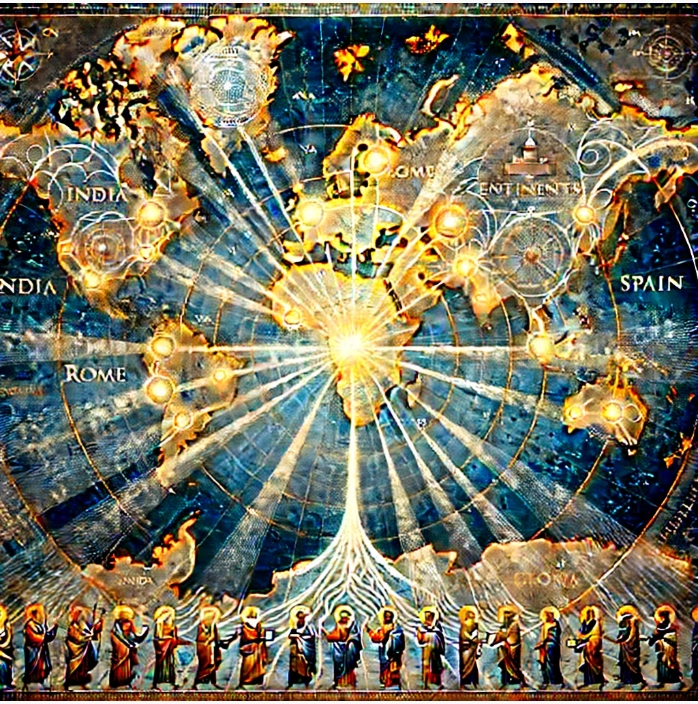
The dispersal of the apostles from Jerusalem was not a random scattering. It was a conscious, divinely-guided spiritual undertaking. Just as the twelve signs of the Zodiac represent the twelve universal archetypes of the cosmos, so the twelve apostles represented twelve primary human soul-types. Their mission was to carry the single, unified light of the Christ Impulse to the twelve great cultural streams of the known world, with each apostle’s unique soul-quality being perfectly suited for the “folk-soul” of the region to which he was sent. The universal message had to be individualized, colored by the unique temperament of each apostle, so that it could be received by the diverse peoples of the Earth.
While historical records are sparse, esoteric tradition and spiritual research have preserved a picture of this divinely ordered mission.
- Peter traveled to Rome. As the apostle of fiery, impulsive faith (the Aries archetype), his mission was to found the great exoteric institution, the Church that could act as a solid, rock-like vessel to carry Christianity through the coming centuries of darkness. His was the mission of building the outer form.
- John, by contrast, remained in the region of Ephesus in Asia Minor. As the apostle of deep, esoteric wisdom and love, his mission was to found a center for the inner, mystical heart of Christianity. He trained initiates and preserved the deepest secrets of the Logos doctrine. His was the mission of nurturing the inner life.
- Andrew, the brother of Peter, is said to have traveled north, through Scythia and Greece. His symbol is the X-shaped cross, and his mission was to act as a great “crosser” and “bridger,” bringing the new impulse to the philosophically minded Greek world and the wilder peoples of the north.
- Thomas, the doubter who needed physical proof, was uniquely suited for his mission to India. He had to carry the new message of a God who had entered into history and the physical body to a culture that possessed an immensely profound and ancient spirituality, but one that tended to see the physical world as an illusion (Maya). His empirical, questioning soul could meet the philosophical soul of India on its own terms.
- James the Greater, one of the “Sons of Thunder,” carried his fiery, zealous impulse to the far western edge of the known world, to Spain (Iberia), planting a seed of passionate Christian devotion that would shape that culture for millennia.
- Matthew, the keeper of accounts and genealogies, is traditionally connected with a mission to the peoples of Ethiopia or Persia, bringing the ordered, historical aspect of the new teaching to cultures with ancient, established traditions of their own.
Each apostle, in this way, became a spiritual ambassador, a unique lens through which the light of the Christ could be focused and adapted to the specific soul-needs of a particular stream of humanity. The mission of the apostles was to incarnate the universal into the particular, to weave the new thread of the Christ Impulse into the twelve different strands of the existing human tapestry.
The Continuing Mission from the Spiritual World
The Celestial Council of the Apostles
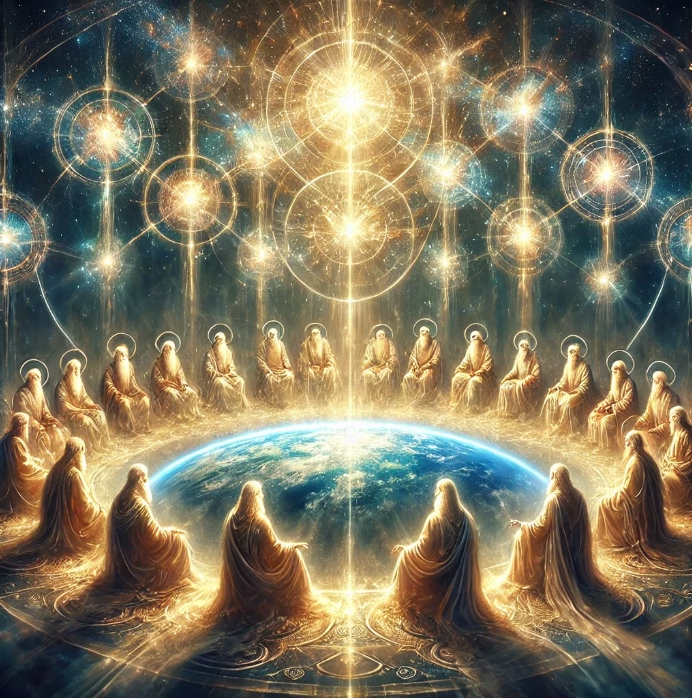
Did the mission of the apostles end when they were martyred or died their natural deaths? From a spiritual-scientific perspective, their earthly work was only the beginning. Having passed through the ultimate initiation of their relationship with the Christ, they did not simply dissolve into a heavenly bliss. They became active, conscious co-workers in the continuing guidance of humanity from the spiritual world.
The twelve apostles form a kind of celestial council, a “White Lodge” or spiritual brotherhood, that continues to oversee the evolution of the Christian stream on Earth. They work as inspiring and guiding beings for those souls on Earth who seek a deep and genuine connection to the Christ Impulse. Great spiritual movements that have arisen throughout history—from the Celtic monks who preserved learning in the dark ages, to the knights of the Holy Grail, to the Rosicrucians—can be seen as having been inspired and guided by one or more of these great apostolic individualities working from the spiritual plane. Their mission continues. They are the eternal guardians of the treasure that they helped to anchor in the world.
The Unique Mission of Paul: The Apostle to the Consciousness Soul
A New Path for a New Ag
We must once again speak of the unique figure of St. Paul. He was not one of the original twelve and, crucially, he never met the physical Jesus of Nazareth. His mission was founded upon a purely supersensible event: his encounter with the resurrected, etheric Christ on the road to Damascus. This makes him the prototype for all of future humanity. He is the apostle for our time, the age of the Consciousness Soul, an age where our connection to the Christ can no longer be based on physical tradition or inherited feeling, but must be born from a direct, inner, conscious experience of the spirit.
Paul’s mission was to take the “new wine” of the Christ Impulse and pour it into new wineskins. He translated the Gospel, which had been experienced by the original apostles primarily as a matter of heart and feeling, into a powerful, world-encompassing language of thought. He created a cosmic theology that could be grasped by the developing intellect of the Greek and Roman worlds. Furthermore, his mission was to break Christianity free from its origins within the Jewish people and to proclaim it as a universal path for every human being, regardless of race, nation, or background. While the twelve had the task of planting the seed in the twelve particular soils of humanity, Paul had the task of tending the universal forest that would grow from those seeds.
Conclusion
The mission of the apostles was a spiritual deed of unimaginable grandeur. It was a journey that took them from being humble, fearful men to being conscious bearers of a divine fire, infused with the courage and wisdom of Pentecost. Their work was not to found a single, monolithic institution, but to carry the living, adaptable impulse of the Christ into all the diverse streams of human culture, planting seeds that would blossom in a thousand different ways over the coming millennia.
Their earthly journeys were but the first chapter of their mission. They continue to work from the spiritual world as the great guardians and guides of the Christian path, inspiring and helping humanity on its long journey. To study their lives and their work is to see a magnificent, divinely-ordered plan unfold, a plan that reveals how the universal spirit can work through the unique gifts of individual human souls to redeem and transform the world. Their mission is a testament to the fact that the greatest forces in history are not armies or empires, but the quiet, world-changing power of a few human hearts set ablaze by the spirit.