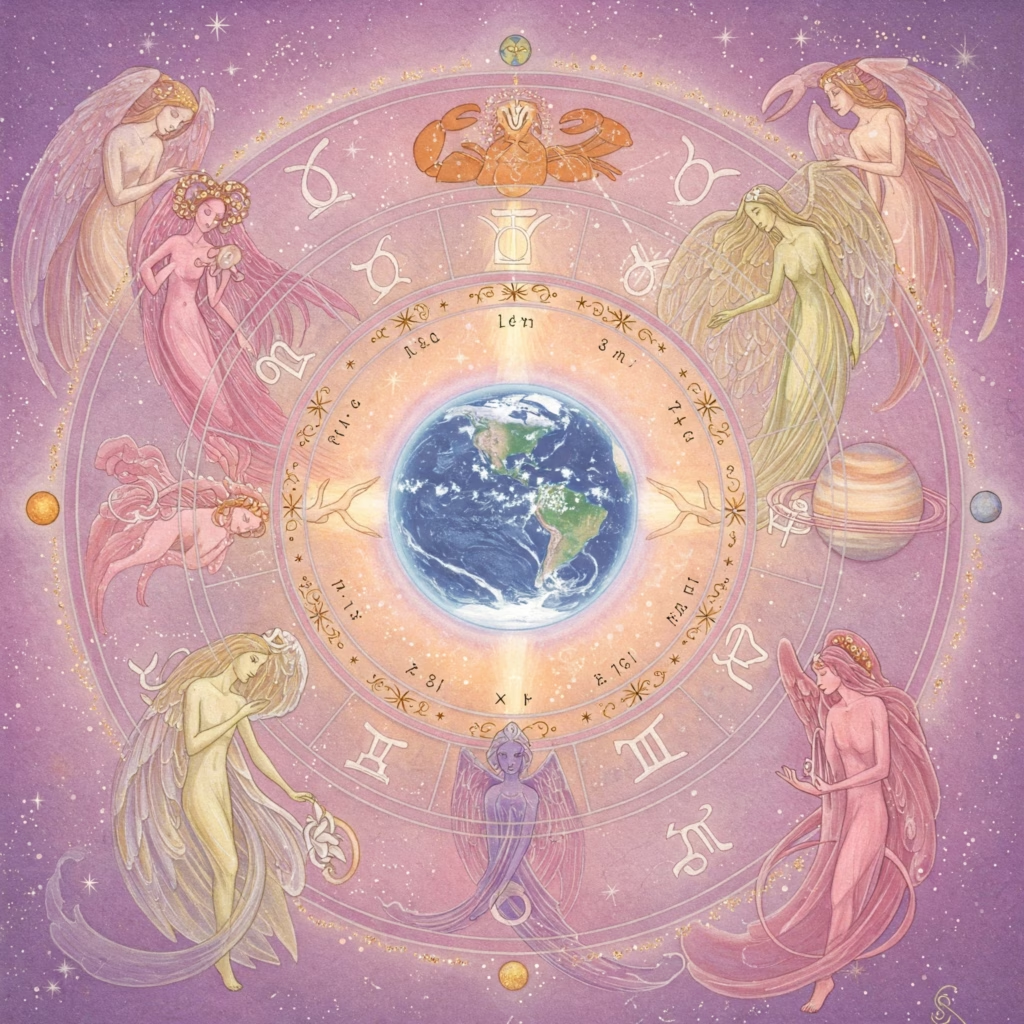
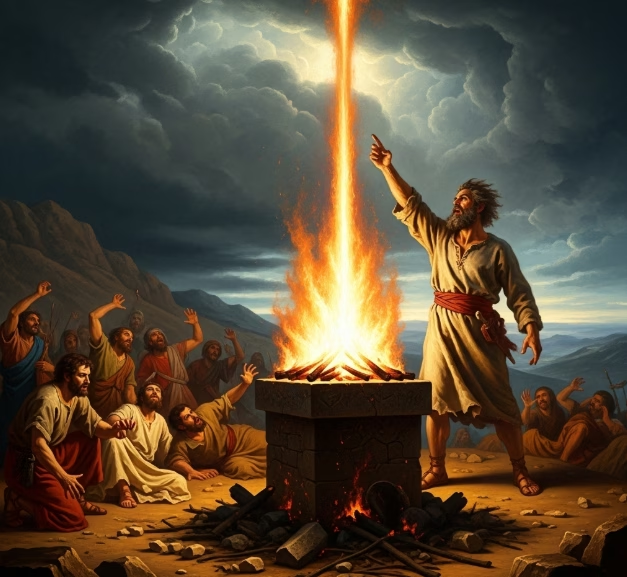
Exploring the spiritual significance revealed through the Rudolf Steiner’s Ten Commandments perspective allows us to understand these ancient laws not merely as historical dictates, but as profound milestones in human evolution. Received by Moses on Sinai, they mark a critical stage in the development of human consciousness, the emergence of the individual “I,” and the preparation for the later Christ impulse. This article delves into the spiritual-scientific understanding of each commandment, drawing upon the wealth of insight found in the provided texts of my work.
The Cosmic Context: Law for the Dawning “I”
Before examining each precept, we must grasp the context. Spiritual science reveals that humanity’s consciousness has evolved. In epochs preceding Moses, the individual “I” was less anchored within the personality; humanity lived within a more group-oriented, instinctive consciousness, guided directly, albeit dimly, by spiritual hierarchies. The declaration “I am the I AM” signifies the point where the potential for individual self-awareness began to dawn within humanity.
However, this nascent “I” required external support. It needed boundaries to navigate the increasingly complex interplay of earthly life and the subtle influences of adversarial powers—Lucifer pulling towards premature spiritualisation and pride, Ahriman towards materialism and illusion. The Ten Commandments, therefore, were divine necessities, cosmic wisdom translated into moral law, providing a protective structure for the developing ego. They established the foundational relationships: to the Divine, to the sacredness of life and name, to cosmic rhythm, to lineage, and between fellow human beings. The Rudolf Steiner’s Ten Commandments understanding sees these as essential steps towards true inner freedom.

Exploring Each Commandment through Spiritual Science
Let us now consider each commandment, seeking its deeper resonance from the Rudolf Steiner viewpoint:
1. “I am the Lord thy God… Thou shalt have no other gods before me.”
This first utterance directly addresses the awakening “I AM.” It establishes the primary orientation: the individual “I” finds its source and true identity not in itself, nor in lesser or adversarial spiritual beings, but in the One Divine Ground of existence. From the Rudolf Steiner’s Ten Commandments perspective, this counters the Luciferic tendency to ego-inflation or the worship of group-specific deities that characterised earlier phases of evolution. It directs the soul towards the universal divine source, preparing it for the later, more individualised connection made possible through Christ. Consequently, recognising this divine origin becomes paramount.
2. “Thou shalt not make unto thee any graven image…”
This commandment speaks profoundly to the evolution of consciousness. Earlier humanity perceived spiritual realities more pictorially, imagistically. The danger arose, particularly with the development of intellectual thought, that these living spiritual perceptions could become rigidified into mere external forms or fixed concepts – “graven images.” This reflects an Ahrimanic impulse, seeking to trap the spirit in matter and deny its living, evolving nature. Thus, this commandment urges humanity to maintain a living, flexible relationship with the spiritual world, resisting the tendency to reduce divine realities to static idols or intellectual abstractions. The Steiner’s Ten Commandments understanding values this flexibility.
3. “Thou shalt not take the name of the Lord thy God in vain…”
In ancient wisdom, the Name was never separate from the Being; to utter the Name was to invoke the very presence and power. This commandment highlights the sacredness of the creative Word, the Logos, and the immense responsibility tied to human speech, which is an echo of this cosmic creativity. Taking the Name “in vain” signifies a profanation, a trivialisation or misuse of divine power for egotistical ends, aligning oneself with adversarial influences that seek to manipulate rather than serve the divine. It is a call for truthfulness and reverence in relating to the spiritual hierarchies. This reverence is central to the Rudolf Steiner’s Ten Commandments view.
4. “Remember the sabbath day, to keep it holy.”
This commandment points to the fundamental necessity of rhythm in human life, reflecting the larger rhythms of the cosmos. Constant engagement in external work without periods of rest and spiritual alignment disconnects the human being from their divine source. The Sabbath represents the conscious creation of sacred time, a space for the soul to breathe, to contemplate, and to receive spiritual nourishment, thereby balancing the demands of earthly existence. It acknowledges that human life unfolds within both earthly and cosmic temporal patterns. Therefore, adhering to this rhythm is crucial.
5. “Honour thy father and thy mother…”
This commandment addresses the stream of physical life, the vessel provided through heredity for the incarnating spirit. Honouring one’s parents, in this deeper sense, means acknowledging and respecting the physical basis and the intricate web of karma that weaves through generations. It is a recognition of the earthly conditions and family ties through which the individual “I” must work out its destiny. It fosters an understanding that our current life is intrinsically linked to those who came before, forming part of a larger human tapestry. The Rudolf Steiner Ten Commandments approach often links this to karmic understanding.
6. “Thou shalt not kill.”
This foundational social law gains profound depth through spiritual science. Physically, it protects the bodily vessel necessary for an individual’s earthly development and karmic unfolding. Spiritually, however, it extends much further. One can “kill” the spirit in another through imposing rigid dogma, through denying their freedom and individuality, or through cultivating hatred. This commandment, therefore, becomes a call to nurture and respect life in all its forms – physical, soul, and spirit – recognizing the sacredness of each individual’s path of becoming.
7. “Thou shalt not commit adultery.”
This precept relates to the sanctity and right ordering of the life forces and the intimate soul relationships through which humanity propagates itself and evolves socially. Adultery represents a violation of faithfulness and responsibility within these deep connections, disrupting the soul fabric and potentially creating difficult karmic entanglements. It points towards the need for conscious awareness and moral integrity in the sphere of human intimacy and the powerful forces of attraction and repulsion that operate there.
8. “Thou shalt not steal.”
From a spiritual-scientific viewpoint, stealing extends beyond the mere taking of material property. One can also “steal” spiritually – by plagiarising ideas without acknowledgement, by usurping another’s rightful position or destiny, or by drawing selfishly on another person’s soul forces or spiritual work. This commandment calls for respecting the sphere of activity, the creative potential, and the karmic responsibility that belongs uniquely to each individual. It fosters an attitude of encouraging, rather than appropriating, the fruits of another’s labour, be it physical or spiritual.
9. “Thou shalt not bear false witness against thy neighbour.”
Truthfulness is the very air the soul breathes in its connection with the spiritual world. Bearing false witness, lying, and slander introduce Ahrimanic forces of illusion and deception into the social sphere. This poisons relationships, obstructs clear perception, and hinders both individual and community progress. This commandment underscores the moral imperative to align one’s speech with reality, fostering clarity and trust as the basis for healthy human interaction. The Rudolf Steiner teachings stress this connection between truth and spiritual health.
10. “Thou shalt not covet…” (thy neighbour’s house, wife, servant, ox, ass, nor anything that is thy neighbour’s)
Covetousness stems from the grasping nature of the lower astral impulses, seeking satisfaction in what pertains to another’s external life or possessions, rather than from within one’s own being and destiny. These final injunctions direct the individual towards inner work, towards mastering desire and finding contentment and purpose through developing one’s own capacities and fulfilling one’s unique karmic tasks. They guide the soul away from comparing and desiring external circumstances and towards the cultivation of inner riches and self-reliance grounded in spiritual reality.
From Law to Love: The Christ Impulse and the Commandments
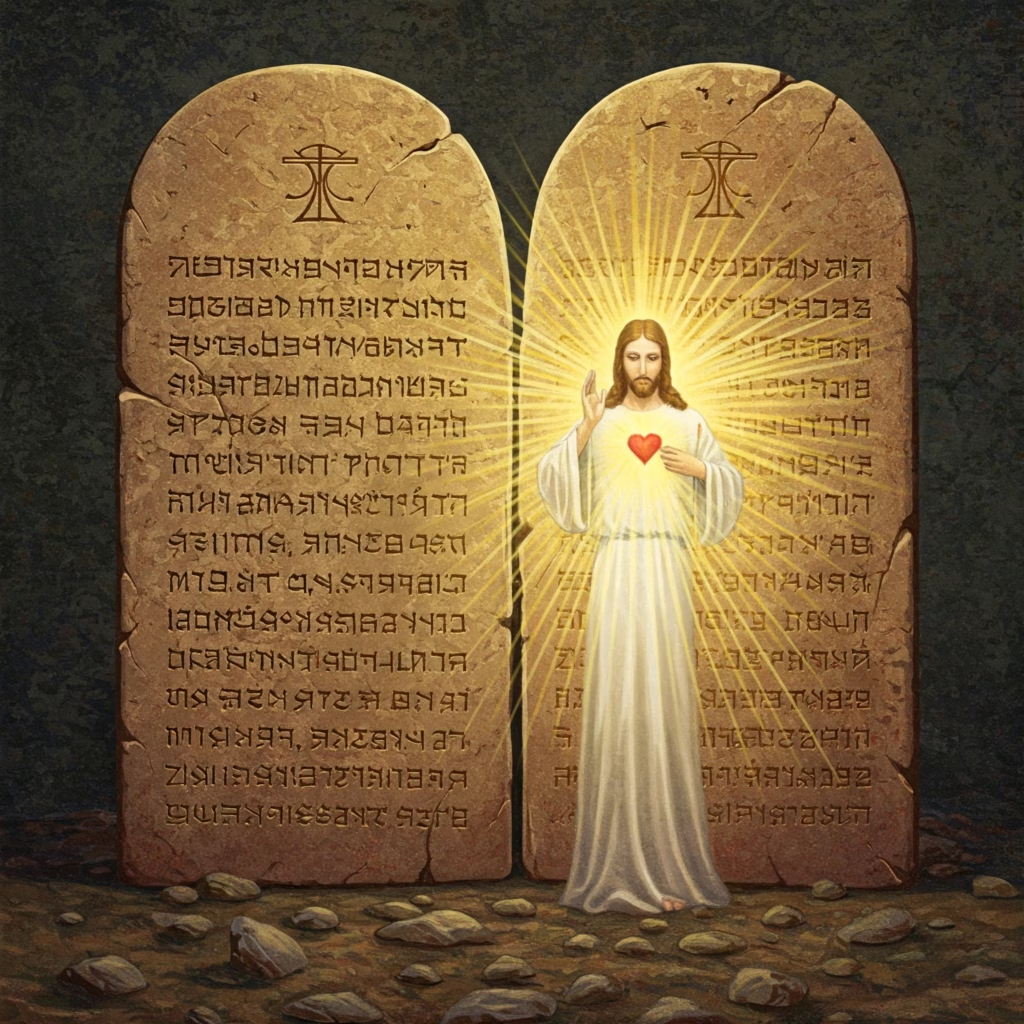
The Ten Commandments provided the essential framework for a specific stage of human evolution. However, humanity’s journey continued towards a time when morality could arise from a different source – from inner freedom and love, rather than external law. The Mystery of Golgotha, the Deed of Christ, signifies the dawning of this new stage.
Christ did not come to abolish the Law but to fulfill it by infusing humanity with the capacity for Divine Love. This Love impulse works within the individual “I,” transforming the “Thou shalt nots” into positive forces. For example, the prohibition against killing becomes the active impulse to cherish and foster life. The commandment against bearing false witness becomes the inner striving for truth in thought, word, and deed. The Law, necessary as an external guide, finds its fulfillment when its essence is grasped inwardly and enacted freely out of love. Understanding this transformation is key to the Rudolf Steiner Ten Commandments analysis.
Conclusion: The Commandments as Evolutionary Signposts
Therefore, viewed through the comprehensive lens afforded by Steiner’s perspective, based on the spiritual science found in the provided works, these ancient edicts reveal themselves as far more than a simple moral code. They are reflections of cosmic wisdom, marking humanity’s passage through necessary stages of consciousness development. They illuminate the challenges faced by the emerging “I” and point towards the forces that seek to lead it astray.
Furthermore, they prepare the ground for understanding the profound significance of the Christ impulse, which elevates humanity beyond external law towards the possibility of free, conscious, moral action arising from love. For us today, revisiting the Ten Commandments with spiritual insight offers not a regression, but a profound opportunity to understand our own evolutionary journey, the moral challenges of our time, and the path forward towards realizing our fullest human potential in freedom and love.