In the great and tragic drama of the Mystery of Golgotha, at the moment when the apostles have fled in fear and the world is plunged into the spiritual darkness of the ninth hour, two figures emerge from the shadows to perform a final, sacred duty. One is Nicodemus, the nightly disciple. The other is Joseph of Arimathea. While his name appears only in this final act of the Gospels, his deeds reveal a mission of breathtaking scope and importance. This article will explore the spiritual mission of Joseph of Arimathea from a perspective informed by the insights of spiritual science.
We will move beyond the simple picture of a well-intentioned sympathizer to see him as a conscious initiate, a guardian of ancient wisdom who recognized the true cosmic nature of the being who had been crucified. We will explore the esoteric meaning of his daring request to Pilate, the profound symbolism of the new tomb he provided, and his legendary post-crucifixion task as the first Guardian of the Holy Grail. Joseph of Arimathea, we will find, was no mere bystander. He was a chosen vessel, a hierophant of a new age, whose sacred task was to protect the physical sheath of the Christ-deed and to carry its innermost spiritual secret forward into the future of humanity.
The “Rich Man” and the “Honorable Counselor”: The Nature of an Initiate
A Disciple Within the Gates
The Gospels provide us with several brief but potent descriptions of Joseph. Matthew calls him “a rich man.” Mark describes him as “an honorable member of the council, who was also himself looking for the kingdom of God.” Luke adds that he was “a good and righteous man.” And John, with the deepest psychological insight, tells us he was “a disciple of Jesus, but secretly, for fear of the Jews.”
These are not just biographical details; they are a spiritual characterization of an initiate.
- “A rich man”: This should be understood in a twofold sense. Yes, his earthly wealth gave him the standing and the means to approach a Roman governor and to possess a private rock-hewn tomb. But on a deeper level, he was “rich” in spiritual knowledge. He was a bearer of the wealth of the ancient mysteries, a soul who possessed a deep understanding of the spiritual laws of the cosmos and the prophecies concerning the coming of the Messiah.
- “An honorable member of the council”: He was a member of the Sanhedrin, the highest religious and legal body of the Jewish people. This places him not outside the system, but at its very heart. Unlike the apostles, who were simple men from Galilee, Joseph was an initiate working from within the established, and now decaying, structure of the old covenant.
- “A disciple… but secretly”: This is not a sign of cowardice, but of esoteric discipline. The deepest spiritual truths, the mysteries, could not be proclaimed publicly on the streets. They were communicated from master to pupil in secret, to those who were prepared to receive them. Joseph’s secrecy was the necessary caution of one who guarded a sacred knowledge that the world was not yet ready to understand. He was, like his companion Nicodemus, a “nightly disciple,” one who had recognized the Christ not through public preaching, but through a deeper, inner knowledge.
These descriptions paint a picture of a man of immense spiritual and worldly stature, an initiate of the old order who had recognized the dawning of the new, and who had been waiting in silence for the appointed moment to fulfill his unique and pre-ordained mission.
The Deed of Courage: Claiming the Sacred Body
An Act of a Hierophant
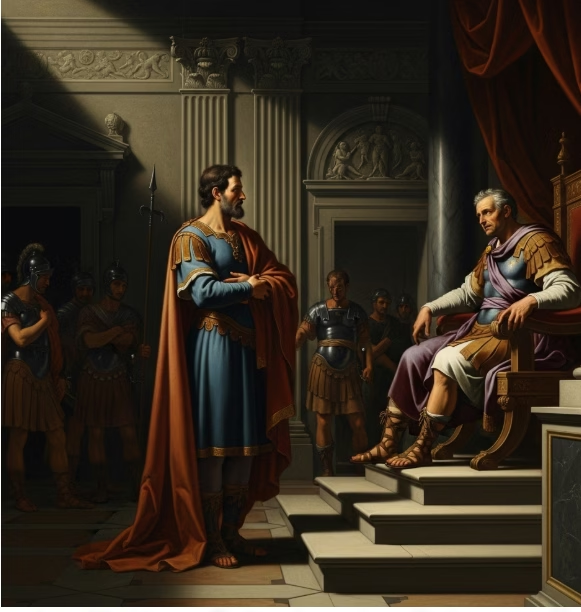
That appointed moment came after the Crucifixion. The Gospels tell us that Joseph, “taking courage,” went to Pontius Pilate and asked for the body of Jesus. We must pause to consider the magnitude of this act. To associate oneself with a man executed by the Roman state for treason and condemned by the Sanhedrin for blasphemy was to risk everything: his position, his wealth, his reputation, and his very life. The fact that Mark’s Gospel explicitly mentions his “courage” tells us that this was a conscious and perilous deed.
But this was far more than a courageous act of human decency. It was the conscious and solemn deed of a hierophant, a priest performing the first great ritual of the new Christian mysteries. The physical body of Jesus of Nazareth was the most sacred substance to have ever existed on Earth. For three years, it had been the temple for the indwelling of the cosmic Sun Spirit, the Logos itself. It had been completely permeated and transformed by this divine being. It could not, therefore, be left to the fate of a common criminal, to be discarded in an unmarked grave. It had to be claimed, protected, and laid to rest in a way that was fitting for its cosmic significance.
Joseph of Arimathea’s request to Pilate was the act of a guardian claiming a holy relic of world-historical importance. It was the necessary first step in ensuring that the Mystery of Golgotha could be brought to its proper earthly culmination.
The New Tomb in the Garden: Providing the Alchemical Vessel
The Crucible for the Resurrection
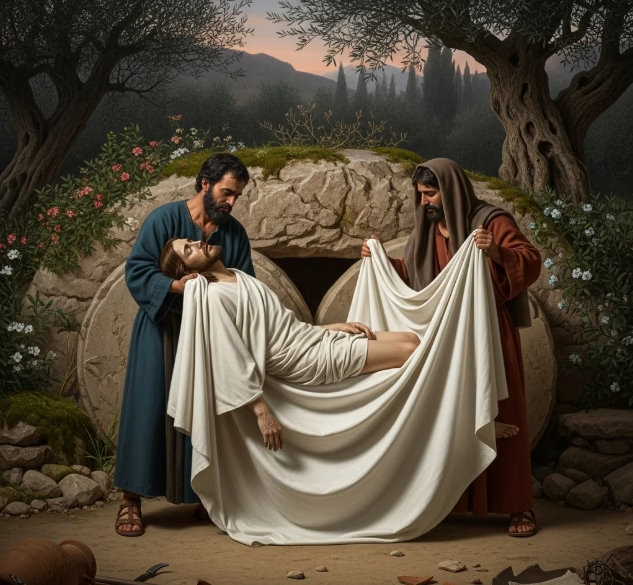
Having received permission from Pilate, Joseph, together with Nicodemus, took the body of Jesus and prepared it for burial. The place of this burial is described with details of immense symbolic importance. It was Joseph’s “own new tomb, which he had hewn in the rock… where no one had ever yet been laid.”
This was not just any grave. This was a sacred and specially prepared vessel for the greatest alchemical transformation in the history of the cosmos.
- “His own new tomb”: Joseph had prepared this place for this very purpose. It was “his own” in the sense that his wisdom and his will had consecrated it. It was “new,” meaning it was a virgin vessel, unsullied by any previous process of death and decay. The sheath for this unique Mystery had to be as pure as the virgin from whom the body itself was born.
- “Hewn in the rock”: The tomb was not a simple grave dug in the earth. It was a chamber carved out of the solid, mineral substance of the planet. The body of the Christ-Jesus was to be laid in the very heart of the mineral kingdom, the densest and most lifeless part of creation. This was so that His resurrecting impulse could work from the very foundation of the physical world, planting the seed of its future spiritualization into the rock of the Earth itself.
- “In a garden”: The setting of the tomb in a garden is a profound echo of the first chapter of Genesis. The first Adam was lost to the spiritual world in a garden. The second Adam, the Christ, is now to be planted like a divine seed in a garden tomb, in order to bring forth a new, resurrected creation.
The tomb provided by Joseph of Arimathea was, therefore, not a place of finality and death. It was a sacred alchemical vessel, a spiritual crucible, a holy sepulcher in which the great transubstantiation of matter was to take place. It was the womb of the Earth in which the body that had died was to be transformed into the glorious Resurrection Body. The spiritual mission of Joseph of Arimathea was to consciously and carefully prepare this sacred space for the deed that would conquer death forever.
The Guardian of the Grail: The Legendary Mission to the West
The Bearer of the Inmost Mystery
The role of Joseph of Arimathea in the canonical Gospels ends with the sealing of the tomb. But a rich and powerful stream of esoteric Christian legend, particularly the legends of the Holy Grail, continues his story and reveals the next, even more profound, stage of his mission.
These legends, which surfaced with great force in Western Europe in the Middle Ages, tell that Joseph, along with Nicodemus, did not just care for the body of Christ, but also collected the sacred blood and water that flowed from His wounded side. They gathered this holy substance into a vessel, which is often identified with the cup used by Christ at the Last Supper. This vessel, containing the physical-spiritual essence of the Christ-Ego, is the Holy Grail.
The legends go on to recount how Joseph was later imprisoned and miraculously kept alive for many years in his prison by the power of the Grail. Upon his release, he was divinely instructed to travel with a small band of followers to the West. His long journey ended in Glastonbury, in the remote land of Britain. It was here, at the “Glassy Isle,” that he is said to have established the first Christian community above ground in Europe and to have become the first guardian in a long line of Grail Kings.
This legendary journey is a magnificent picture of a world-historical spiritual process. It is the story of the transference of the central mystery-stream of humanity. The great mysteries of the pre-Christian world were centered in the East. But the new Christian mysteries, which were to be founded on the freedom of the individual human “I,” had to find a new home in the soul-soil of the West, the geographical sphere where the Consciousness Soul was destined to have its strongest development.
The spiritual mission of Joseph of Arimathea, in this grander legendary context, was to be the Guardian and Bearer of the Grail. He was the initiate entrusted with carrying the inmost, most secret, and most potent aspect of the Christ-deed—the mystery of the purified soul and the redeemed “I”-substance—away from the decaying outer forms of the old world and planting it like a precious seed in the fertile ground of Europe’s future.
Joseph and Nicodemus: Two Poles of the Inner Path
In his great work at the tomb, Joseph is joined by Nicodemus. They are the two great “secret disciples” who act with courage when the public disciples have fled. Together, they represent the complete, inner path of discipleship that is required for the new mysteries.
- Nicodemus, as we have explored, represents the path of the head, the path of wisdom. He is the great scholar who must transform his intellectual knowledge into a living devotion. He brings the myrrh and aloes, the precious substances of ancient wisdom, to anoint the body.
- Joseph of Arimathea represents the path of the will and the deed. He is the man of stature and action in the world. He does not bring the incense; he provides the sacred space itself—the pure linen and the virgin tomb.
Together, they embody the two pillars of all true esoteric work: wisdom and action, knowledge and will, transformed thinking and courageous deeds. They are the archetypes of the esoteric Christian who must unite a deep understanding of the spirit (Nicodemus) with a firm and courageous standing in the practical world (Joseph).
Conclusion
The spiritual mission of Joseph of Arimathea was far greater than a single act of piety. He was a pivotal figure, an initiate of the old world who became the guardian and servant of the new. He stands as the conscious bridge between the Sanhedrin and the Cross, between the old covenant and the new reality. His first great task was to act as a courageous hierophant, claiming the most sacred body that ever walked the Earth from the hands of the profane world. His second task was to provide the pure, alchemical vessel—the garden tomb—in which the great miracle of the Resurrection could be prepared.
And his third, legendary task was to become the first Guardian of the Holy Grail, carrying the inmost secret of the Christ Impulse from the dying East and planting it as a seed of future spiritual life in the soul of the West. His story is a profound testament to the truth that the greatest and most decisive deeds in human history are often performed not in the full glare of public life, but in the quiet courage of prepared souls who understand the spiritual necessities of their time and act with selfless devotion at the great turning points of destiny.