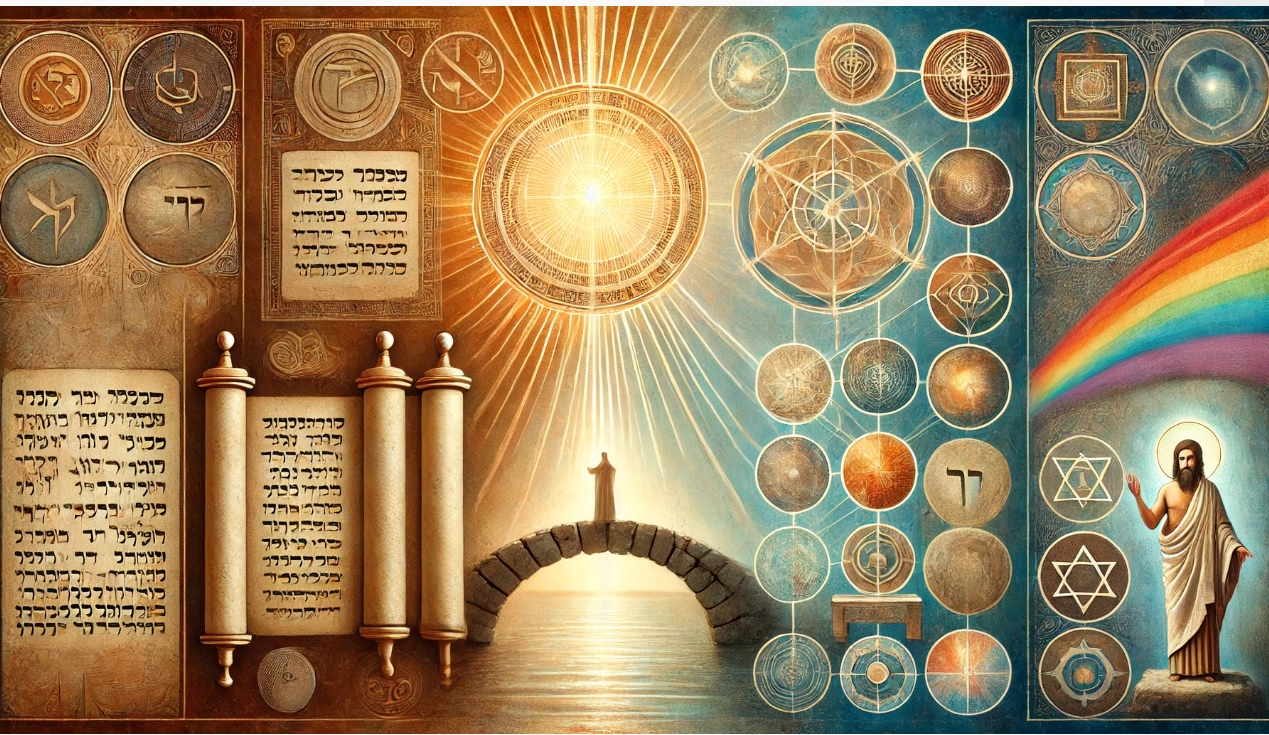
The New Testament Gospels each paint a unique portrait of Christ Jesus. St. Matthew’s Gospel stands out. It acts as a powerful bridge. It connects the Hebrew tradition with the new Christian impulse. Matthew presents Christ Jesus as the Messiah, the one who fulfills prophecy. He also shows Him as the bringer of the Kingdom of Heaven. Rudolf Steiner’s spiritual science, Anthroposophy, offers profound insights into Matthew’s account. The Steiner Gospel of Matthew interpretation goes beyond history. It reveals deep esoteric truths. It explains the Christ’s entry into world events. It details the spiritual streams preparing His way. It outlines the inner transformation needed for spiritual self-governance. Understanding the Anthroposophy’s Gospel of Matthew perspective illuminates Christ’s earthly mission profoundly.
Matthew: Connecting Old and New Covenants
Rudolf Steiner frequently highlighted Matthew’s role as a bridge builder. The author clearly writes for a Jewish-Christian audience. He constantly links Christ’s life and teachings to Old Testament prophecies. This demonstrates Christ as the awaited fulfillment of divine promises. These promises trace back to Abraham and David. This focus on historical continuity and lineage marks Matthew. It differs from John’s cosmic viewpoint or Mark’s immediate dynamism. Matthew situates the Christ event squarely within the flow of earthly history. He shows how the divine entered this specific stream. But Steiner shows this historical framework holds deep spiritual truths. The Rudolf Steiner Gospel of Matthew interpretation uncovers this hidden reality.
The Two Jesus Children: A Profound Mystery
Steiner’s spiritual research revealed a complex reality concerning the genealogies in Matthew and Luke. This is one of his most distinctive teachings. He found evidence in the spiritual world-record (Akasha Chronicle) for two boys named Jesus. They were born near the same time in Palestine. They represented culminations of different major spiritual streams. Both streams were vital to prepare the unique human vessel for the Christ Being.
Matthew’s Gospel traces the lineage through King Solomon, David’s son. This is the kingly line. The Matthew genealogy follows a spiritual current linked to ancient Persia. It carries the wisdom of Zarathustra. This stream preserved cosmic wisdom through generations. It focused on understanding the outer world. The Matthew Jesus child came from this Solomonic line. He carried this ancient, world-oriented wisdom. Steiner identified his individual Ego as the reincarnated Zarathustra. This Jesus possessed a highly developed individuality. It was matured through the kingly line’s experiences.
Luke’s Gospel presents a different genealogy. It traces the lineage through Nathan, another son of David. This represents the priestly line. It connects back to Adam. Steiner linked this stream to inner soul warmth and selfless love. It carried the compassionate wisdom associated with the Buddha impulse. The Lukan Jesus child embodied immense heart forces.
These two Jesus children developed separately. Steiner described a profound spiritual event around their twelfth year. The Zarathustra-Ego of the Matthean Jesus departed his physical, etheric, and astral bodies. This left them uniquely prepared. The soul forces of the Lukan Jesus child (whose physical body soon faded) then flowed into these prepared sheaths. This act created the composite human vessel. It united Zarathustra’s cosmic wisdom (Matthew) with Buddha’s profound heart-forces (Luke). This vessel could uniquely receive the cosmic Christ Spirit. This reception occurred years later at the Baptism by John. This view challenges convention. Yet, it illuminates the immense cosmic preparation for the Incarnation. It shows how different spiritual streams converged for this central event. This is key to the Esoteric Christianity in the Gospel of Matthew.

Charter for the Age: The Sermon on the Mount
The Sermon on the Mount (Matthew 5-7) forms the ethical core of Matthew’s Gospel. Steiner saw this as the foundational teaching for our current epoch. This is the age of the consciousness soul. In this age, the human ‘I’ awakens fully. It becomes capable of self-reflection. It can make independent moral judgments.
The Sermon on the Mount interpretation by Steiner highlights a crucial shift. Christ moves beyond external laws (“You have heard that it was said…”). He calls for an inner transformation (“But I say to you…”). The Beatitudes focus on inner soul states. Commandments evolve. The prohibition against killing extends to anger. The law against adultery includes inner lust. Truthfulness replaces oaths. Turning the other cheek replaces retaliation. Love extends even to enemies. This demands a new level of inner mastery. It requires the ‘I’ to actively shape thoughts and feelings. It calls for morality born from inner understanding, not just outer rules. The Spiritual meaning of the Sermon on the Mount awakens this inner moral freedom. It places responsibility firmly within the individual Ego.
The Kingdom of Heaven: Entering Inner Reality
Matthew consistently speaks of the “Kingdom of Heaven” (or “Kingdom of God”). Spiritual science views this primarily as an inner state of being. It is not just a future place. The Kingdom of Heaven represents the spiritual reality underlying the physical world. One can enter this kingdom now. It requires inner transformation.
Christ’s parables in Matthew often illustrate this. They use earthly images. They show the laws of this spiritual kingdom. They depict how the soul grows into it. One must become “like little children”—open, trusting, direct. One must seek “righteousness”—aligning oneself with divine truth. One must practice forgiveness. The Kingdom is where the human ‘I’ finds its true purpose. This happens when the ‘I’ aligns with the Christ impulse. It transcends purely selfish motives. This applies both during earthly life and beyond.
Matthew and the “Fifth Gospel”
Steiner introduced the concept of the “Fifth Gospel.” This refers not to a text, but to the spiritual record of Christ’s deeds. This record exists in the Akasha Chronicle, the world-memory. The four written Gospels are inspired reflections of this deeper reality. Each Gospel writer captures different aspects. Their perspective reflects their specific mission and audience.
The Steiner’s fifth Gospel idea clarifies Matthew’s unique role. He presents the Akashic events most relevant to earthly history. He shows the connection to Hebrew prophecy. He emphasizes the moral path within physical life. Matthew provides the essential historical and ethical foundation. This perfectly complements the cosmic perspective offered by John.

Golgotha: The Kingly Sacrifice and Fulfillment
Matthew’s account of Christ’s final days powerfully emphasizes fulfillment. Christ fulfills Old Testament prophecy. He enters Jerusalem as the prophesied King. Yet, His kingdom is spiritual, not earthly. He establishes it through sacrifice, not conquest. Matthew vividly describes events surrounding the Crucifixion: the earthquake, the darkness, the temple veil tearing. Spiritual science sees these as symbols of cosmic impact. The old era of external law ends. The Christ impulse directly enters earth reality. Matthew emphasizes the fulfillment aspect of the Esoteric Christianity. Christ’s death and Resurrection confirm His spiritual Kingship. He overcomes death itself. He opens the path to the Kingdom for humanity.
Matthew’s Continuing Relevance
The Rudolf Steiner Gospel of Matthew interpretation makes this Gospel vital today. It illuminates Christ’s work within human history. It clarifies the soul’s ethical development. The Sermon on the Mount provides the moral basis for the consciousness soul. The genealogy, esoterically understood, reveals the deep spiritual streams preparing the Incarnation. The Kingdom of Heaven is shown as an attainable inner state. Spiritual science, supported by Steiner’s lectures (like those in GA 123), offers a path to understand Matthew’s unique message. It reveals the journey into earthly moral struggle as preparation for spiritual ascent.
Conclusion: Matthew’s Call to Inner Transformation
Seen through the lens of Anthroposophy, this Gospel is a profound call to inner work. It bridges the ancient past with the Christ-filled future. It details the spiritual heritage flowing into the Matthew Jesus child. It lays out the ethical path in the Sermon on the Mount. It defines the Kingdom of Heaven as a state achieved through conscious soul transformation. Matthew firmly grounds the Christ event in history, yet simultaneously points inward. It shows that becoming a citizen of the true Kingdom requires actively cultivating the moral forces of the Christ-filled ‘I’ within the challenges and responsibilities of earthly life.