Introduction: Rethinking Eternal Damnation
Traditional religious ideas often include concepts of hell. Many imagine hell as a place of eternal punishment for sins committed during earthly life. This image evokes fear and raises profound questions about divine justice and mercy. Does a permanent hell truly exist? Rudolf Steiner, founder of Anthroposophy or spiritual science, offered a radically different perspective. His insights stem from direct spiritual investigation, not dogma. The Steiner concept of hell diverges significantly from conventional views. Anthroposophy permanent hell interpretations focus on processes of purification, cosmic evolution, and the consequences of choices, rather than eternal damnation in the traditional sense. Understanding the Rudolf Steiner afterlife suffering perspective requires exploring the soul’s journey after death through the lens of karma, reincarnation, and spiritual transformation.
Kamaloka: The Realm of Purification, Not Punishment
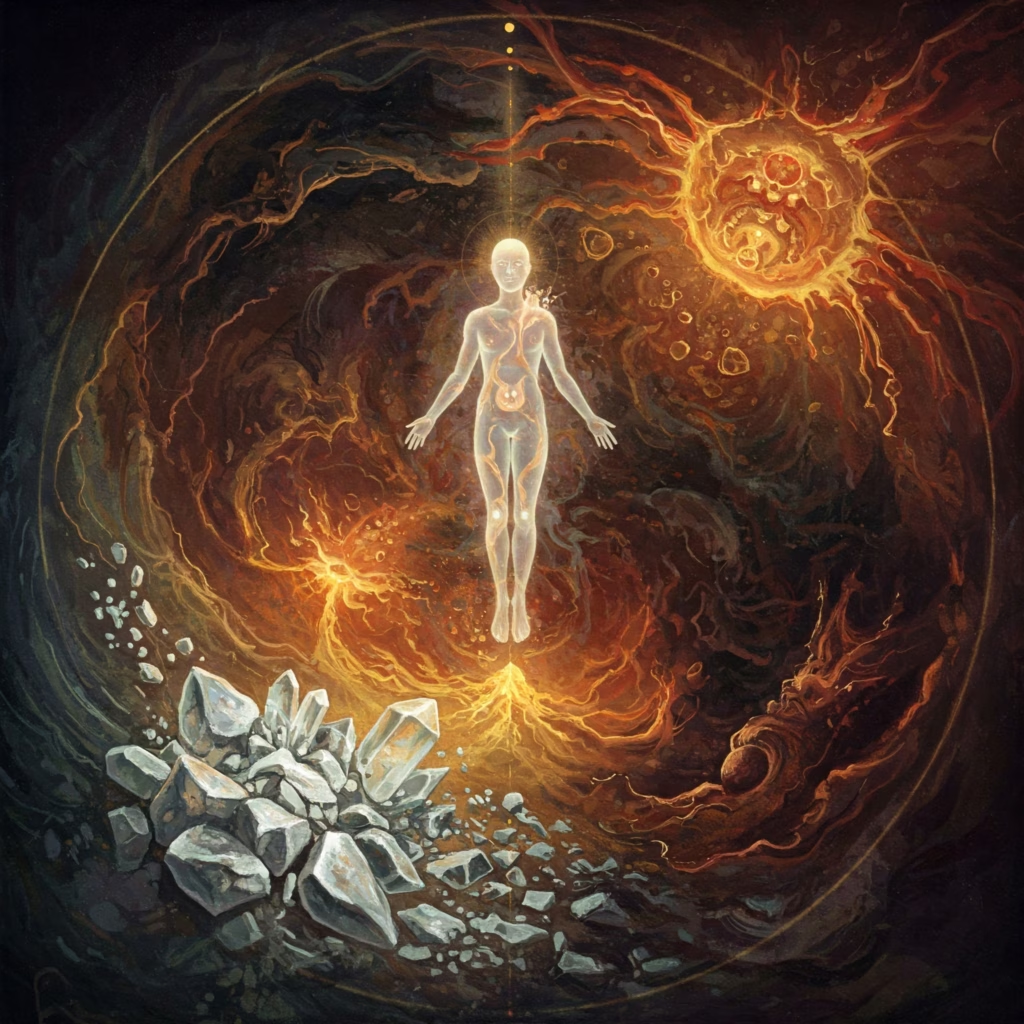
Steiner described the soul’s experience immediately after death and the dissolution of the etheric body. The soul enters a state or region known as Kamaloka, often translated as the “place of desires.” This realm is a key focus in books like Theosophy and Between Death and Rebirth. Kamaloka is not an externally imposed place of punishment. Rather, it is a necessary period of purification. During this time, the soul must gradually detach itself from desires and habits connected solely to the physical world.
After death, the soul retains its astral body. This body carries the imprint of all earthly passions, cravings, and attachments. However, the soul now lacks the physical body needed to satisfy these desires. A person who excessively indulged in physical appetites, for instance, still feels the craving intensely after death. Yet, without a physical stomach or palate, the desire cannot be fulfilled. This unmet craving causes inherent suffering – a burning thirst that cannot be quenched. Similarly, negative feelings indulged during life – anger, hatred, envy – persist. The soul must gradually wean itself from these lower impulses.
Furthermore, in Kamaloka, the soul re-experiences its past earthly life. It relives events, but crucially, it does so in reverse order, from death back to birth. Moreover, it experiences its deeds not from its own perspective, but from the perspective of those affected. An act that caused pain to another is now experienced as that other person felt it. This process vividly reveals the consequences of one’s actions. This intense reliving, driven by the soul’s own past, constitutes the core of post-mortem suffering described by Steiner. It is a direct, karmic consequence, not an external judgment. This purification after death is essential for the soul’s progress.
The Continued Influence of Lucifer and Ahriman
The adversarial powers, Lucifer and Ahriman, also play a role in the soul’s afterlife experience. Their influences, which impact earthly life, continue to resonate within the soul after death, particularly during Kamaloka. Understanding Lucifer & Ahriman afterlife connections helps clarify the nature of some post-mortem struggles.
Luciferic influences, connected to pride, fantasy, illusion, and escaping earthly reality too soon, can shape Kamaloka experiences. Attachments to personal spiritual pride, or illusions held during life, may create specific purifying challenges after death. The soul might confront the insubstantiality of its own cherished fantasies. It might struggle to release itself from self-created spiritual illusions.
Ahrimanic influences, linked to materialism, lies, fear, and attachment to the purely physical, create different types of Kamaloka suffering. A soul deeply bound to materialistic thinking may find detachment incredibly painful. The intense craving for physical sensations, now impossible to satisfy, becomes a source of torment. Illusions fostered by Ahriman during life regarding the nature of reality must be painfully dissolved. The soul confronts the consequences of its own untruthfulness or fear-driven actions. These adversarial influences contribute to the intensity of the Kamaloka purification. However, they do not represent an external “devil” tormenting the soul. Rather, they are forces the soul itself entertained during life, whose consequences must now be faced.
Permanent Loss? The Eighth Sphere and the Asuric Danger
Does Anthroposophy admit any concept akin to permanent hell? Steiner emphatically rejected the notion of eternal conscious torment for the entire human being as understood in conventional dogma. The core spiritual identity of the human being, the ‘I’ or Ego, is destined for ongoing evolution. However, Steiner did describe a significant spiritual danger – the possibility of losing parts of one’s being, or becoming entangled in a realm outside the normal course of progressive evolution. This is connected to the concept of the Steiner eighth sphere.
The Eighth Sphere is not a geographical location. Steiner described it as a kind of spiritual “slag heap” or “counter-sphere” to normal earthly evolution. It consists of spiritual substance that has become overly hardened, materialized beyond its intended state, or corrupted through misuse. It represents spiritual potential that has fallen out of progressive development. It is a realm characterized by extreme Ahrimanic influence – intense materialism, illusion, and mechanization pushed to their ultimate degree.
How can a human being become connected to this sphere? Steiner indicated this danger arises primarily through extreme attachment to materialism and the denial of the spirit. Furthermore, he connected it to the influence of the third group of adversarial beings, the Asuras. As previously discussed (in lectures like The Deed of Christ and the Opposing Spiritual Powers), Asuric beings target the human consciousness soul and the ‘I’ itself. Their influence promotes the deepest forms of egoism, sensuality detached from spirit, and the will to actively destroy spiritual potential.
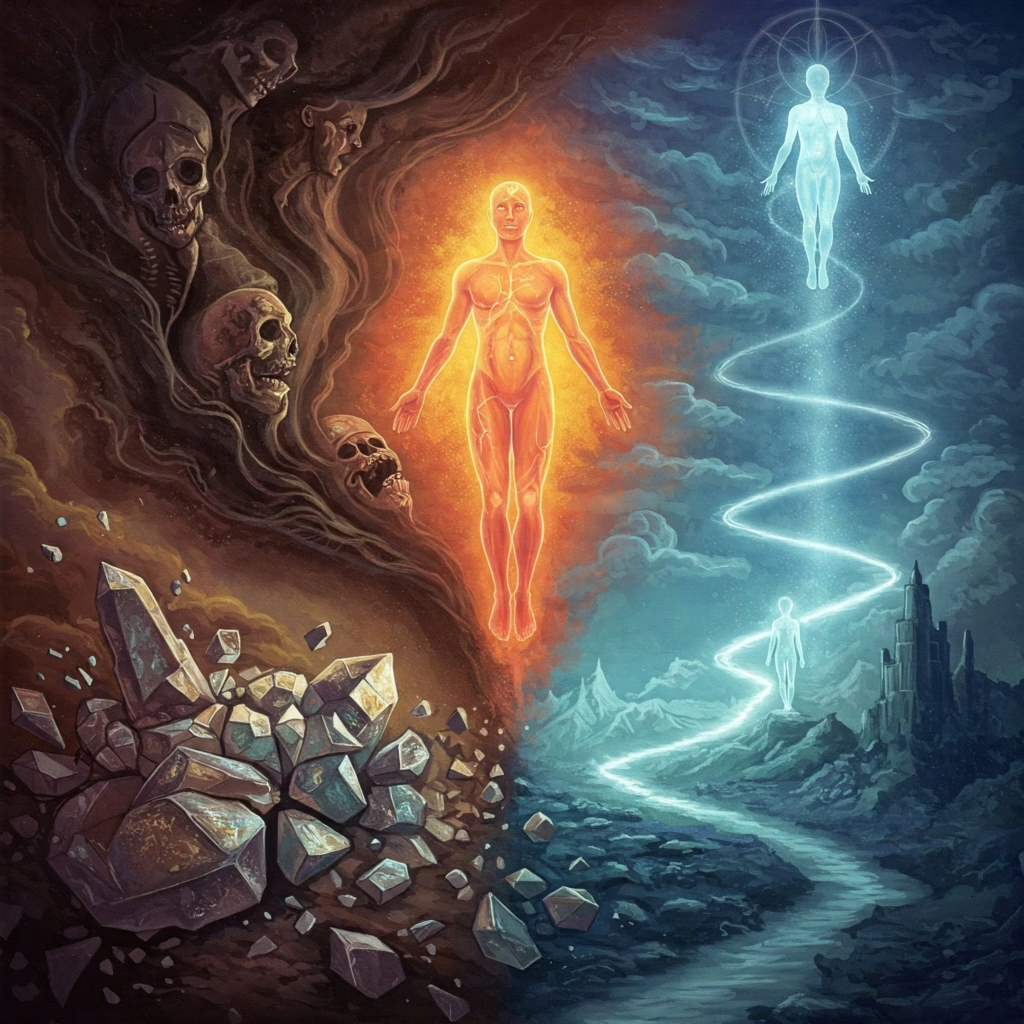
If a human being yields completely to these Asuric impulses, identifying wholly with the material body and its lowest desires, and actively working against spiritual evolution, parts of their ‘I’ can become so hardened, so interwoven with purely material forces, that they are effectively “torn away” from the progressive spiritual stream upon death. These spiritual fragments, Steiner indicated, become forfeit. They fall prey to the Eighth Sphere, contributing to its substance. This represents a permanent loss of that specific portion of the individual’s spiritual potential. It is not eternal damnation of the conscious soul in a fiery pit. Rather, it is the tragic loss of spiritual substance, a self-inflicted exclusion from future positive evolution for those lost parts. This is the most severe consequence spiritual science outlines, and it relates directly to the destiny of evil Steiner described in connection with beings fully resisting progress. The answer to Is hell eternal Steiner would provide is “No” in the traditional sense, but the consequences of certain choices leading towards the Eighth Sphere are indeed permanent for the lost potential.
Redemption Through Karma, Reincarnation, and Christ
Crucially, Steiner’s cosmology is overwhelmingly one of hope, transformation, and redemption. The danger of the Eighth Sphere exists, but it is counterbalanced by powerful forces working for progress. The core principles of Karma reincarnation Steiner taught ensure that evolution provides endless opportunities for learning and growth.
Karma is not fatalistic punishment. It is the law of consequence that allows beings to learn from their actions and balance past deeds. Reincarnation provides the stage – repeated earthly lives – where this learning and balancing can occur. Every life offers new chances to overcome past errors, cultivate virtues, and progress spiritually. Even beings who fall behind, like the Luciferic and Ahrimanic spirits, are not eternally condemned in Steiner’s view. They too are part of the cosmic plan and have potential paths toward future transformation, often linked intricately with humanity’s own development.
Most importantly, the Christ impulse acts as the central redemptive force within Earth evolution. Christ’s descent into the earthly and spiritual realms, culminating in the Mystery of Golgotha, provides the power to overcome the deepest adversarial influences. He brought light into the Kamaloka realm, mitigating its suffering for those who turn to Him. He offers strength to the human ‘I’ to resist Luciferic pride and Ahrimanic materialism. He provides the ultimate force of selfless love, which is the antidote to Asuric egoism. Connecting with the Christ impulse during life provides the soul with the means to navigate the afterlife consciously and avoid the dangers of spiritual hardening or fragmentation.
Conclusion: Purification, Potential Loss, and Progress
In summary, the Steiner concept of hell finds its primary correspondence in the soul’s self-created experiences during Kamaloka. This is a necessary, though potentially painful, period of purification from earthly attachments, not eternal punishment. Rudolf Steiner afterlife suffering arises from confronting one’s own deeds and desires, often amplified by lingering Luciferic and Ahrimanic influences.
Steiner firmly rejected the dogma of eternal damnation for the entire soul. However, Anthroposophy permanent hell discussions must acknowledge the grave concept of the eighth sphere. This represents the potential for permanent loss of spiritual substance if the human ‘I’, under extreme Ahrimanic and Asuric influence, completely hardens in materialism and egoism, forfeiting parts of itself. Yet, this tragic possibility stands against the vast backdrop of cosmic evolution guided by divine wisdom and love. The overarching principles of Karma reincarnation Steiner described, together with the redemptive power of the Christ impulse, ensure that the path of progress remains open. The journey after death, like life itself, is one of consequences, purification, and ultimately, the potential for transformation and continued spiritual ascent.