Introduction: Monument of Mystery
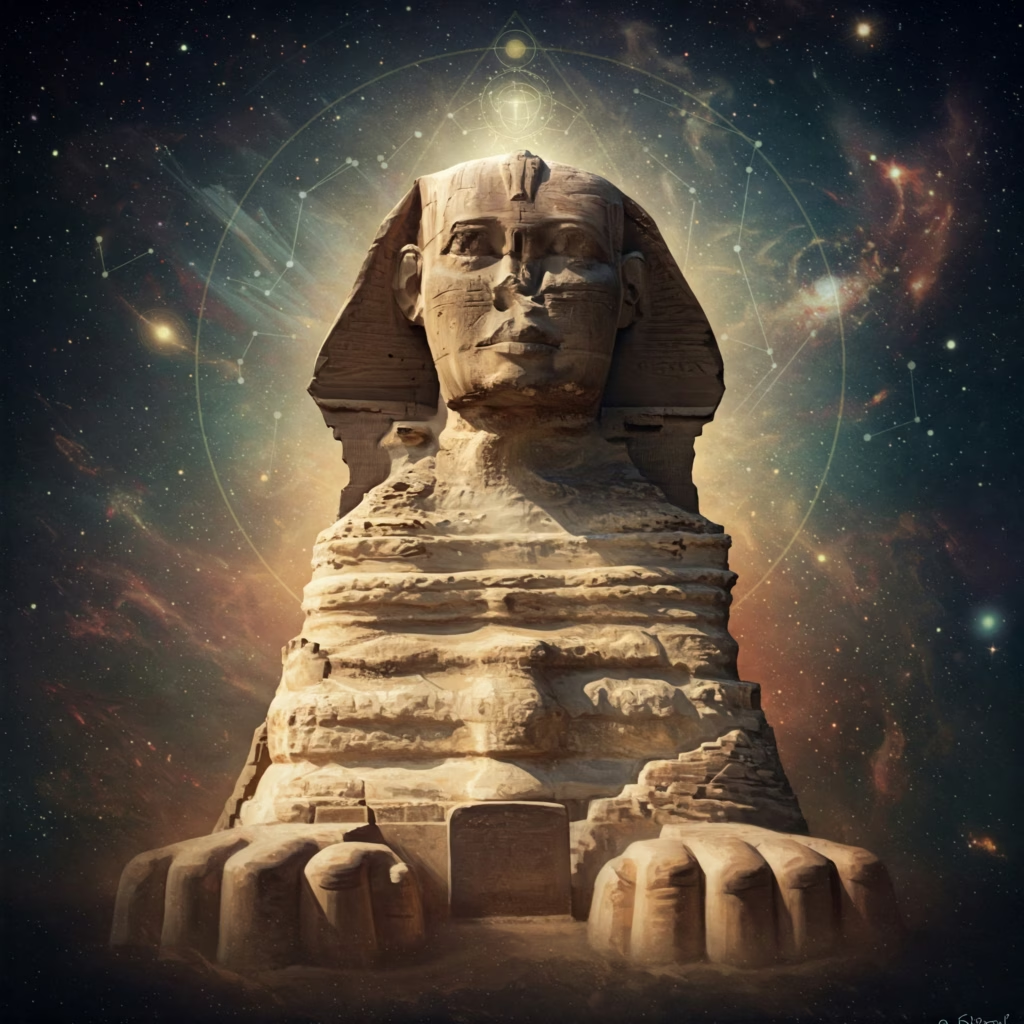
The Great Sphinx of Giza stands as one of the world’s most iconic and mysterious monuments. Its colossal form, with a human head and a lion’s body, has gazed across the Egyptian sands for millennia. Conventional interpretations vary. Some see it as a guardian statue. Others view it as a portrait of a pharaoh. Many simply marvel at its ancient construction. However, Rudolf Steiner, through the insights of Anthroposophy or spiritual science, offered a profoundly deeper understanding. The Steiner Sphinx interpretation moves beyond purely physical explanations. It reveals the Sphinx as a powerful memory-image. It reflects crucial stages in human evolution and the development of consciousness. Understanding the Sphinx meaning from Anthroposophy unlocks insights into our own complex human nature and the enduring riddle of existence.
Myths and Monuments as Pictures of Reality
To grasp Steiner’s view of the Sphinx, we must first understand his general approach to ancient myths and monuments. He taught that these are not merely primitive art forms or fanciful inventions. Instead, they often represent accurate, albeit imaginative, pictures of spiritual realities or past evolutionary conditions. Ancient humanity possessed a different form of consciousness than ours today. This consciousness perceived spiritual beings and processes directly, often through vivid, dreamlike imagery. Sacred art, architecture, and mythology became the natural language for expressing these supersensible perceptions. Therefore, enigmatic forms like the Sphinx should be approached not as primitive errors, but as potentially precise records of realities experienced by ancient consciousness.
The Sphinx: An Image of Human Evolution
Steiner’s core insight into the Sphinx connects it directly to the evolution of the human form and consciousness itself. He explained that the Sphinx’s composite nature—part human, part animal—is not arbitrary symbolism. Instead, it reflects an actual stage through which humanity passed in its far-distant past, primarily during the Lemurian epoch.
During that ancient time, Steiner described human consciousness as much less individualized. The human form itself was far more malleable and less solidified than today. It was still deeply interwoven with the group souls guiding the animal kingdom. Human beings were not yet sharply differentiated from certain animal forms in their physical or etheric organization. Steiner saw the Sphinx monument as a potent memory-image of this transitional state. It pictures a being whose upper part, the head, already foreshadows the future development of individual human consciousness and intelligence (the ‘I’). Simultaneously, its powerful animal body (typically leonine) represents the strong, instinctive life forces and group-soul characteristics still dominating the rest of the human organization at that stage. The Sphinx embodies the point where the individualized human spirit began to emerge from, yet remained partially embedded within, powerful, nature-bound group forces.

The Sphinx and the Human Constitution
Steiner further connected the Sphinx’s form to the multi-layered constitution of the human being. Anthroposophy describes the human being as consisting of physical body, etheric (life) body, astral (soul/sentience) body, and the spiritual ‘I’ or Ego. The Sphinx can be seen as an imaginative picture of the interplay between these members:
- The Human Head: Represents the emerging ‘I’ consciousness, the capacity for thinking, self-awareness, and future spiritual development. It looks forward, surveying the world with nascent intelligence.
- The Animal Body (Lion): Symbolizes the powerful forces of the etheric body (vitality) and especially the astral body. The astral body is the seat of instincts, desires, passions, and sensations – forces humanity shares with the animal kingdom. The lion form specifically suggests courage, strength, and powerful will impulses connected to the heart and circulatory system.
The Anthroposophy Sphinx meaning thus includes its representation of the inner human struggle. It portrays the challenge faced by the emerging individual spirit (‘I’) to master and spiritualize the powerful life forces and astral impulses inherited from earlier evolutionary stages and shared with the animal kingdom. It embodies the tension between spirit and nature within the human constitution.
Guardian of the Threshold, Bearer of Riddles
As human consciousness evolved further into the Egyptian and Greek epochs, the direct memory of Lemurian conditions faded. However, the Sphinx retained profound significance within the Mystery traditions. It became known as the Guardian of the Threshold. It stood symbolically (and often physically, as at Giza) before the temples or pyramids where initiation took place. Its presence signified that entry into sacred knowledge required confronting and understanding the riddle of one’s own complex nature.
The Sphinx became the archetypal questioner. Its famous riddle, posed to Oedipus in Greek myth (“What walks on four feet in the morning, two feet at noon, and three feet in the evening?”), directly concerns the nature and stages of human life itself. Steiner saw this riddling aspect as deeply significant. The Riddle of the Sphinx represents the profound questions about existence, self-knowledge, and destiny that confront the awakening human intellect. The Sphinx embodies the challenge posed by the complexities of life and the spiritual world to the developing ‘I’ consciousness. Can the human ‘I’ penetrate the mysteries of its own being and its connection to the cosmos?
Oedipus and the Sphinx: Ego Mastering the Astral
Steiner offered a specific, detailed interpretation of the Greek myth of Oedipus confronting the Sphinx. He saw this story as a crucial picture of the evolutionary task facing humanity during the Greco-Latin cultural epoch (the fourth post-Atlantean period).
- Oedipus: Represents the newly emerging, self-aware human Ego, particularly the power of clear, logical thinking developing strongly within Greek culture.
- The Sphinx: Represents the powerful, riddling, and potentially destructive forces of the astral world and the human astral body. These forces, inherited from earlier, more instinctive stages of consciousness, could overwhelm the nascent Ego if not properly understood and mastered.
Oedipus solves the Sphinx’s riddle through the power of his intellect, his self-conscious thinking. This act symbolizes the Greek Ego achieving intellectual mastery over the older, potentially chaotic astral forces. By understanding the riddle of human nature through thought, Oedipus overcomes the Sphinx’s destructive power. (Her subsequent plunge into the abyss signifies these mastered astral forces being integrated or brought under the control of the conscious ‘I’). The Oedipus myth of Sphinx Steiner depicted shows a key victory in the evolution of consciousness: the triumph of clear thinking over primal astral power.
The Sphinx and the Adversarial Forces
While not identical to Lucifer or Ahriman (who Steiner linked more to interventions during Lemurian and Atlantean times affecting the astral and etheric/intellectual soul respectively), the Sphinx archetype relates to the challenges these adversarial forces pose. The powerful animal body can be seen as representing the lower nature, the field where uncontrolled Luciferic passions (pride, excessive fantasy) or Ahrimanic impulses (binding to the purely physical, fear) can take hold. The riddling nature of the Sphinx reflects the illusions and deceptions woven by both Lucifer and Ahriman. Lucifer creates illusions by pulling the soul away from reality into fantasy. Ahriman creates illusions by presenting the material world as the only reality, obscuring the spirit. The Sphinx, as the embodiment of the threshold question of self-knowledge, challenges the human being to see through both types of illusion through the strength of the developing, truth-seeking ‘I’. The Esoteric meaning of Sphinx involves this confrontation with inner and outer deception.
Relevance for Modern Consciousness
Why does Steiner’s interpretation of the Sphinx hold meaning today? Because the riddle it poses remains central to human existence. The Sphinx, as a symbol of our evolutionary past and our inner constitution, reminds us:
- We carry within us the legacy of vast evolutionary epochs.
- Our nature is complex, a meeting ground of spiritual potential (the human head/I) and powerful soul forces and instincts (the animal body/astral/etheric).
- The central task of human life involves the conscious ‘I’ striving to understand, master, and integrate these different aspects of our being.
- Self-knowledge is not an abstract pursuit; it is the key to overcoming inner obstacles and fulfilling our spiritual potential.
Understanding the Sphinx explanation by Rudolf Steiner encourages us to engage consciously with the riddle of our own existence. It prompts us to explore the different layers of our being – physical, life forces, soul impulses, and spiritual self – and to work towards harmonizing them through conscious awareness and inner development.
Conclusion: The Enduring Riddle of Self-Knowledge
In conclusion, the Steiner Sphinx interpretation elevates this ancient monument far beyond a mere statue. It reveals the Sphinx as a profound memory-image left by ancient humanity. It reflects a crucial stage in the human evolution. It symbolizes the composite nature of the human constitution – the spiritual ‘I’ emerging from powerful life and soul forces. As the Guardian of the Threshold and the eternal questioner, the Sphinx embodies theRiddle of the Sphinx: the fundamental challenge of self-knowledge. The Sphinx meaning resonates through time. It reminds us that the journey towards spiritual consciousness involves confronting and integrating all aspects of our being – the ‘animal’ and the ‘human’, the instinctual and the spiritual. By courageously facing the riddle of ourselves, as Oedipus did through thought, and as modern humanity must do through developing spiritual science, we take necessary steps towards fulfilling our human destiny. The Sphinx, viewed through Steiner’s insights derived from sources like GA 106 Egyptian Mysteries, becomes a timeless symbol of the quest for self-awareness.