Few works of world literature have endured as powerfully as the Divine Comedy. Written by Dante Alighieri in the early fourteenth century, it describes a journey through Hell, Purgatory, and Paradise. For most modern readers it is a supreme work of poetic imagination. Rudolf Steiner’s spiritual science reveals something entirely different.
The Divine Comedy is not primarily a literary work. It is a precise description of genuine supersensible experience — a record, encoded in medieval Catholic imagery, of a real initiatory journey through the spiritual world. Steiner addresses this in GA 233 (“World History in the Light of Anthroposophy”). For Steiner, Dante was not simply a great poet. He was a genuine initiate — a human being who had passed through the threshold of the spiritual world consciously and who encoded what he experienced in the most ambitious spiritual document produced in the medieval West.
Dante as Initiate
Steiner describes in GA 233 how Dante was connected to the tradition of Christian esotericism flowing through the Fedeli d’Amore — the “Faithful of Love” — a group of Italian poets and spiritual seekers among whom Dante moved during his most formative years. Furthermore, the Divine Comedy encodes its spiritual content in layers. The surface layer is a narrative of a journey through three spiritual realms. Beneath this, however, lie precise descriptions of actual experiences of the spiritual world — experiences that correspond with remarkable accuracy to what Steiner’s own spiritual science describes about the soul world, the spirit world, and the higher spiritual regions.
The Three Guides and Their Meaning
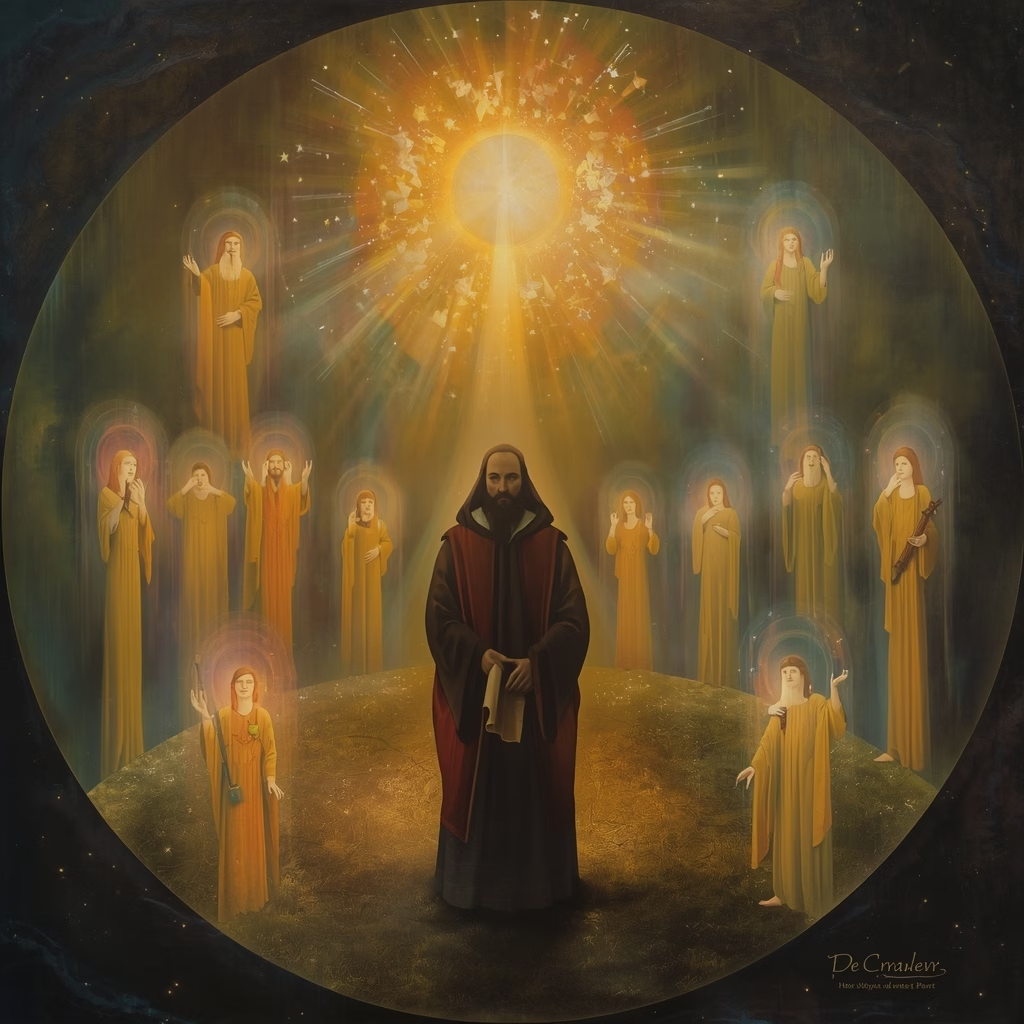
One of the most spiritually precise elements of the Comedy is Dante’s use of three guides. Virgil guides him through Hell and Purgatory. Beatrice guides him through Paradise. Bernard of Clairvaux guides him through the highest region.
Steiner interprets this in GA 233 as a precise description of three modes of consciousness. Virgil — the pre-Christian poet — represents the ancient mystery wisdom that could perceive the lower spiritual worlds but could not penetrate the Christian mysteries. Consequently, he can guide Dante through Hell and Purgatory but must stop at the entrance to Paradise.
Beatrice represents Sophia — the cosmic feminine wisdom made available through the Mystery of Golgotha. She guides the soul that has received the Christ impulse and can now perceive the higher spiritual world. Bernard of Clairvaux, finally, represents the highest form of Christian contemplative consciousness — the mystical union with the divine that lies beyond what either intellectual wisdom or Sophianic guidance can reach.
Hell: Hardened Soul Forces
Steiner does not interpret Hell as a place of divine punishment. Rather, he sees in Dante’s elaborate geography of Hell a genuine supersensible perception of souls who have allowed specific lower forces to harden into spiritual rigidity.
In Steiner’s account in GA 9 (“Theosophy”), the soul world beyond death contains a region corresponding to what Dante calls Hell — a region where the soul encounters the concentrated force of its own unredeemed lower nature. The different circles correspond to different qualities of soul hardening — different ways in which the human soul can become imprisoned in its own unresolved desires and egoisms.
Furthermore, Steiner connects Dante’s journey through Hell with the encounter with the Double — the shadow being formed from the unredeemed lower forces of the soul, described in GA 147 (“The Secrets of the Threshold”). Dante’s descent is therefore not a tour of the damned but a confrontation with the full spectrum of human spiritual failure — encountered with compassion rather than condemnation.
Purgatory and Paradise
Dante’s Purgatory — organised around seven terraces corresponding to the seven capital sins — carries a sevenfold structure that Steiner connects with the sevenfold path of inner development that all mystery traditions recognise. The souls in Purgatory are not fixed but progressing — suffering purposefully, oriented toward a genuine goal. Steiner sees in this a precise perception of Kamaloka — the post-death condition of transformation described in GA 9.
Dante’s Paradise — organised around the nine heavens of medieval cosmology — corresponds precisely to the nine orders of the celestial hierarchies that Steiner describes in GA 110 (“The Spiritual Hierarchies and the Physical World”). Consequently, Dante’s ascent through the heavens is a genuine description of the soul’s journey through the hierarchical regions of the spiritual world — the journey every soul undertakes between death and rebirth.
A Living Spiritual Document
Dante’s Divine Comedy has endured for seven hundred years not simply because it is a great poem. It carries within it a genuine spiritual content — a real perception of real spiritual realities encoded in the most precise literary form that medieval culture could produce.
Steiner’s spiritual science invites a deepened reading — one that sees in the structure of Hell, Purgatory, and Paradise not simply poetic imagination but genuine spiritual cartography. The love that Dante places at the summit of his work — the love that moves the sun and the other stars — is the same truth Steiner places at the heart of Earth evolution: that the entire vast process of cosmic development is ultimately an expression of a love so free and conscious that it freely creates the conditions for its own genuine reception.
The full article on Substack covers the specific initiatory tradition connected with Dante’s circle, the spiritual meaning of Beatrice as Sophia, and Steiner’s complete account of how the Comedy’s structure corresponds to real supersensible geography. Free to read on Substack.
Read the full article free on Substack →