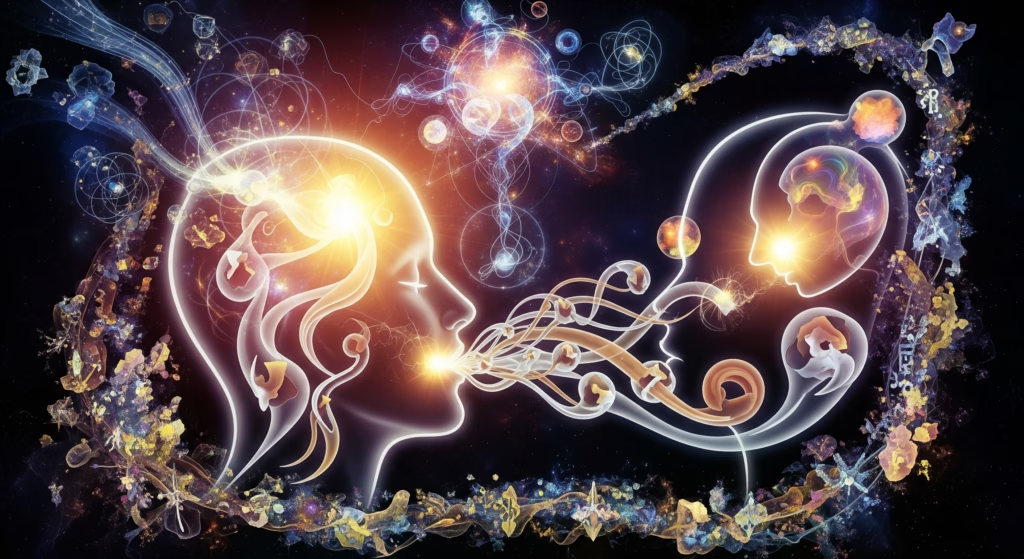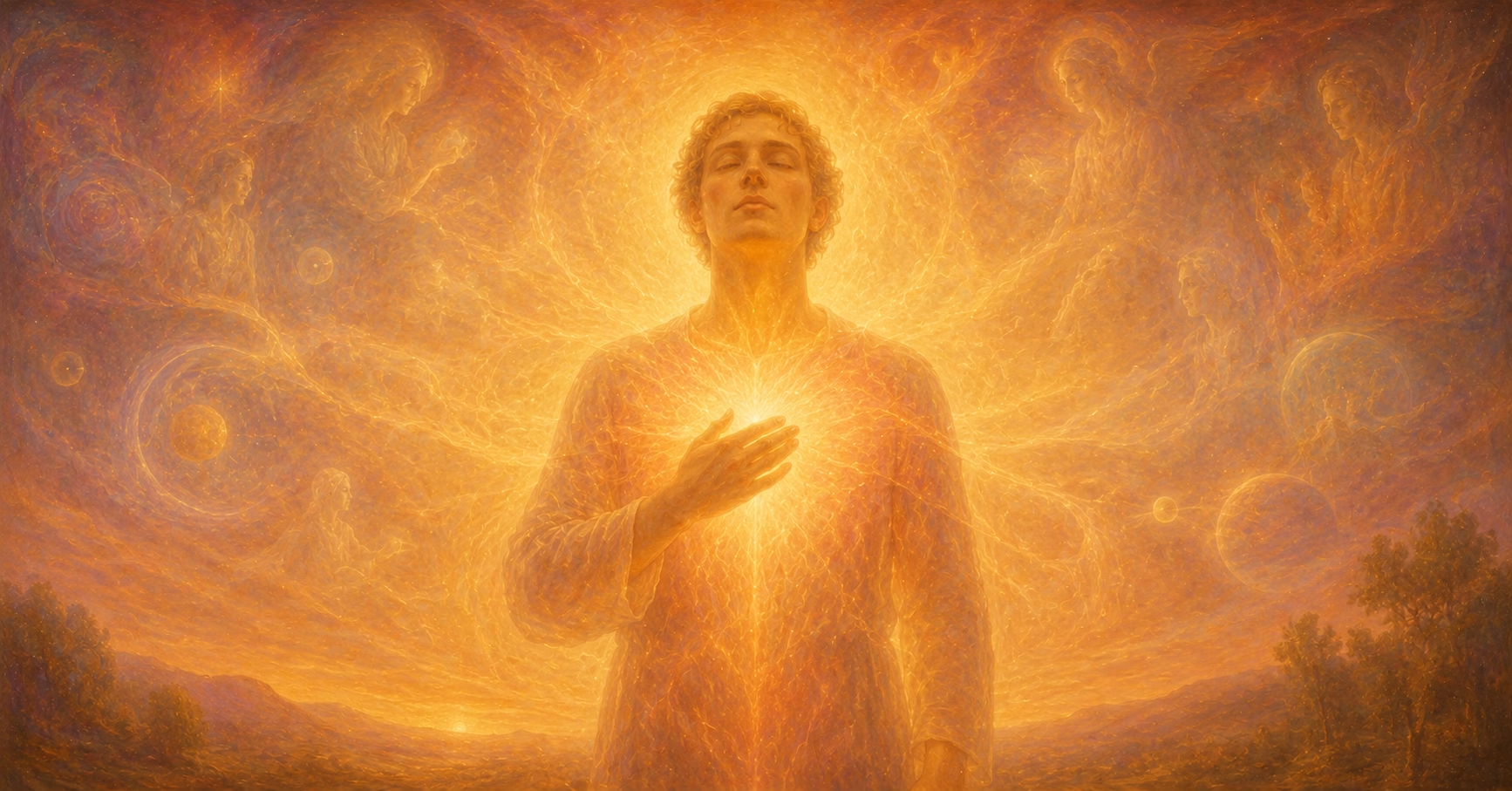
Modern culture worships the brain. The brain is the organ of intelligence, of personality, of everything that makes us who we are. Yet Rudolf Steiner identifies an entirely different organ as the true centre of the human being — one venerated across virtually every culture in history, recognised by every genuine spiritual tradition as the seat of the deepest human capacities, and consistently underestimated by modern science because its most significant functions are not physical at all.
That organ is the heart. Steiner addresses its spiritual significance in GA 212 (“The Human Heart”), GA 218 (“Spiritual Connections in the Formation of the Human Organism”), and GA 293 (“Study of Man”).
The Heart Is Not a Pump
Modern physiology describes the heart as a mechanical pump. Steiner indicates in GA 212 that this description misses almost everything spiritually and physiologically most significant about the heart. He notes that no mechanical pump could survive the sheer quantity of rhythmic contractions the heart performs across a human lifetime — its longevity requires an understanding that recognises the specific living forces working through it that no purely mechanical account can describe.
More significantly, Steiner indicates in GA 212 that the relationship between the heart and blood is the reverse of what modern physiology assumes. The blood drives the heart — the heart’s rhythmic activity is a response to the movement of forces that originate in the broader living system of the organism and, beyond it, in the cosmic forces working through that organism. The heart is therefore not a mechanical driver but a highly sensitive receiver.
Furthermore, Steiner describes the heart as the most sensitive and most spiritually significant sense organ in the human body. Just as the eye perceives light and colour, the heart perceives the movement of spiritual forces working through the blood — and through the blood, the spiritual reality of the human being’s own inner life and the inner life of others. The heart rate is not simply a mechanical consequence of physical activity. It is a sensitive expression of the soul’s condition — of its fears, loves, courage, and grief — carried in the blood and read by the heart with extraordinary precision.
The Heart and the “I”
Steiner makes a profoundly significant statement in GA 212 about the relationship between the heart and the individual spiritual self — the “I.” He indicates that the “I” works most directly and most immediately not through the brain but through the heart.
The brain is the instrument of the “I’s” reflective thinking — of concepts, logical argument, and intellectual understanding. However, the direct, living, immediate activity of the “I” — its genuine presence in the present moment, its capacity for genuine love, courage, and moral decision — works through the warmth of the blood and expresses itself most directly through the heart’s rhythmic activity.
This is why the most direct expressions of genuine individual selfhood are not intellectual but warmth-related. Genuine love, genuine courage, genuine compassion — these are all experiences of warmth, of an expansion of the heart’s activity, of a quality of inner fire that the “I” produces when it is most genuinely itself. Conversely, fear, depression, and spiritual despair are consistently experienced as coldness and contraction — a diminishment of the heart’s warmth.
The Heart and Future Evolution
Steiner makes one of his most striking cosmological statements about the heart in GA 212. He indicates that in future stages of evolution the heart will become the primary organ of spiritual perception — through which the developed human being will perceive spiritual realities with the same directness and clarity with which the eye now perceives physical colours.
Furthermore, Steiner indicates in GA 218 that specific soul practices directly contribute to this transformation. The consistent, daily cultivation of genuine reverence, genuine compassion, and genuine warmth of heart is not simply good psychology. It is a contribution to the cosmic developmental process through which the heart is gradually becoming what it is destined to be — the future instrument of the highest human spiritual perception.
The Twelve-Petalled Lotus
Steiner addresses in GA 10 (“How to Know Higher Worlds”) the twelve-petalled lotus — the spiritual organ associated with the heart region in the etheric and astral bodies. This organ is developed through the consistent cultivation of specific moral qualities: control of action, perseverance, tolerance toward other human beings, trust in the world’s spiritual ordering, and positivity. Each quality, consistently cultivated, develops specific petals — and the twelve-petalled lotus gradually becomes the instrument through which genuine spiritual perception of a warm, compassionate, immediately responsive quality becomes possible.
The brain gives us thinking. The heart gives us being. Every tradition has placed love, courage, and moral seriousness in the heart rather than in the brain — and Steiner’s spiritual science confirms this ancient wisdom, revealing the exact mechanisms through which the heart serves as the true centre of the human being.
The full article on Substack covers the complete account of the heart as a sense organ, the relationship between the heart and karma, the specific cosmic forces working through the heart’s rhythmic activity, and Steiner’s complete account of the future transformation of the heart into an organ of spiritual cognition. Free to read on Substack.
Read the full article free on Substack →